All events of the day›2026-08-29›Holy Mass and procession at the Church of Maria Santissima del Lago
18:00
Church of Maria Santissima del Lago, Castel Gandolfo
⛵ Feast of the Madonna del Lago
Holy Mass and procession at the Church of Maria Santissima del Lago
📍 Church of Maria Santissima del Lago, Castel Gandolfo
Pope Leo XIV presided over Holy Mass in the small church of Maria Santissima del Lago, on Lake Albano at Castel Gandolfo, for the traditional feast of the Madonna del Lago, celebrated every year on the last weekend of August. Before some 350 faithful, from the altar of the church consecrated by Saint Paul VI on 15 August 1977, the Pope recalled his predecessors Paul VI and John Paul II and urged all to walk “the way of life”, the way of love: “hatred and violence bring nothing good, but only destruction and death, always, even when they are a response to injustices suffered”. The Mass was concelebrated by the Bishop of Albano Vincenzo Viva, the parish priest of San Tommaso da Villanova, Fr. Tadeusz Rozmus, and representatives of the Salesians, in the year marking the centenary of their presence at Castel Gandolfo (1926). Afterwards, the Pontiff and the faithful carried the statue of the Madonna del Lago in procession, first through the streets to the Tropicana lido, then — past the beach — onto the water: for the first time in history a Pope took part in the procession by boat as well, boarding the vessel “Falco” of the Castel Gandolfo Lakeside Association, decorated with yellow and white flowers, together with the statue of the Virgin. The roughly 25-minute crossing to Giorgio’s Beach, at the foot of the Apostolic Palace, was accompanied by about a dozen civilian craft, canoes and dragon boats and by several police vessels. On the beach, as the tenor Aurelio Grimaldi and the soprano Elena Kovalova, accompanied on the piano by maestro Massimiliano Franchina, performed “La Vergine degli angeli” from Verdi’s La forza del destino and Franck’s Panis Angelicus, the Pope stepped off the boat to applause and recited a supplication to Our Lady: “look with kindness on your children wounded by war and encourage in everyone the desire for peace… Where hatred grows, teach us forgiveness; where fear prevails, restore hope”. It is the Pontiff’s last public engagement tied to the summer calendar published by the Press Office on 30 July. The event was broadcast live by Vatican Media, Telepace and TV2000.
🎥 Videos
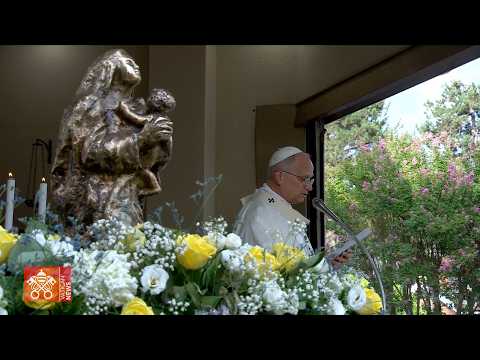
Highlights of the Holy Mass in the Church of Maria Santissima del Lago (Vatican News).
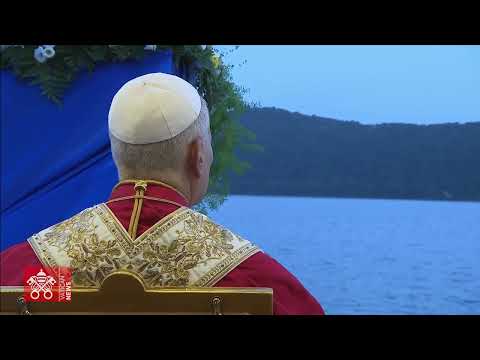
Highlights of the Marian procession on the lake presided over by Pope Leo XIV (Vatican News).
Full live coverage of the Holy Mass and procession (Vatican News).
The recitation of the Rosary and the Angelus at the end of the evening celebration (Vatican News).
📷 Photos

Holy Mass in the Church of Maria Santissima del Lago (Vatican Media).

Pope Leo XIV delivers the homily (Vatican Media).

The procession with the statue of the Madonna del Lago through the streets of Castel Gandolfo (Vatican Media).

The vessel “Falco” carrying the Pope and the statue of the Virgin on Lake Albano (Vatican Media).

Pope Leo XIV greets the faithful on the lake beach at sunset (Vatican Media).
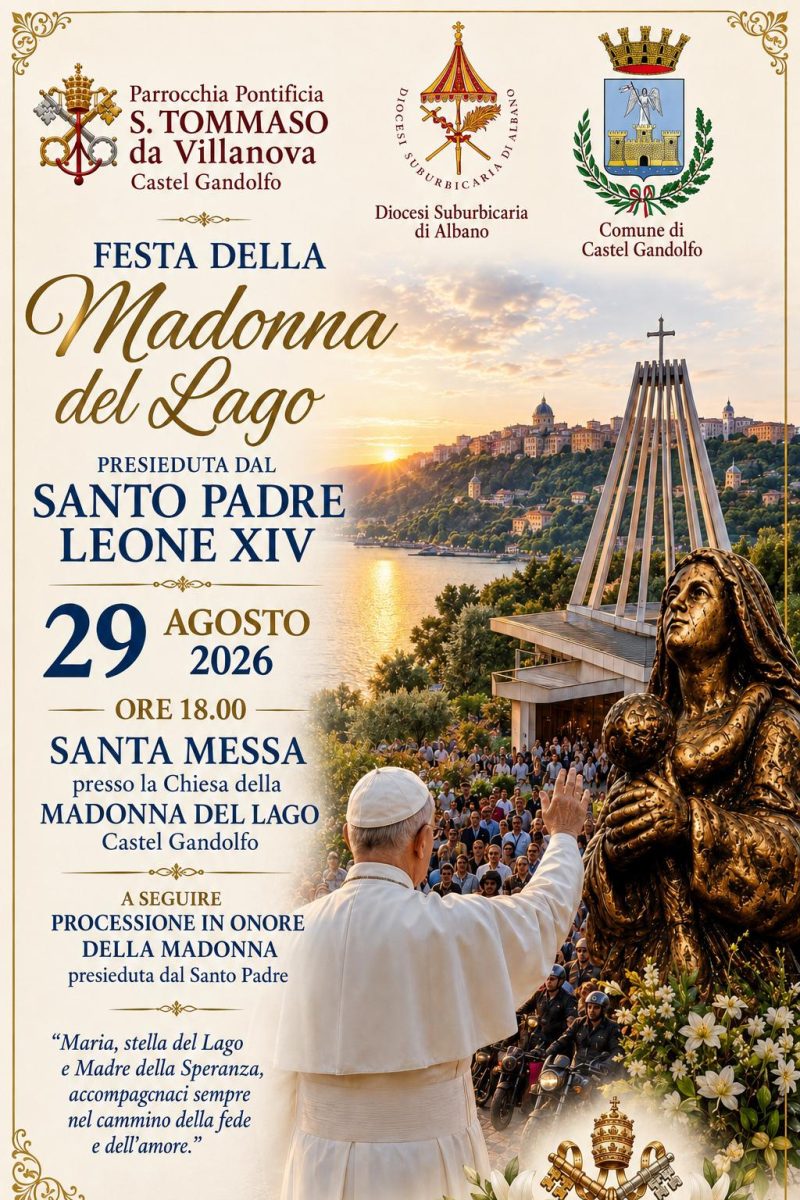
The Diocese of Albano poster for Pope Leo XIV's Mass at the Church of Maria Santissima del Lago (August 29, 2026).
📰 Articles
Vatican NewsOfficial
The Pope: do not yield to hatred in the face of injustice, let evil not disfigure humanity
Report on the Mass and homily in the Church of Maria Santissima del Lago, with the 350 faithful present and the centenary of the Salesians at Castel Gandolfo.
Vatican NewsOfficial
Leo XIV on the lake of Castel Gandolfo to entrust the children wounded by war
The arrival of the vessel “Falco” at Giorgio’s Beach, the supplication to Our Lady and the final greeting to the faithful on the beach at sunset.
Holy See Press Office BulletinOfficial
Calendar of liturgical celebrations presided over by the Holy Father Leo XIV (August 2026)
Official announcement of the Holy Mass and procession of August 29, published on July 30, 2026.
Vatican NewsOfficial
Leo, first Pope in the procession on Lake Albano
The official presentation of the celebration: Mass at 6 p.m. in the Church of Maria Santissima del Lago, procession to the Tropicana and boat crossing to Giorgio's Beach.
Diocese of AlbanoOfficial
On Saturday August 29 Pope Leo XIV will celebrate Mass in the Church of Maria Santissima del Lago, at Castel Gandolfo
The suburbicarian Diocese of Albano's announcement of the 6:00 p.m. Mass and the procession towards the Tropicana and Giorgio's Beach establishments.
Castelli Notizienews
Pope Leo XIV will sail on Lake Albano together with the statue of the Madonna: August 29, a historic day at Castel Gandolfo
The route of the water procession aboard the vessel "Falco" and the precedents of Paul VI and John Paul II.
AgenSIRArticle
Leo XIV, first Pope by boat on Lake Albano. Fr. Rozmus: "A gesture of gratitude towards the people who welcome him"
The parish priest of San Tommaso da Villanova explains the meaning of the water procession and of the Pope's bond with Castel Gandolfo in the year of the 400th anniversary of the papal presence.
Zazoomnews
Leo XIV in August: Masses in Assisi, Rimini and twice at Castel Gandolfo
Overview of the August calendar, with details on the feast of the Madonna del Lago.
il Giornalenews
Mass on the lake, Leo follows in Wojtyła's footsteps
In-depth look at the tradition of the feast of the Madonna del Lago at Castel Gandolfo and its papal precedents.
Castelli Notizienews
Castel Gandolfo prepares for the historic day: security, traffic and programme of the Lake Albano procession
The schedule: Mass at 6 p.m., the Pope boarding around 7.15 p.m. and arrival at the Giorgio's Beach lido around 7.45 p.m.; the lakeside road closes from 5 p.m. and a security plan involves Police, Carabinieri, Guardia di Finanza and the Vatican Gendarmerie.
Il Messaggeronews
Pope Leo XIV at the lake procession of Castel Gandolfo: “Turning the other cheek is not for losers”
An account of the evening celebration and the Pope’s words on forgiveness and the rejection of violence even in the face of injustice.
📜 Speech text
Homily at the Holy Mass and Procession of the Madonna del Lago (Castel Gandolfo) (translated)
Dear brothers and sisters, I am glad to celebrate with you the Feast of the Madonna del Lago, as some of my Predecessors have done in the past: Saint Paul VI, who desired and supported the building of this church dedicated to Mary and consecrated it, and Saint John Paul II, who wished here to recall its memory and renew its message.