All events of the day›2026-09-14›Inauguration of "AQVA" — first chapter of "Catastrophe and Wonder"
11:00
Vatican Apostolic Library, Vatican City
📚 Vatican Library
Inauguration of "AQVA" — first chapter of "Catastrophe and Wonder"
📍 Vatican Apostolic Library, Vatican City
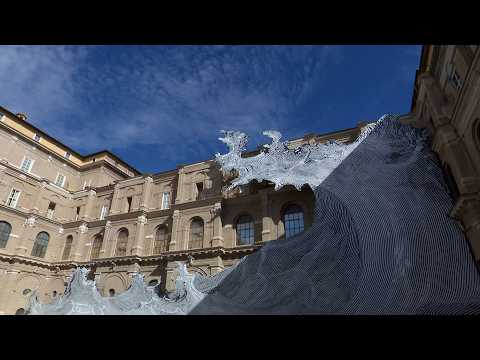
At 11:00 AM on Monday, September 14 — his 71st birthday — Pope Leo XIV visited the Vatican Apostolic Library and inaugurated "AQVA", the first chapter of the three-year exhibition cycle "Catastrophe and Wonder", supported by Fondazione Roma and Intesa Sanpaolo. The exhibition puts the Pope's Library's collections and spaces in dialogue with the works of three contemporary creatives — artist JR, typographer Bill Moran, and chef Fulvio Pierangelini — in a reflection on water as both threat and resource. The path opens with "Diluvium", JR's monumental installation on the Library's sixteenth-century facade. Curated by Fr. Giacomo Cardinali, Simona De Crescenzo, Francesca Giannetto and Delio Proverbio, the exhibition will be open to the public from September 25, 2026 to May 14, 2027, marking a new chapter in the Vatican Library's centuries-old mission of conservation and outreach.
🎥 Videos
▶
Highlights - BAV: AQVA Catastrophe and Wonder exhibition
📷 Photos
The Vatican Apostolic Library, on the occasion of Pope Leo XIV's visit to inaugurate "AQVA" (@Vatican Media)
Address to the staff of the Vatican Apostolic Archive and Library (tradotto)
Your Excellency, Excellencies, dear brothers and sisters, ladies and gentlemen, before greeting you formally with a short speech I have prepared, I would just like to say that God, in his Providence, and sometimes with a certain sense of humor, always reminds us that he is with us. Many of you may not know that my mother was a librarian, and today I find myself here for my birthday precisely to greet all of you.
Your Excellency, Excellencies, dear brothers and sisters, ladies and gentlemen,
before greeting you formally with a short speech I have prepared, I would just like to say that God, in his Providence, and sometimes with a certain sense of humor, always reminds us that he is with us. Many of you may not know that my mother was a librarian, and today I find myself here for my birthday precisely to greet all of you.
I thank the Archivist and Librarian of Holy Roman Church, Msgr. Pagazzi; I greet the Prefects and Vice-Prefects of the Apostolic Library and the Apostolic Archive, together with the directors and all those who work there; the President of the Governorate and some friends and benefactors, to whom I express my deep gratitude.
For the first time as Pontiff I visit the Vatican Library, following in the footsteps of my Predecessors. This is meant to be a sign of the Pope's closeness to and appreciation for the mission of the Apostolic Archive and the Apostolic Library, at the service of the development and dissemination of culture, for the benefit of the Church and of all humanity. In particular – as the Apostolic Constitution Praedicate evangelium states – for the "custody and enhancement of the acts and documents concerning the government of the universal Church" and their study (n. 242), and for "gathering and preserving a most rich patrimony of knowledge and art and […] making it available to scholars who seek the truth" (n. 243).
When we think of a library, we imagine a calm, quiet environment. Indeed, books are silent and demand silence. In reality, though, if on the one hand a book brings peace, on the other it kindles restlessness, nourishing the desire and the courage to search. Saint Augustine is an emblem of this dynamic. Full of life and torment because of the powerful forces clashing within him – as he writes – for years he "cried out in desperation" (Confessions, VIII,12,28), until a child's voice reached him, singing: "Take up and read, take up and read." He immediately took a book from a friend's hands, the Letter to the Romans of Saint Paul, read it, and "a light of certainty, as it were, flooded my heart, and all the darkness of doubt was dispelled" (cf. Confessions, VIII,12,29). The doubt was extinguished, but not the desire, which instead grew stronger, driving him to explore the full breadth and depth of Sacred Scripture. He himself speaks of this many times, saying that he studied carefully, bent over like a question mark, different manuscripts of the biblical books in order to establish the best text (cf. In Hept. loc. 3, 6, 14 and 3, 6, 17; Enarr. Ps. 36, III, 6; Enarr. Ps. 138,20). The book of Scripture that reached Augustine is the same one that opened his spirit wide. Dear friends, all of you, by preserving, studying and making available to scholars the books of the Successor of Peter, help the Church and humanity to rise to the depth of this desire. Without it, everything drifts away from the living God, source of truth and love.
How can we describe the Pope's Library? I turn to a metaphor: the Apostolic Library is a heart. The heartbeat is the symbol of life, and results from two opposite movements, systole and diastole: a concentration and a relaxation, a movement toward the center and one toward the periphery. The Apostolic Library, too, remains alive to the extent that it ensures both its own systole and its own diastole.
The systole: may the Apostolic Library continue to be a place rich in privacy, quiet, respect and care. Within the Vatican walls, the almost monastic atmosphere of the Apostolic Library recalls every day the Savior's command: "If you are to build, if you are to do battle, first sit down and take counsel" (cf. Lk 14:28-32). The interiority of the Apostolic Library also depends on the one, inestimable treasure it preserves. While it is right to facilitate its study, also through digitization and the sharing offered by the digital environment, it is likewise necessary to maintain and encourage the ancient gesture of physically moving toward the Library. Indeed, it is not merely a reservoir of books to be conveniently accessed from a home computer, but an atmosphere made up of relationships, dialogue, and exchange of ideas.
Yet the heart also lives by diastole, and so does our Library. We are gathered in the Sala Leonina, dedicated to Pope Leo XIII. He was a pastor able to grasp the most dramatic questions of his time, such as the changes brought about by the industrial revolution. He was also the Pontiff of great cultural transitions, such as the opening of the Vatican Archive to scholars from around the world and the increased access to the Library, to the extent that he transformed an old armory into this beautiful reading room. The openness, the breadth of spirit of this Library is evident from its very humanistic origins: not only works of theology, but also of literature, philosophy, astronomy, physics, mathematics, geography, botany, zoology, medicine, history, law, art, and economics. Not only European and Christian books, but also volumes written in other religious contexts, coming from every corner of the world. And this, many centuries before this became a universally shared sensibility. With this style, the Apostolic Library bears witness to the ancient and ever-new cultural openness of the Church. The cycle of exhibitions begun today confirms this as well. A sign of this cultural cordiality is also the gentle diplomacy that finds, among the documents and books of the Vatican Archive and Library, an open path, one of the "openings for reconciliation" of which the Encyclical Magnifica humanitas speaks (n. 211). So then, forward! Faithful to the past and faithful to the future, with the languages and means proper to you, find new openings for reconciliation.
I greet you, recalling an urgency common to both the Apostolic Library and the Apostolic Archive: the need for new spaces. Just today I have given instructions in this regard, and I hope they will help meet this need. I intend to continue along the path traced by my Predecessors who, over the centuries, have shown the Apostolic See's care for the institutions that preserve and promote its cultural and administrative memory.
Dear friends, thank you all and good work! I bless you from my heart and pray for you.