Monday 28 September 2026 — Holy Mass in Metz and conclusion of the journey to France
16:00
Saint-Étienne Cathedral, Metz, France
⛪ Holy Mass
Holy Mass at Metz Cathedral
📍 Saint-Étienne Cathedral, Metz, France
In the afternoon of the final stop of the apostolic journey, Pope Leo XIV presides over Holy Mass at Saint-Étienne Cathedral in Metz, concluding his fifth international journey, under the motto "So that the world may have life." The cathedral, which can hold about 2,000 faithful, is known as the "lantern of the good Lord" for its stained-glass windows covering 6,500 square meters; for those remaining outside, giant screens are set up at Place de la République and near the Centre Pompidou-Metz. The Bishop of Metz, Mgr Philippe Ballot, recalled that the diocese lived through three wars and two annexations by Germany (1870-1918 and 1940-1945), noting that Franco-German reconciliation shows that "peace is always possible, even where there is war." The Mass, attended by around 35,000 faithful in the cathedral and surrounding streets according to local authorities, is attended by French President Emmanuel Macron and his wife Brigitte. In the homily the Pope recalls the contribution of monasticism and the Rule of the Canons of Saint Chrodegang in shaping the "moral principles that govern the world in which we live" - from the sacred and inviolable nature of life to care for the poor and the stranger - and, referring to the cathedral's stained-glass windows enriched by Marc Chagall, states that "Europe's future does not lie in uniformity, but in the harmony of differences, where the wounds of the past become openings through which light shines." He reminds the community of Metz, marked by three wars and two German annexations, that "it is not true that those who seek revenge are stronger than those who forgive."
I am very pleased to preside over this Eucharistic celebration, in which we entrust the diocesan community of Metz and the whole of Europe to the Lord. In this historic Moselle region, which has always been a crossroads for different peoples and has suffered as a result of its location on Europe’s frontier, God’s promis
Dear brothers and sisters,
I am very pleased to preside over this Eucharistic celebration, in which we entrust the diocesan community of Metz and the whole of Europe to the Lord. In this historic Moselle region, which has always been a crossroads for different peoples and has suffered as a result of its location on Europe’s frontier, God’s promise resounds today with extraordinary power.
In the first reading (cf. Is 32:15-18), the prophet Isaiah speaks of the coming of the Kingdom of God in terms of righteousness, justice and peace. He draws on three images: the desert, the garden and the house.
In the desert — a place of sobriety and silence — justice is established; that is, the law that helps people to walk in the path of goodness. This austere image reminds us of the importance of simplicity and what is essential, allowing us to assign the proper value to things, while at the same time teaching us renunciation and sacrifice.
The second image is that of a garden where justice reigns. While the desert represents what is essential, the garden represents beauty. There is water, seeds sprout, shoots emerge, and flowers bloom, each with their own particular beauty. This is the effect of a righteous life, which enables a person to flourish fully by freely adhering to the Lord’s plans.
The third image is that of the house, a place of peace. Note that while the desert and the garden are settings where God’s action prevails, causing things to sprout and grow, building a house, on the other hand, requires a more direct and significant contribution from human beings. It involves applying strength and skill through shared effort — a true “construction project.” Similarly, peace, a gift from God, requires a response from human beings through combined effort. After all, a home is more than just a stone structure; it is a place of human presence and love. In this sense, the prophet’s words remind us that, in a world marked by limitations, harmony can only be built through charity, a charity that knows how to share joys and sorrows, that knows how to encourage and forgive, without calculation or limit, just as in a family.
The Gospel we have just heard also addresses this (cf. Mt 5:38–48). In a world marked by so much violence, manipulation and arrogance at various levels, Jesus teaches us how to transform deserts into oases, to plant gardens, and to build homes. He shows us the path that leads through forgiveness, mercy and magnanimity: “If anyone strikes you on the right cheek, turn the other also; and if anyone wants to sue you and take your coat, give him your cloak as well; and if anyone forces you to go one mile, go also the second mile” (Mt 5:39–41).
To some, these words might seem like a sign of weakness, or a concession to evil, but that is not the case. Let us look carefully at ourselves and our surroundings: What do attitudes such as vengeance, retaliation, and rejection bring about, both in the world and within ourselves? What kind of future for humanity do relationships and systems imbued with the ruthless mentality stemming from these attitudes hold in store? Those of you, who are the children of this land torn apart in the past by fratricidal conflicts, know full well that it is not true that those who seek revenge are stronger than those who forgive. It is not true that those who refuse to yield are stronger than those who seek reconciliation. It is not true that those who walk away are stronger than those who face the challenge of walking together.
Metz and Moselle bear witness to the whole world that reconciliation is only possible when one has the courage to break the chains of resentment. It takes strength and great integrity not to be overwhelmed by evil, especially when the wounds inflicted are deep. However, in the face of injustice, humanity’s only path to salvation is a love that cares for others and seeks to give trust regardless of the circumstances, even when confronted with the most difficult behavior to accept (cf. Mt 5:42). Thus, law, justice and peace are stages on a path of conversion that begins as a personal journey and becomes increasingly communal, leading to a civilization that respects human beings and their Creator.
It is no coincidence that Saint Augustine defined the peace of the heavenly city as a harmonious communion in which people find joy in God and in one another through him (cf. De Civitate Dei, XIX, 13,1). He also described peace among people as the fruit of a tranquillitas ordinis, whereby each person recognizes and respects the unique and sacred dignity and role of others.
Here in Metz, it is worth recalling that these are precisely the values upon which the Europe we know has been built over the centuries, with its spiritual and moral heritage preceding its economic and political heritage. As Saint John Paul II recalled with emotion, it has its roots in the lives and deeds of men and women who lived, preached, and shared the teachings of the Gospel (cf. Address at the Pro-EU Event, Santiago de Compostela, 9 November 1982). This can be seen in the great spiritual, cultural and even agricultural and artisanal contributions that monasticism has made to the continent’s history, as well as by the work of saints such as the great Chrodegang, the tireless shepherd of this community. Indeed, in this very place, he gave visible form to ecclesial communion in the Rule of the Canons.
The moral principles that govern the world in which we live were handed down to us from there: principles such as the primacy of the person and the sacred and inviolable nature of human life at all stages and under all circumstances; the protection of individual freedom; the primary importance of the family as the foundation of society; caring for the poor and the most disadvantaged; welcoming the stranger; and respecting the elderly.
Your local Church, which preserves the unique legacy of a fruitful dialogue between civil society and faith by virtue of its special status, has the responsibility to be a living laboratory of this fidelity. Remaining faithful to these principles has never been easy, even for those who came before us. Nevertheless, through faithfulness and perseverance, our ancestors bequeathed them to us as treasures to be passed on in turn to future generations, and enriched by our experience, the value of our efforts and our stories.
The magnificent cathedral of this city where we gather today illustrates all of this very well. It is known as the “Lanterne du Bon Dieu” thanks to its 6,500 square meters of stained-glass windows depicting biblical scenes. It seems that the builders sought to minimize the walls — which remain solid — so that light might flood in abundantly to the faithful. Anyone who enters is thus immersed in a rich “biblia pauperum,” a source of prayer and meditation, through the reflections of a thousand colors. In this place of light, the splendor of the historic stained-glass windows has recently been enhanced by the genius of Marc Chagall. The works of this great Jewish painter, set into the cathedral’s walls, transform the “Lanterne du Bon Dieu” into an extraordinary symbol of ecumenism and interreligious dialogue. This cathedral teaches us that God’s light does not erase our unique identities but rather unites different histories and cultures into a single marvelous mosaic of peace — so necessary in our time, torn as it is by new divisions and conflicts. As we contemplate these stained-glass windows, we learn that Europe’s future does not lie in uniformity, but in the harmony of differences, where the wounds of the past become openings through which light shines.
Herein lies a symbol of our identity as the Church. We, too, make use of structures that only have meaning insofar as they help us to bring the light of the Gospel to the world. Without these stained-glass windows, the windows of Saint Stephen’s Cathedral would be mere spaces flooded with blinding light. With these stained-glass windows, however, they become “books” that bring us together to remember wonderful stories full of heroism, goodness, mercy, love and moral beauty, to which we, in turn, must be generous and courageous witnesses.
With gratitude and trust as my trip to France draws to a close, this is the wish I share with you for the community in Metz, which today more than ever is called to be a beacon of hope for this country, for Europe and for the world, and I entrust this to the intercession of the Virgin Mary and your patron saints.
Final words of thanks at the end of Mass (tradotto)
Dear brothers and sisters,
This Holy Mass is the last public event of my visit to France, and so I have celebrated it with a deep sense of gratitude to the Lord; I also wish to express my thanks to all those who made it possible through their efforts.
I thank the President of the Republic and the various civil authorities who took care of the wel
Dear brothers and sisters,
This Holy Mass is the last public event of my visit to France, and so I have celebrated it with a deep sense of gratitude to the Lord; I also wish to express my thanks to all those who made it possible through their efforts.
I thank the President of the Republic and the various civil authorities who took care of the welcome in Paris, in Lourdes and here in Metz. I renew with affection my gratitude to the Presidency of the Bishops' Conference and to the Bishops most involved, and together with them the priests, deacons, consecrated persons, lay faithful, and all the volunteers who collaborated. Thank you all!
Dear friends, let us continue to walk together, united in holy mother Church, for the glory of God and in the service of his Kingdom of love, justice and peace. Thank you!
After the morning transfer from Lourdes to Metz (departure 7:40, arrival at Metz-Nancy-Lorraine at 9:20), Pope Leo XIV takes part in an interreligious meeting at the "Robert Schuman" Congress Center, with representatives of the various faiths present in France. In his address the Pope states that "to invoke God's name in order to justify violence or oppression is to profane that name" and that "religious discourse must constantly call for the disarmament of hearts and words," describing religions as "guardians of life" and a solid point of reference for young people.
🎥 Videos
▶
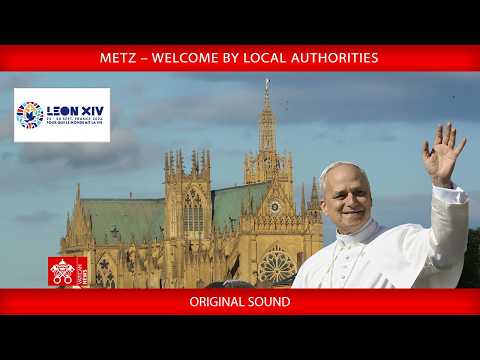
The Pope's arrival in Metz and welcome by local authorities
📷 Photos
Pope Leo XIV with representatives of different religious traditions at the Robert Schuman Congress Center
Interreligious Meeting at the "Robert Schuman" Congress Centre
Dear brothers and sisters,
Dear friends and representatives of various religious traditions,
It is with joy, but also with a keen sense of spiritual responsibility, that I stand among you today in Metz, a city of borders and crossroads, at the Robert Schuman Center, named after one of the founding fathers of the European Union. This man of faith
Dear brothers and sisters,
Dear friends and representatives of various religious traditions,
It is with joy, but also with a keen sense of spiritual responsibility, that I stand among you today in Metz, a city of borders and crossroads, at the Robert Schuman Center, named after one of the founding fathers of the European Union. This man of faith and conviction knew how to transform old dividing lines into bridges of hope for all of Europe, becoming a true ambassador of unity in diversity. Following his example, our shared responsibility as men and women of faith is to bear witness that, beyond all borders, it is always possible to meet one another, forge friendships, and seek peace.
Dialogue does not diminish our identity, but expresses it with simplicity and truth by opening it to the diversity of the other. As my predecessor Pope Francis wrote, “Dialogue between the followers of different religions does not take place simply for the sake of diplomacy, consideration or tolerance… ‘the goal of dialogue is to establish friendship, peace and harmony’” (Encyclical Letter Fratelli Tutti, 271). Beforehand, Saint John Paul II regarded dialogue as an intrinsic requirement of human nature itself (cf. Message for the World Day of Peace, 1 January 2001, 10). According to Paul Ricœur, this is the path through which we recognize otherness as a promise rather than a threat. It is an art of encounter that our world sorely needs, and it is the very opposite of aggression and violence.
Indeed, to invoke God’s name in order to justify violence or oppression is to profane that name. Nothing that disfigures human dignity can claim to be inspired by God. Religious discourse must constantly call for the disarmament of hearts and words. This places a direct responsibility on each of us as guardians of our respective traditions.
Moreover, if the fruitfulness of religious traditions is seen above all in their service of peace and fraternity, it is also expressed in their ability to protect, accompany and serve life. The greatness of a civilization is not measured by its material achievements, but by the way it cares for, protects and upholds the human person. Religions are guardians of life, for they affirm its sacred value. Their fruitfulness is shown in their loving presence alongside those who are most vulnerable and fragile. To serve life means to surround it with care, presence and tenderness, especially in times of trial, right to the very end. For those of us who are open to transcendence, our mission is to offer sound points of reference, especially to young people, to help build a communion that respects and upholds the dignity of every human person.
Dear friends, “the Church regards all who sincerely seek ‘truth, goodness and beauty’ as companions on the journey” (Encyclical Letter Magnifica Humanitas, 23). Once again, I thank you for your closeness and your presence. May the infinite goodness and wisdom of God accompany us and teach us to live ever more fully as his children and as brothers and sisters to one another. Thus, wherever we live, may we be artisans of peace and witnesses to a hope that never ceases to grow in our world.
The Pontiff takes part in a meeting dedicated to the Christian roots of Europe, to peace and to the unity of the continent, in the hometown of Robert Schuman, one of the founding fathers of the European Union. The invitations, signed by French President Emmanuel Macron, were sent to the twenty-seven heads of state and government of the European Union countries and to EU leaders; bilateral talks are possible at the end of the meeting. The papal delegation includes Cardinals Filippo Iannone, José Tolentino de Mendonça, Dominique Mamberti and George Jacob Koovakad (Secretary of State Card. Pietro Parolin is absent, engaged in the United States). A meeting with representatives of different religions follows, with the reading of a joint appeal. Also among the participants is a delegation from the Fraternité Européenne d'Étudiants Robert Schuman: one of its members, Axel Raynaud, stressed on the eve of the meeting that "Europe cannot be reduced to its institutions or its economy: it is a project of fraternity." In his address the Pope warns against the "illusion of rearmament," denounces that "relations between individuals and States are becoming increasingly uncivilized," and points to international law and multilateralism as "the best antidote to the desire for domination." He calls on young people not to give in to "the mentality of violence and oppression" and to be "builders of community."
📷 Photos
Members of the Fraternité Européenne d'Étudiants named after Robert Schuman
Leo XIV in Metz, a border city and symbol of friendship between peoples
Pope Leo XIV at the "Roots of Europe" meeting at the Robert Schuman Congress Center in Metz
The Pope with European heads of state and government present in Metz
A moment from Leo XIV's address on the Christian roots of Europe
Meeting "To the Roots of Europe for Peace and Unity"
Mr President,
Your Eminence,
Distinguished Civil and Religious Authorities,
Ladies and Gentlemen,
I am pleased to be here in this historic city, a crossroads at the heart of the continent, for this meeting entitled “To the Roots of Europe, for Peace and Unity.” I thank you for the kind words just addressed to me.
The title of our meeting was und
Mr President,
Your Eminence,
Distinguished Civil and Religious Authorities,
Ladies and Gentlemen,
I am pleased to be here in this historic city, a crossroads at the heart of the continent, for this meeting entitled “To the Roots of Europe, for Peace and Unity.” I thank you for the kind words just addressed to me.
The title of our meeting was undoubtedly inspired by the figure of Venerable Robert Schuman, whom we would like to honor in a special way today in this Center that bears his name, and especially here in Moselle, where he lived for many years, where he is buried and which he represented for many years in the National Assembly. It was from this region, with all its trials and tribulations in the nineteenth and twentieth centuries, that he drew the inspiration to help shape the Europe of today and tomorrow through his famous Declaration of 9 May 1950. This text marks both the starting point and the culmination of his lifelong commitment to the reconciliation and unity of the European continent.
Today, I would like us to make an imaginary journey that begins from the roots of Europe, moves through the present and looks towards the future. We can ask ourselves: how was Robert Schuman shaped by the history of this land, of which he was a son, and how did he play a fundamental role in shaping modern Europe, to the point of being regarded as one of its founding fathers?
It is always difficult to define Europe, whether we are speaking of its present or past. Europe gradually developed a sense of its own identity over the course of the historical periods of Hellenistic civilization, the Roman Empire and then the spread of Christianity, integrating, over time, new cultures, including the Germanic and Slavic cultures, thereby expanding to encompass ever larger regions.
Europe must therefore be understood as a cultural and historical reality before a geographical one. Over the centuries, its contours and definitions have changed, undergoing periods of growth, profound crises and new beginnings. One constant however can be observed throughout its long and turbulent history, namely that Europe has flourished and progressed when it has been able to draw on the best aspects of its past and reinvent them in new and creative ways through encounters with others. Indeed, European civilization is also the fruit of centuries-long encounters, even though these have not always been easy. We need only think of the presence of Arab culture in the Iberian Peninsula, or of the expansion of the “old continent” into the “new world,” which gave rise — at times painfully — to new integrations on the American continent.
Yet in order to understand this long history, we cannot overlook another founding father of Europe: Saint Benedict, whom Saint Paul VI proclaimed its patron in 1964, describing him as a “messenger of peace, craftsman of unity, teacher of civilization.” [1] Care for the poor, the sick and the elderly; education of children and universities; hospitals and medicine; architecture and engineering; the development of the sciences; law and the organization of cities and States themselves — so much in Europe stems from the profound influence of Saint Benedict and his monks! Without this monastic tradition, European civilization as we know it would not exist. Here in Metz, thanks in part to the work of Saint Chrodegang, one can sense the Benedictine spirit of fraternity, communion and sharing. It was from here that Gregorian chant spread throughout the Carolingian territories, bringing harmony and beauty to the whole continent.
We cannot speak of Europe, then, without mentioning Christianity. Robert Schuman understood this when he wrote: “Christianity taught the equality of all people by nature, as children of the same God, redeemed by the same Christ, without distinction of race, color, class or profession. It taught the dignity of work and the duty of all to undertake it. It recognized the primacy of those inner values which alone ennoble the human person. The universal law of love and charity made every person our neighbor, and it is on this that social relations in the Christian world have since been founded.” [2]
Another founding father of modern Europe was Alcide De Gasperi, who expressed the same idea, emphasizing that the “common European heritage” [3] [] is “that shared moral outlook which exalts the human person and his or her responsibility, with its spirit of evangelical fraternity, its respect for the law inherited from the ancients, its love of beauty refined over the centuries, and its commitment to truth and justice sharpened by a thousand years of experience.” [4]
Far from being an exclusively religious criterion, [5] [] recognizing Europe’s debt to Christianity helps us understand more clearly that openness to the transcendent is always a constitutive part of the human person and a living source of civilization.
In this regard, Article 17 of the Treaty on the Functioning of the European Union is of great importance. It calls for “an open, transparent and regular dialogue with… churches,” and it “respects and does not prejudice the status” which Churches enjoy in the Member States. The principle of secularity (laïcité) that governs the life of States does not simply imply the non-confessional nature of civil institutions; it also presupposes genuine cooperation among all parties, as well as respect by national and European authorities for the autonomy of the Churches and the promotion of their freedom of organization, expression and worship.
This requires returning to the sources of the values that underpin civil society, namely “the universal values of the inviolable and inalienable rights of the human person, freedom, democracy, equality and the rule of law” (Treaty on European Union, Preamble).
In today’s multicultural context, affirming the universal character of these values, which is essential to their survival, requires both a rediscovery of Europe’s roots and an openness to dialogue with others. This is a social and political necessity if we are to rediscover the central place of the human person and give real substance to words such as freedom, democracy, peace and unity. For this reason, Pope Francis’ invitation remains valuable, namely to appreciate the complexity of European reality in all the richness of its traditions and sensibilities, while “striving to create a constructive harmony, one free of… pretensions to power.” [6]
This twofold movement — returning to our roots and then engaging in dialogue — can also help us to restore a proper balance both among the rights themselves and between rights and duties. As Pope Francis always reminded us, “The equally essential and complementary concept of duty no longer seems to be linked to such a concept of rights. As a result, the rights of the individual are upheld, without regard for the fact that each human being is part of a social context wherein his or her rights and duties are bound up with those of others and with the common good of society itself.” [7]
Contemporary Europe is now entering a new stage in its long history of encounters, with the arrival on the continent of so many men and women fleeing war and persecution or seeking a better life far from poverty and hardship.
As I said during my recent visit to the Canary Islands in Spain, “Human dignity demands legal and safe pathways, rescue and assistance, real cooperation against traffickers, effective protection for victims, serious processes of reception and integration, and policies that allow every person to live with dignity in their own land” (Address to Organizations working with Migrants).
However, this alone would not suffice. To welcome a person means to integrate them as if they were part of one’s own family, offering them the opportunity to develop their gifts, abilities and sensibilities, but also to enter into the life of the household. We must grasp the historical significance of what is taking place, namely an unprecedented encounter between peoples and cultures, which calls us to rediscover our roots in new and creative ways, while at the same time listening carefully to others. The universal character of Europe’s founding values assures us that this dialogue is possible and that it can provide a solid foundation for our societies, enabling us to work more effectively for peace and a reconciled world.
It was precisely this clear-sightedness that inspired men like Schuman to overcome the opposition between cultural identities and to establish the European institutions after the immense tragedy of the Second World War, which showed the depths of the evil that human beings are capable of when they believe that nothing stands in the way of their exercise of power.
Robert Schuman, who lived through a time of constantly shifting borders, helped to lay the foundations of a Europe that was aware of the urgent need to tear down the walls that were dividing it. His Christian formation taught him the value of equality, without distinction of race or social class, and the dignity of work. The succession of different national sovereignties taught him the importance of international law and the value of keeping one’s word. Having grown up in an environment where pride and a spirit of revenge seemed to prevail, Schuman committed himself to peace and fraternity among peoples who, after having been in conflict for so long, finally recognized their need for each other.
What, then, can Robert Schuman teach Europe and the world today? First of all, a deep desire for peace. Today, sadly, war has returned, even to Europe: a new “senseless slaughter,” [8] claiming countless civilian lives every day. And today, as in 1950, the words of the Schuman Declaration remain timely: “An organized and revitalized Europe can make a contribution to civilization which is indispensable for maintaining such peaceful relations.” [9] We need to commit ourselves to patient dialogue, to show courage in negotiation and to be willing to give up some positions for the greater good of peace.
Of course, the search for peace in Europe, as throughout the world, must not be confused with a naïve form of pacifism. On the contrary, Schuman’s words are more relevant than ever: “World peace cannot be safeguarded if constructive efforts are not made commensurate with the dangers that threaten it.” [10] However, we must also guard against the illusion that rearmament is the answer. “It is no coincidence that repeated calls to increase military spending, and the choices that follow, are presented by many government leaders as a justified response to external threats” ( Message for the 59th World Day of Peace, 1 January 2026). Promoting peace is an active task. Today we must ask whether we are truly making “creative efforts” to advance world peace, or whether we are simply seeking to “stem the tide of war” and better prepare ourselves for wars that we assume are still to come.
According to Schuman, Europe is a continent where dialogue is preferred to armed conflict, and where resources are shared so that “any war… becomes not only unthinkable but materially impossible.” [11]
Schuman understood Europe to be based on respect for international law, which, unlike national law, cannot be enforced by one State through force, but rests on the universally recognized principle of pacta sunt servanda. This principle is safeguarded by the specific legal framework of this region, which also governs relations between the State and the Catholic Church on the basis of the 1801 Concordat between the Holy See and France, which is still in force.
International law and multilateralism emphasize the genuine equality of States in their relations and constitute the best antidote to the desire for domination, which lies at the root of every conflict. Today, relations between individuals and States are becoming increasingly uncivilized. The value of keeping one’s word is dismissed; instead, people boast of lies and deceit. Europe can help to break this cycle through the respect for others that it has learned to cultivate and preserve. Over the past eighty years, Europe has amply demonstrated that it is possible to articulate divergent opinions, claims and interests through encounter rather than conflict.
Schuman reminds us that we must always be realistic and courageous: “Europe will not be made at once, nor according to a single master plan of construction. It will be built by concrete achievements, which create de facto dependence.” [12] We must never lose confidence in our ability to move forward, even when the steps we take are small and almost unnoticed. The modern desire to “have everything, and right away” does not fit with European history and culture, which instead teach us the value of time and patience. It is through small steps that we can bring to life this concrete solidarity, so that no one feels abandoned or forgotten.
As I share these thoughts with you, I am thinking above all of young people, who are called upon to build the Europe of today and tomorrow. Schuman already expressed this hope: “May this idea of a Europe reconciled, united and strong become the watchword of the younger generations, eager to serve a humanity at last freed from hatred and fear, which, after far too many divisions, is learning once again about Christian fraternity.” [13]
To young people, I say: have the courage to take up with responsibility the task of promoting peace — in your hearts, in your relationships, within your families, in schools and universities, in your cities and countries, and throughout all of Europe.
Do not give in to the mentality of violence and oppression.
Love life at every moment, and do not be afraid of the future!
Do not be afraid to start a family, to bring children into the world, to defend the dignity of every person, from the moment of conception to death.
Do not be afraid to work tirelessly for the good of your communities, including through political engagement.
Be builders of community!
And with you, Europe, firmly rooted in its heritage, will continue to flourish and to inspire the whole world.
May God sustain you in these commitments, and may he bless and protect all of Europe.
___________________________________________
[1] SAINT PAUL VI, Apostolic Letter Pacis Nuntius (24 October 1964): AAS 56 (1964), 965.
[2] R. SCHUMAN, Pour l’Europe, Geneva 2010 5, 57-58.
[3] A. DE GASPERI, Our Homeland, Europe: Address to the European Parliamentary Conference, 21 April 1954, in: Alcide De Gasperi e la politica internazionale, Rome 1990, vol. III, 437-440.
[4] Ibid.
[5] Cf. ibid.
[6] FRANCIS, Address to the Council of Europe, 25 November 2014.
[7] FRANCIS, Address to the European Parliament, 25 November 2014.
[8] BENEDICT XV, Note to the Heads of the Belligerent Peoples (1 August 1917): AAS 9 (1917), 423.
📍 From Avenue Foch to Place de la République and the Cathedral, Metz, France
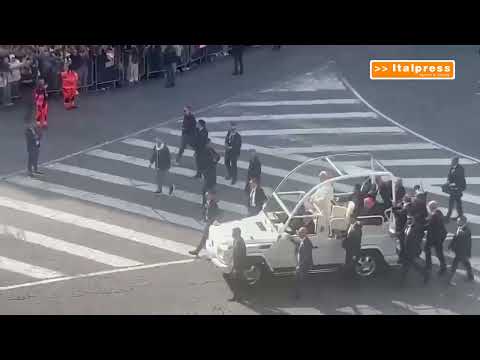
From 14:30 to 15:00, Pope Leo XIV crosses the center of Metz aboard the popemobile, along a route that passes Place Mondon, Avenue Robert Schuman, Place de la République, Rue Haute-Pierre, Rue du Juge-Pierre-Michel, Rue de la Garde, Quai Paul Vautrin and Place de Chambre, before reaching Saint-Étienne Cathedral. Along the way the Pope stops several times to greet the faithful, notably to bless a group of sick children. A fan zone with giant screens for about 15,000 people is set up at Place de la République; between 50,000 and 100,000 people are expected in Metz for the day. About 30,000-35,000 faithful gather in the town-hall square in front of the cathedral: the Pope receives a vintage tennis racket as a gift and signs the city's Golden Book with the wish "May God's peace always reign in the city of Metz and in the hearts of all people." He also greets some faithful with disabilities and the altar servers, including young Louis.
🎥 Videos
▶
Leo XIV greets the faithful from the popemobile in the town-hall square in Metz
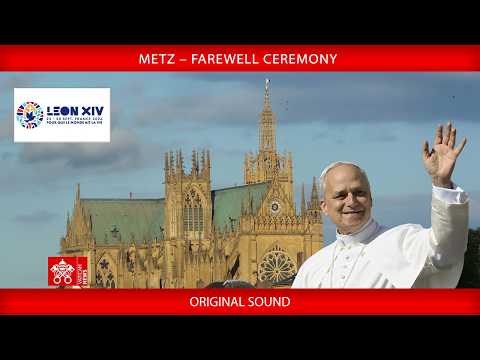
At the end of the Mass, the official farewell ceremony from France takes place. The Pope leaves Metz-Nancy-Lorraine at 19:33, landing in Rome/Fiumicino at 20:53, closing the apostolic journey and his fifth international journey. President Macron also takes part in the ceremony, having rearranged his schedule to attend both the Mass and the farewell, marking the conclusion of Pope Leo XIV's fifth international journey.
🎥 Videos
▶
Metz – Farewell Ceremony, 28 September 2026 – Pope Leo XIV
📷 Photos
The farewell ceremony at Metz-Nancy-Lorraine airport
Pope Leo XIV greets President Macron before departure
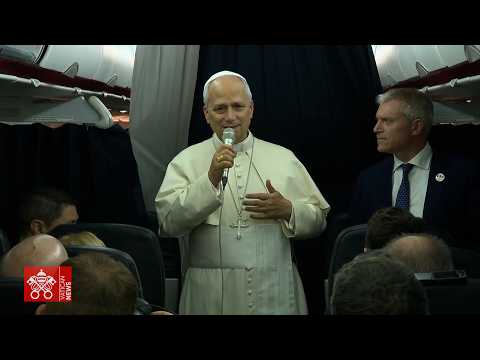
During the return flight (departure from Metz-Nancy-Lorraine at 19:33, landing at Fiumicino at 20:53), Pope Leo XIV holds the traditional press conference with the 80 accompanying journalists, introduced by Holy See Press Office director Matteo Bruni. Answering six questions in English and Spanish, the Pope describes the four days in France as "literally full of blessings," recalling in particular Lourdes and the roughly 80,000 young people at the Stade de France. On the Russia-Ukraine conflict he says the two countries should "come, sit down, talk, look for ways to solve their problems without continuing these wars that no longer make sense," denouncing those who are "getting very rich with an industry that promotes war" and recalling the efforts of Archbishop Gallagher and Cardinal Zuppi for dialogue. On abuse in the Church he says he prefers not to use the term "systemic," while acknowledging responsibility in accompanying victims. On end-of-life legislation in France he reiterates that "what is legal is not necessarily moral." On artificial intelligence he says he is "relatively optimistic" but not "in panic mode," announcing a Vatican commission's commitment to ensuring "AI does not destroy humanity." He confirms he has an invitation to visit Germany, though with no date set.
🎥 Videos
▶
Pope's in-flight press conference on the way back from France, 28 September 2026
📷 Photos
The Pope aboard the plane during the return flight to Rome
At 17:00, in the Vatican Gardens near the Grotto of Lourdes, the Pope recites the Rosary with hundreds of children (between 700 and 1,000) from schools and parishes in Rome, opening the world week of prayer "One Million Children Praying the Rosary," promoted by the pontifical foundation Aid to the Church in Need.
📰 Press conference on the tenth anniversary of Amoris Laetitia
At 11:30, in the Holy See Press Office, the meeting "Ten years from Amoris Laetitia: Proclaiming the Gospel with Families Today," convoked by Pope Leo XIV in the Vatican from October 7 to 14, is presented.
📖 Encounter on the tenth anniversary of Amoris Laetitia
Encounter in the Vatican (October 7-14) convoked by the Pope with the heads of the Eastern Churches, the presidents of Episcopal Conferences, and a number of families.