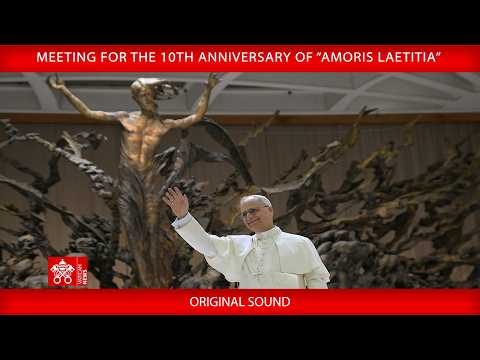
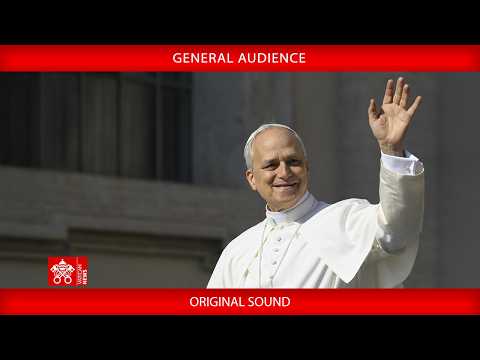
Wednesday 7 October 2026 — General Audience and opening of the Meeting on the tenth anniversary of Amoris Laetitia
📖 Amoris Laetitia Meeting
Opening of the Meeting on the tenth anniversary of Amoris Laetitia
📍 Paul VI Hall, Vatican City
In the afternoon, in the Paul VI Hall, the Meeting "Ten Years After Amoris Laetitia: Proclaiming the Gospel with Families Today" begins, convened by Pope Leo XIV with a Message dated 19 March 2026 and scheduled to run until 14 October. About 187 people take part: the heads of the Eastern Catholic Churches, the presidents of Episcopal Conferences, experts and some married couples from around the world. After a meditation by Sister Helen Alford, president of the Pontifical Academy of Social Sciences, the Pope delivers his opening address: he recalls the synodal journey on the family begun by John Paul II and relaunched by Pope Francis, and invites participants to bring before Jesus the stories of grace and the challenges of these ten years, following the model of Paul and Barnabas who "related all that God had done with them". The Pope urges courage in facing the growing distance between the Christian vision of marriage and the way intimacy and relationships are lived today, and closeness to those who experience fragility, asking for mutual listening, evangelical freedom and discretion during this time of synodal discernment.
Meeting with the Heads of the Eastern Churches and the Presidents of the Episcopal Conferences, on the occasion of the tenth anniversary of Amoris Laetitia
My dear Brothers in the Episcopate, Dear families, Dear brothers and sisters, I wished to convene this meeting ten years after the publication of Amoris Laetitia, and I thank you for arranging your commitments so that we could spend these days together
My dear Brothers in the Episcopate, Dear families, Dear brothers and sisters,
I wished to convene this meeting ten years after the publication of Amoris Laetitia, and I thank you for arranging your commitments so that we could spend these days together. I warmly thank the married couples and all those who have come to share something of their lives in Christ and who will take part in our conversations, as well as the experts and facilitators.
Allow me to begin by recalling the long and fruitful synodal and missionary journey that the Church has made in relation to marriage and the family, a journey that we are called to continue.
The family has always held an important place in the pastoral concern of the Successor of Peter and of the Bishops who assist him through their participation in the Synod of Bishops. The Synod of 1980 took up a desire already expressed by Pope John Paul I during his brief pontificate, eventually leading to Saint John Paul II's Apostolic Exhortation Familiaris Consortio.
At the beginning of his own pontificate, Pope Francis once again placed the family at the heart of a synodal process, recognizing the need to continue the Church's discernment in the face of profound changes affecting an area so closely linked to her mission in the world today. That journey led, ten years ago, to the Apostolic Exhortation Amoris Laetitia.
In this regard, the Church has continued along the path indicated by the Second Vatican Council. When the Fathers of the Council placed the dignity of marriage and the family at the beginning of the second part of Gaudium et Spes, they recognized that family life offers a privileged point of entry into the great cultural, economic, social and political questions of our time, including the work of promoting peace among peoples. The interdependence of these questions has become even more evident today, always under the light of God's word: "'God made them male and female.' For this reason, a man shall leave his father and mother and be joined to his wife" (Mk 10:6-7). The family remains key to an approach that holds together the local and the global, guided by the search for a universal fraternity in Christ that the Gospel calls us to build with everyone. This history of more than half a century places upon our meeting a particular responsibility as Shepherds, as the synodal vocation of the whole Church continues to unfold.
Within this history, Amoris Laetitia marked an important stage, and the ten years since its publication have become part of the life of our particular Churches. During this time, the Apostolic Exhortation has been received in different cultures and pastoral contexts, accompanied the concrete lives of families and inspired initiatives and processes.
These are the ten years we now bring together before the Lord Jesus. With the guidance of the Holy Spirit, looking attentively at what has happened can help us recognize more deeply what Christ has been teaching his Church through these years.
The Acts of the Apostles offer us a beautiful image for what we are about to do. At the end of their missionary journey, Paul and Barnabas gathered the Church together and "related all that God had done with them" (Acts 14:27). Later, as they made their way to Jerusalem, they passed through Phoenicia and Samaria recounting what had happened in the mission, and their account brought great joy to the brothers and sisters. When they reached Jerusalem, they were welcomed by the Church, the Apostles and the elders, and once again "reported all that God had done with them" (15:4).
There is something of this movement in our own gathering. As I have said, the Church has spent these ten years receiving Amoris Laetitia and walking with families in very different circumstances.
We too bring stories of what God has done among us. They are stories gathered along the path of mission: stories of conversion, of unexpected fruit, and of the relationships God has woven within families as our communities have sought to accompany them, together with the difficulties we have faced, the questions that have emerged, and what we have learned along the way. They give us confidence as we begin our work together. Let us place them before the Lord, share them with one another, seeking to recognize what God has been doing among us and where his Spirit is leading the Church today.
In my message of March 19th, on the tenth anniversary of Amoris Laetitia, I recalled that "there are, in fact, places and circumstances in which the Church 'can become the salt of the earth' only through the lay faithful and, in particular, through families." Indeed, Amoris Laetitia invites us to take seriously this vocation and responsibility. Families themselves participate in the Church's mission in the ordinary fabric of their lives, through love and fidelity, care and forgiveness, the education of children, their efforts in transmitting faith, attention to the elderly and the vulnerable, and the many ways in which they serve their communities and society. In all these ways, families bear witness to the Gospel and contribute to the life and the mission of the Church.
As Pastors, we have received the responsibility, in season and out of season, of proclaiming the beauty of God's plan for marriage and the family and his call for love and tenderness. This challenges us to accompany people as they seek to live their vocation in the concrete circumstances of their lives.
This ministry also places us in a school of listening. The wisdom of the People of God reaches us through our common faith, which enlightens all families, including situations marked by difficulties, loneliness and at times even apparent failure. The Lord himself patiently teaches us when we take the time to listen, and we certainly have much to learn from families.
Their lives also place before us questions that deserve to be faced with courage. In many contexts, a growing distance has emerged between the ways in which sex and intimacy are lived and the Christian vision of marriage. Young people continue to long for love, fidelity and belonging, yet many find it difficult to embrace how such a vision of love can take shape in their own lives or to believe that a lifelong commitment is the condition for reaching what they desire. Economic insecurity, migration, violence, loneliness and other forms of emotional fragility also shape the choices people make and the possibilities they can imagine for their future.
These realities raise a number of questions that we must face with courage. What are people truly seeking beneath these cultural changes? What do their joys and hopes, griefs and anxieties reveal to us? Where do our pastoral language and practices succeed in opening a path, and where do they fail to touch people's hearts or assist their efforts to do what is good? What is the lived experience of families teaching us — an experience from which we have not yet fully learned? What can we offer as formation for healthy and holy family life? In particular, what can we learn from parents as they seek to accompany their children and young people in such contexts?
Fragility deserves special attention, for it can profoundly shape the way people see themselves, their future, and even their relationship with God and with the Church. The experience of fragility raises the question of whether we are able to remain close to one another when life no longer corresponds to what had been hoped for, and whether we can recognize the work of grace even in situations marked by limits, wounds and apparent failure.
In this respect too, the experience of families has something to teach everyone, since fragility belongs to our common human condition and therefore also to the life of the Church. We all know the gap between the good we desire and what we are able to live. We need grace, forgiveness and new beginnings to accomplish God's will, and we learn that fidelity is itself a grace to be received and a path to be gradually renewed, often through trial. Recognizing this shared challenge should shape the way we accompany one another in the Church. What kind of Church, then, do people encounter precisely when they are most fragile? Do our communities help them discover that they still have a place, a responsibility and gifts to offer? Can the truth we proclaim be encountered through the patience, closeness and mercy of our pastoral presence? How can we announce to them the fullness of the Gospel's teaching about the family?
During these days, I invite you to give such questions their full weight. The Holy Spirit often speaks through the very situations that challenge us, and enlightens us that we may discover how God's mercy and the salvific grace of Christ can reach our families today, particularly in their weakness and resilience, in their hopes and disappointments, in their longing for communion and their search for meaning. Our task, therefore, is not only to interpret these realities but to let them question us and motivate our pastoral responsibility, so that the Church may find renewed ways of proclaiming the Gospel, offering sacramental graces, accompanying families, and making visible the tenderness with which Christ continues to walk among his people.
May our dialogue with one another be marked by the evangelical freedom we see in the Acts of the Apostles. We can share what has brought joy in our Churches, what has challenged us and what questions have emerged more clearly through experience. Moreover, the diversity of the situations from which we come can become a gift for the discernment of the whole Church.
The Thematic Framework prepared for this meeting is meant to keep the breadth of Amoris Laetitia before us and to bring the Apostolic Exhortation into conversation with what our Churches have experienced during these past ten years. Let us draw inspiration from the richness of Christ's word and the Church's tradition. The program has been made public so that the People of God may accompany our work through prayer and synodal reflection.
For our part, listening to one another, allowing what we hear to resonate within us, and remaining attentive to the promptings of the Holy Spirit can awaken the pastoral creativity we need in the face of new questions.
This is why our common retreat this evening, and the prayer with which we will begin each day, are at the heart of our work. I ask the Lord to help us gather together the fruits that Amoris Laetitia has borne in our local Churches, so that they may nourish the whole Church.
I hope that, through the many stories you bring from your Churches and from different cultural contexts, a shared narrative of these ten years may gradually take shape, one marked by joy and hope, and that will enable us to face honestly the trials and difficulties that remain. This will nourish the pastoral discernment of the Episcopal Conferences and the hierarchical structures of the Eastern Churches. It will likewise help the local Churches recognize new paths, and draw all the baptized more deeply into the Church's synodal journey. I would also ask that we all preserve the discretion and confidentiality that this time of listening and discernment requires.
May the Lord give us the freedom to listen to one another, the wisdom to recognize his work among his people, and the courage to follow where he leads us, so that, each day, the Gospel may become ever more fully good news for families throughout the world. Thank you.
In Saint Peter's Square, before about 32,000 faithful and pilgrims, Pope Leo XIV continues his cycle of catecheses on the Conciliar Pastoral Constitution Gaudium et Spes, dedicating his reflection to the fourth chapter of the first part, on the mission of the Church in the contemporary world. The Pope recalls that the Church is not "above" or "beside" the world but is grafted into it, sharing its fragility and beauty, and that her mission is also fulfilled by contributing to the building of the earthly city through the witness of faith, charity and commitment to justice and peace, without accepting the oppression of the weak and the poor. He underlines the role of the lay faithful, called to enliven family life and the workplace with the Gospel spirit, and recalls that consistency between professed faith and daily life remains decisive for the credibility of the Christian proclamation. At the end of the audience the Pope also greets a delegation from Rome's ASL Roma 2 mental health department, engaged in combating the stigma faced by people living with mental distress and by former prisoners.
General Audience - The Documents of the Second Vatican Council. IV. Constitution Gaudium et Spes. 5. The mission of the Church in the contemporary world
Brothers and sisters, good morning and welcome! Resuming our reflection on the Conciliar Constitution Gaudium et Spes (GS), today we will consider the fourth chapter of the first part, dedicated to the Church's mission in the contemporary world. First of all, the Council recalls that the Church is not "above" or "beside" the world, but is, as it were, grafted into it
Brothers and sisters, good morning and welcome!
Resuming our reflection on the Conciliar Constitution Gaudium et Spes (GS), today we will consider the fourth chapter of the first part, dedicated to the Church's mission in the contemporary world.
First of all, the Council recalls that the Church is not "above" or "beside" the world, but is, as it were, grafted into it. "Mundus reconciliatus Ecclesia", wrote Saint Augustine (Sermon 96): the Church is the world already reconciled with God; we are pilgrims on earth and share in this world's fragility and beauty (cf. GS, 40).
Just as the Son of God was incarnated to give life to the world and to reconcile it with the Father, so the Church dwells in the world as a sign of the incarnation of God, in order to manifest His plan to make us all His children in one great human family. Therefore, the Church journeys through history in the midst of peoples and cultures, and "this involvement in people's lives helps the Church understand ever more clearly that her mission has a historical scope and entails a responsibility for the way in which social relations are built" (Encyclical Letter Magnifica Humanitas, 19).
The first mission of the Church is to help people be attentive to the profound questions of life: those concerning our origin and our destiny, as well as those concerning the meaning of love and suffering (cf. GS, 41). The logic of profit at all costs and the manipulation of information risk exerting undue pressure on people to conform to a lifestyle centred on the consumption of material goods, but our hearts are made to look upwards.
The Council Fathers remind us that the Church's mission is fulfilled also in contributing to the construction of the earthly city. However, her methods and aims are not primarily of a political order; rather, they consist in bearing witness to faith and charity, together with commitment for justice, peace, and fraternity. By worshipping Christ, the Righteous One who died for the unrighteous, the believer cannot accept the oppression of the weak and the poor, nor the unjust structures that perpetuate conditions of dependence and injustice. The social doctrine of the Church guides the actions of Christians, who collaborate with all people of good will in promoting the common good. The Church, therefore, "has no fiercer desire than that in pursuit of the welfare of all she may be able to develop herself freely under any kind of government which grants recognition to the basic rights of person and family, to the demands of the common good" (GS, 42).
To fulfil the Gospel mission effectively, it is necessary for every baptized person to commit to cooperating with the grace of the Holy Spirit, so that their faith may be living and expressed in consistent behaviour. Indeed, as the Council Fathers reiterate, the discrepancy between professed faith and daily life "deserves to be counted among the more serious errors of our age" (GS, 43).
Gaudium et Spes reserves special mention (cf. ibid.) for the mission of the lay faithful who, by virtue of their Baptism, are called to enliven the world with the Christian spirit and the vision of the Gospel. The principal settings for this activity, which may well be described as priestly, are undoubtedly the family and the workplace, but it extends to every sphere of life.
Finally, the Church is always attentive to what is taking place and developing in society (cf. GS, 44). It is the task of the whole People of God, especially pastors and theologians, to discern what in the cultures of our time is worthy of consideration, always taking the Word of God and the Tradition of the Church as the supreme criteria for discernment. This requires a balanced mind, free from cultural trends, capable of viewing the world in a positive light whilst remaining steadfast in preserving and presenting the Gospel message in its entirety. Indeed, "it is certainly not by watering down the content or softening the demands that Christianity can be made attractive" (Address to the Plenary Assembly of the Dicastery for Evangelization – Section on Fundamental Questions regarding Evangelization in the World, 28 May 2026).
Dear friends, as she journeys through history, "the Church has a single intention: that God's kingdom may come, and that the salvation of the whole human race may come to pass" (GS, 45). She strives towards this end above all through personal holiness and fraternal love. Saint Paul VI wrote: "Without this mark of holiness, our word will have difficulty in touching the heart of modern man. It risks being vain and sterile" (Apostolic Exhortation Evangelii Nuntiandi, 76). Let us therefore be open to the action of the Holy Spirit, that He may help us to live in holiness and charity, so that the world may believe and hope.
In the morning, Pope Leo XIV meets a group of "Patrons of the Arts in the Vatican Museums" on pilgrimage to Rome from Louisiana. The Pope recalls Pope Paul VI's role in the origins of the association and his words that "this world in which we live needs beauty in order not to sink into despair", thanking the Patrons for their longstanding support in preserving the art of the Vatican Museums. He invites them to cultivate a spirit of contemplation in an age dominated by efficiency and profit, and to open themselves to the Beauty who is God himself, on the day the Church celebrates Our Lady of the Rosary.
📷 Photos
The Pope in the Paul VI Hall Auditorium receives a group of "Patrons of the Arts in the Vatican Museums" from Louisiana
In the name of the Father, and of the Son, and of the Holy Spirit. Peace be with you. Dear friends, I am pleased to meet with you this morning and welcome you to the Vatican. As Patrons of the Arts in the Vatican Museums, you are undoubtedly drawn to Rome by your love for art and beauty
In the name of the Father, and of the Son, and of the Holy Spirit.
Peace be with you.
Dear friends,
I am pleased to meet with you this morning and welcome you to the Vatican. As Patrons of the Arts in the Vatican Museums, you are undoubtedly drawn to Rome by your love for art and beauty, and the desire to preserve humanity's artistic and religious patrimony for the benefit of future generations. But you also come today as pilgrims, moved to visit the sacred sites of Rome in order to ask for God's grace and blessing, experience his mercy and find renewed strength in your daily journey of faith. In a particular way, I hope that your time spent in prayer at the tombs of the Apostles will reinforce your bonds with the Successor of Peter and the Universal Church.
As you well know, Pope Saint Paul VI played an important role in the series of events that would eventually give rise to your Organization. He once said that "this world in which we live needs beauty in order not to sink into despair. It is beauty, like truth, which brings joy to the heart of man… unites generations and makes them share things in admiration" (Address to Artists at the Conclusion of the Second Vatican Council, 8 December 1965). As Patrons, I trust that you have experienced firsthand that beauty possesses the power to awaken the noblest desires of the human heart, calling us beyond ourselves and opening our souls to the gratuity of God's gifts. It is in this context that I would like to thank you for your generous collaboration over the past decades in helping to maintain the art of the Vatican Museums.
In an age dominated by technology, in which efficiency and profit often take precedence, it is so important that we continue to cultivate a spirit of contemplation and allow time and space for beauty. Such an attitude will greatly help humanity, especially young people, not only to discover the ability of art to uplift and reveal the depths of the human spirit and our openness to the divine, but also to realize that the gift of self is essential for authentic fulfilment. Ultimately, contemplation presents a marvelous opportunity to encounter the God who is Beauty, whom Saint Augustine described as ever-ancient and ever-new, a Beauty that captivates and continuously draws all people to himself (cf. Confessions, X, 27; Jn 12:32). Dear friends, as you continue your pilgrimage, I encourage you to open yourselves to this Beauty and consider ways of helping others to do the same.
In renewed gratitude and entrusting all of you, and your families, to the loving intercession of Our Lady of the Rosary, whose Feast we celebrate today, I willingly impart my Apostolic Blessing, which I extend to everyone associated with The Patrons of the Arts in the Vatican Museums, as a pledge of peace and joy in the Lord.
The Press Office releases a video message by Pope Leo XIV ahead of the 100th World Mission Day, to be celebrated on 18 October 2026 on the theme "One in Christ, united in mission". The Pope thanks God for the fruits of the Day instituted a hundred years ago by Pius XI and recalls his own personal experience as a missionary in Peru, stating that "the prayers and offerings of the faithful encouraged and sustained" his missionary work. He renews his invitation to support the Pontifical Mission Societies generously and to contribute, each according to his or her own vocation, to the Church's evangelizing mission toward the poorest.
The Pope appoints Archbishop Jan Romeo Pawłowski, titular Archbishop of Sejny, previously Apostolic Nuncio to Greece, as Apostolic Nuncio to Ireland. He also accepts the pastoral resignation of Bishop Miguel Ângelo Freitas Ribeiro from the leadership of the Brazilian diocese of Oliveira, who is succeeded by Bishop Antônio Carlos Paiva, previously Coadjutor Bishop of the same diocese.
🎓 Mass for the inauguration of the academic year of the Pontifical Universities
At 6:00 pm, in Saint Peter's Basilica, the Pope presides at Holy Mass for the opening of the academic year of the Roman Pontifical Universities and Institutions.
🌱 Presentation of the "Pope Leo XIV Sustainability Medal" to Card. Czerny
At the Borgo Laudato si' in Castel Gandolfo, the Pope presents Cardinal Michael Czerny with the first sustainability medal named after him, established by Villanova University.
🕊️ To Assisi for the 40th anniversary of the Spirit of Assisi
Interreligious meeting promoted by the Community of Sant'Egidio for the fortieth anniversary of the World Day of Prayer for Peace desired by John Paul II in 1986.
🙏 Opening of the congress "The Splendor of the Human: Safeguarding Fertility"
Papal audience in the Vatican for the opening of the international congress on fertility and responsible procreation, promoted by the Paul VI International Scientific Institute on its 25th anniversary, at the Università Cattolica del Sacro Cuore (October 16-18).