Today — Audience for the municipalities of Central Italy struck by the earthquake · Villanova and Notre Dame pilgrimage · World Mission Day 2027 theme
🤝 Audience
Audience with delegates of the municipalities of the earthquake-stricken areas of Central Italy
📍 Apostolic Palace, Clementine Hall
In the morning Leo XIV received in the Clementine Hall delegates of the municipalities struck ten years ago by the 2016 sequence of earthquakes in Central Italy. In his address, starting from the Book of Nehemiah (cited in the encyclical Magnifica humanitas), the Pope pointed to a twofold approach to reconstruction: a communal, synodal one, and a prophetic vision able to “glimpse in a ruin the plan of a house and of a city”. Recalling Saint Rita, Saint Nicholas of Tolentino, Saint Benedict and Saint Francis, he called for “tangible and urgent responses” so that material reconstruction takes place “as quickly as possible, safely and transparently”, and with the prophet Haggai invited them to start again from the centre: from God, from people, from the common good, from relationships.
Address to delegates of the municipalities of the earthquake-stricken areas of Central Italy (translated)
In the name of the Father, and of the Son, and of the Holy Spirit. Peace be with you.
Your Excellencies, brothers and sisters, good morning to you all. Welcome!
Ten years have passed since the tragic sequence of earthquakes that struck your areas. These were events that caused hundreds of victims, enormous destruction and deep sorrow in entire co
In the name of the Father, and of the Son, and of the Holy Spirit. Peace be with you.
Your Excellencies, brothers and sisters, good morning to you all. Welcome!
Ten years have passed since the tragic sequence of earthquakes that struck your areas. These were events that caused hundreds of victims, enormous destruction and deep sorrow in entire communities, which still bear the wounds today.
In the face of this reality, I would like first of all to listen with you to the Word of God, starting from a text that plays an important role in the Encyclical Magnifica humanitas (cf. n. 8). It is the Book of Nehemiah, which recounts the return of the people to a Jerusalem still in ruins after the devastation wrought by the Babylonians. Nehemiah teaches us a twofold approach. First of all, a communal one: the city, in fact, is reborn not through the work of a single person, but through the shared responsibility of the whole people. Nehemiah also suggests that in order to rebuild, one needs a vision. In such dramatic cases, it is not enough to have good intentions or to rely on disorganized voluntarism. To rebuild, it is necessary to acquire eyes capable of glimpsing, in a ruin, the plan of a house and of a city. It is the gift of a prophetic gaze that can see beyond the rubble something that no one yet sees, a gaze able to discern, within the present evil, the good that is possible and that must be accomplished.
I therefore encourage you to resume the journey with this twofold perspective: on the one hand, the synodal approach in order to build together; on the other, the prophetic vision which, starting from present needs, is able to look ahead and grasp the common good that is to be pursued in practice.
This is how the saints acted. Your land has been blessed by the presence of women and men of God who knew how to live these two dimensions and, in history, to turn evil into good. I think, for example, of Saint Rita of Cascia or Saint Nicholas of Tolentino, who through prayer and the proclamation of the Gospel brought peace to families and communities devastated by hatred and violence. Moved by the same farsightedness, Saint Benedict had already been able to reform and rebuild the Church and society through prayer and work, laying the foundations of what would become today’s Europe. Finally, eight hundred years after his Transitus, we remember Saint Francis of Assisi. Before the crucifix he heard the voice of the Lord saying to him: “Go and repair my house, which, as you see, is falling into ruin” (Second Life by Thomas of Celano: FF 593). He then set about materially restoring several small churches in the area, later understanding that the “house” of which the Lord spoke was the Church herself, which at that time was going through a profound spiritual crisis.
The example of the saints reminds us that hope, if it is not to remain a mere wish, needs above all tangible and urgent responses. For this reason, ten years after the earthquake, every effort must be made so that the material reconstruction takes place as quickly as possible, safely and transparently. Moreover, hope, in order to endure, requires perspective: it must identify points of reference that guide the journey.
In this regard, I would like to point you to the example of another biblical figure involved in the rebuilding of Jerusalem: the prophet Haggai. Living shortly before the governor Nehemiah, he too urged the people to rebuild. Like Nehemiah, he addressed the religious and civil authorities and the people of the city, so that everyone would feel responsible for their common rebirth. His message, however, is very specific: Haggai invites the people, concerned with their own houses and individual needs, not to forget the centre that represented the heart of the Holy City, namely the temple. Indeed, one cannot begin again without first rebuilding what gives meaning and foundation to a community. Otherwise everything remains divided and falls apart. It is therefore a matter of starting again from the centre, starting again from God, from people, from the common good, from relationships. Then our hope will be founded on rock. Thank you.
Dear friends, I encourage you in this work of reconstruction with the words of the prophet Haggai himself: “Take courage, all you people of the land, says the Lord; work, for I am with you” (Hag 2:4).
I thank you for your visit and, invoking the intercession of Most Holy Mary and of your holy Patrons, I wholeheartedly bless all of you and your communities.
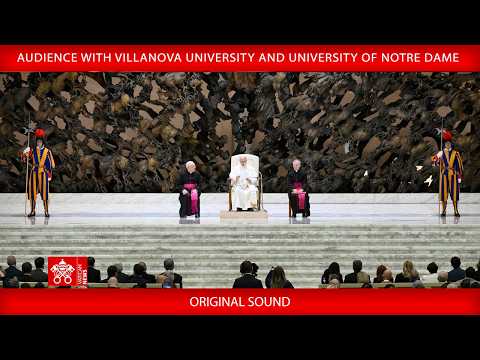
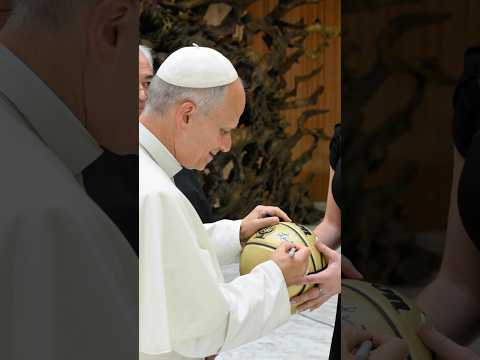
In the Paul VI Hall the Pope met some 7,000 students, faculty, staff and alumni of Villanova University — where he earned his degree in mathematics — and of the University of Notre Dame, in Rome also for the college basketball (NCAA) game between the two teams scheduled for November 1. In his address, delivered in English, Leo XIV spoke of sport as a means of cooperation and sharing “in an age marked by the distance that can be created by technology”, recalling that opponents “are certainly not enemies”. On the eve of All Saints he pointed to the example of Pier Giorgio Frassati: “no one is born a champion, just as no one is born a saint”. At the end he signed a basketball and greeted athletes and officials.
🎥 Videos
▶
Audience with Villanova University and University of Notre Dame — full broadcast (Vatican News)
▶
Pope: In an age marked by distance, sports bring people together (Vatican News EN)
Address to a pilgrimage from Villanova University and the University of Notre Dame
In the name of the Father, and of the Son, and of the Holy Spirit. Peace be with you.
Dear friends,
I am pleased to welcome all of you to the Vatican as part of your pilgrimage to Rome. In a particular way, I greet Father Peter Donohue, President of Villanova University, and Father Robert Dowd, President of the University of Notre Dame, along wit
In the name of the Father, and of the Son, and of the Holy Spirit. Peace be with you.
Dear friends,
I am pleased to welcome all of you to the Vatican as part of your pilgrimage to Rome. In a particular way, I greet Father Peter Donohue, President of Villanova University, and Father Robert Dowd, President of the University of Notre Dame, along with the students, faculty, staff, alumni and supporters of these two academic institutions who are present.
There are many activities occurring during your visit, including, of course, the basketball games that will take place tomorrow between the teams from your universities. In this regard, given the enthusiasm and widespread interest surrounding these games, we can see the potential for sport to play an impactful role both in the life of an academic community as well as in the wider society.
Various Christian authors throughout the centuries, including a number of my predecessors, have noted the many praiseworthy effects that result from participation in athletic activities. In this respect, in more recent years, especially through the voices of the popes, the Catholic Church “has proposed a vision of sport centered on the dignity of the human person, on his or her integral development, on education and on relationships with others, highlighting its universal value as a means of promoting values such as fraternity, solidarity and peace” (Letter Life in Abundance, 6 February 2026).
As many of us have experienced, by acting as a concrete means of bringing people together, athletics can teach the values of cooperation and mutual sharing. This is increasingly necessary in an age marked by the distance that can be created by technology (cf. Homily for the Solemnity of the Holy Trinity, Jubilee of Sport, 15 June 2025). Indeed, “sport is a medicine for both body and spirit, when it is practiced well” (Address to Members of the Italian Swimming Federation, 25 June 2026).
During sporting events, there is the natural desire to cheer, often passionately, for one’s own side. It is important to remember that in any competition, the members of two teams, even when they have a competitive rivalry, are certainly not enemies (cf. Letter Life in Abundance). I hope, therefore, that despite the competitive nature of college basketball, there will be opportunities for the players and the fans of both teams to get to know each other in your days here in Rome.
Providentially, your visit is taking place on the eve of the Solemnity on which the universal Church venerates “in one celebration the merits of all the Saints” (Roman Missal, Collect for the Solemnity of All Saints). On All Saints’ Day, we remember that God calls everyone to be a saint. Indeed, Saint Peter emphasizes that since the Lord himself is holy, we ourselves are to be holy in all of our conduct (cf. 1 Pet 1:15). We are invited, therefore, to ensure that every aspect of our lives, including our athletic endeavors, will help us to love God and our neighbor. For a number of saints, including Pier Giorgio Frassati, a patron saint of athletes, sport was an important component of their lives. His life, as well as that of many holy men and women, reminds us that no one is born a champion, just as no one is born a saint. Rather, holiness requires a daily training in love (cf. Homily for the Solemnity of the Holy Trinity, Jubilee of Sport).
In this regard, Christians are called to run in the race of life with the objective of winning an imperishable crown of glory (cf. 1 Cor 9:24-25). I pray that the activities which comprise your pilgrimage, especially your visits to the tombs of the Apostles, who gave their lives in defense of the faith, will serve as a reminder that our true goal, beyond emerging victorious in any one event, is to win the prize of everlasting life.
My dear friends, with these thoughts I once again thank you for your presence, and I entrust all of you to the intercession of the Blessed Virgin Mary, of Saint Augustine, St. Thomas of Villanova and Blessed Basil Moreau. To you, and to the members of your university communities, I willingly impart my Apostolic Blessing. Thank you.
The Dicastery for Evangelization announced the theme chosen by Pope Leo XIV for the 101st World Mission Day, to be celebrated on Sunday 24 October 2027: “The love of Christ sends us forth” (cf. 2 Cor 5:14). The statement recalls the Pope's Message for World Mission Day 2026: “if unity is the condition for mission, love is its substance”.
The Pope also received Cardinal Kevin Joseph Farrell, Archbishop Filippo Iannone, Archbishop Dimas Lara Barbosa of Campo Grande and Archbishop Nelson Jesus Perez of Philadelphia.