Monday 9 November 2026 — Buenos Aires: Cottolengo, Mass, world of work, religious leaders and Vespers
11:39
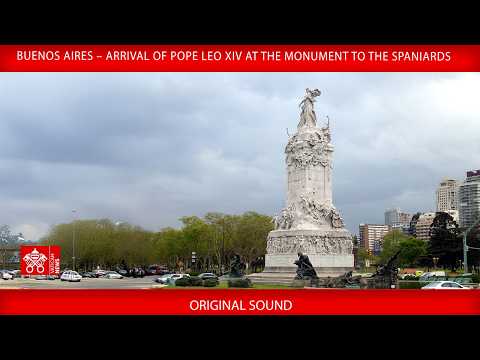
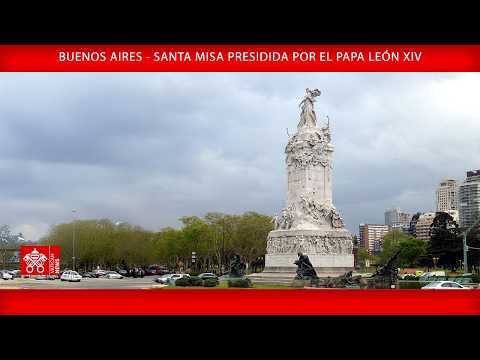
Monumento de los Españoles, Buenos Aires, Argentina
⛪ Holy Mass
Holy Mass at the Monumento de los Españoles
📍 Monumento de los Españoles, Buenos Aires, Argentina
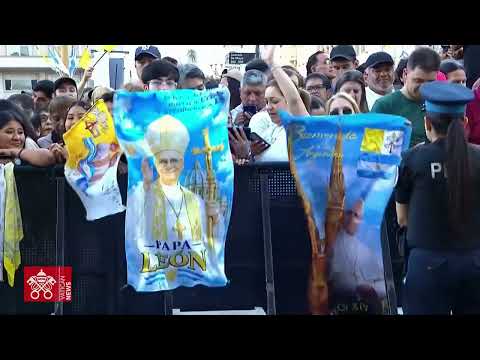
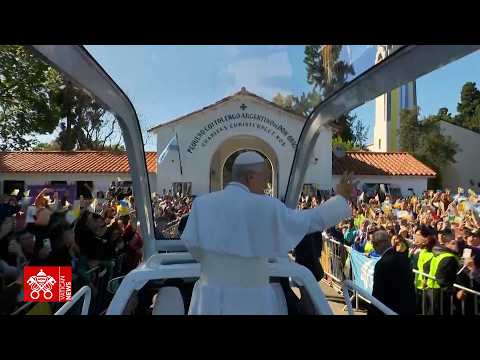
On the Feast of the Dedication of the Lateran Basilica, the Pope presided over the Mass for families at the Monumento de los Españoles, after an open-car tour among the faithful: according to local authorities about 2.5 million people attended. In his homily, starting from the image of the temple, he urged Argentine families to take a leading role in evangelization and entrusted all families to Our Lady of Luján. At the end he was greeted by the Archbishop of Buenos Aires, Jorge Ignacio García Cuerva.
Homily at Holy Mass at the Monumento de los Españoles (Buenos Aires)
Dear brothers and sisters,
It fills my heart with joy to celebrate this Holy Eucharist with you. “Come, behold the works of the Lord” (Ps 46:8), the psalmist invites us today. My visit to this land of Argentina has allowed me to see on your faces the enthusiasm of your faith, that great gift of the Holy Spirit within us. The most beautiful work…
Dear brothers and sisters,
It fills my heart with joy to celebrate this Holy Eucharist with you. “Come, behold the works of the Lord” (Ps 46:8), the psalmist invites us today. My visit to this land of Argentina has allowed me to see on your faces the enthusiasm of your faith, that great gift of the Holy Spirit within us. The most beautiful work the Lord has entrusted to us is his Church, made visible whenever the people of God gather around the same table to give him thanks.
The Feast of the Dedication of the Lateran Basilica, which we celebrate today, brings us to the heart of what it means to be the Church. The Basilica of Saint John Lateran is the cathedral of the Bishop of Rome, the Pope, and as such is a sign of unity and communion for all the Churches throughout the world. For this very reason, it is called the “Mother of all Churches.”
The motherhood of the Church of Rome finds expression in her service of communion, so that all the baptized may recognize one another as brothers and sisters in one household. In the Church, we are all welcomed as “members of the household of God, built upon the foundation of the apostles and prophets, with Christ Jesus himself as the cornerstone. In him the whole structure is joined together and grows into a holy temple in the Lord” (Eph 2:19-21).
It is precisely the image of the temple that brings together the readings we have heard.
In this regard, the Gospel recounts a striking gesture by the Lord: Jesus drives the merchants out of the temple with a whip made of cords (cf. Jn 2:15). In doing so, he seeks to restore the Father’s house to its true purpose. Humanity has always been tempted to “bargain” with God. This is the pagan mentality of giving in order to receive — the illusion that we can win God’s favor by offering him something of our own in return. Christ uproots this way of thinking, for God is Father, always ready to give us every good thing. In this way, the temple, the dwelling place of his presence, becomes once again a house of prayer for all his children.
From this house, according to the vision of the prophet Ezekiel, a river flows beneath the threshold towards the east (cf. Ez 47:1). This image is rich in meaning: its waters purify everything they touch, bringing creation to life and making every kind of tree flourish with fruit that never fails. The waters flow toward the region of the Arabah. With this detail, the biblical text is referring to the desert region that descends towards the great Dead Sea depression, where nothing grows, as its name suggests. Yet these waters are made wholesome: fish abound, and every living creature comes to life again. Where there was death, now there is life; where there was sickness, now there is health; where there was barrenness, now there is fruitfulness.
The Psalm describes the earth shaking and mountains trembling in the depths of the sea. These images reflect the fragility and chaos that we so often encounter in human experience. Our families often face difficult circumstances: instability, social hardship, precarious employment, domestic violence, painful separations and addictions that destroy young people’s futures and damage family relationships. Amid all these hardships and crises, God’s word shines out as a source of hope: God is in our midst; we need not be afraid. “God is our refuge and strength, a very present help in trouble” (Ps 46:1). On the rock that is Christ, our families and society as a whole find the foundation that sustains the house and protects it from the storms that beat against it (cf. Mt 7:24-27).
As we celebrate the Dedication of the Lateran Basilica today, we call to mind the sign of God the Father’s saving presence in his Church. The Church, temple of the Spirit and mystical Body of Christ, offers us the living water that is Jesus himself, who cleanses and heals our wounds (cf. Jn 4:14). In the Lord’s presence, within his house, our families likewise find strength and healing, and never cease to bear fruit.
Dear brothers and sisters, through his resurrection, Christ has already made room for us in his heart. Welcome this grace into your families! With him and in him, every family can become a seed of genuine renewal for this country. Throughout Argentina’s history, culture and society, the family has been a source of the fundamental values of its people. In this land, where different cultures and ethnic groups have come together, the family is the place where faith, human virtues, a culture of work, respect for the elderly, the defense of life and fidelity to one’s word are handed on. Do not give in to those who dismiss the Christian family as outdated. On the contrary, today more than ever, it remains a pillar amid the many insecurities of our time.
Open the doors of your homes to Christ! Speak naturally to your children about Jesus, and remain united to him. In the intimacy of the home, faith is passed on along with life itself, through the simplest gestures: a blessing before meals, a prayer before going to bed, forgiveness and mutual listening, grandparents teaching their grandchildren to pray, going to Mass on Sundays, and preparing for a retreat or a pilgrimage. Indeed, the family is a privileged place for coming to know and encounter Christ. Our beloved Pope Francis, who was Bishop of this city, expressed with great conviction that “the family is called to join in daily prayer, to read the word of God and to share in Eucharistic communion, and thus to grow in love and become ever more fully a temple in which the Spirit dwells” (Amoris Laetitia, 29).
Dear families, I encourage you to take a leading role in evangelization! The Church in Argentina needs you. Support the bishops, parish priests, pastoral workers and catechists in their mission. This Church is renewed and filled with enthusiasm when families, animated by faith, pray together and live out their ministry of proclaiming the Good News. In this way, your families bear fruit anew as you fulfill your educational mission “as a true ministry through which the Gospel is transmitted and radiated, so that family life itself becomes an itinerary of faith and in some way a Christian initiation and a school of following Christ” (Saint John Paul II, Familiaris Consortio, 39).
We entrust all our families to the Virgin Mary, Our Lady of Luján, and to her spouse, Saint Joseph. In the Holy Family of Nazareth, the Son of God found a home in this world. May he bless us, so that our homes, too, may become temples of his presence.
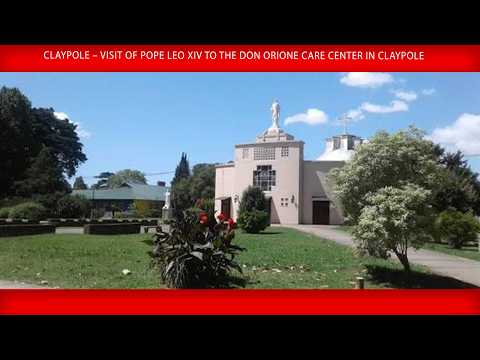
📍 Pequeño Cottolengo Don Orione, Claypole, Argentina
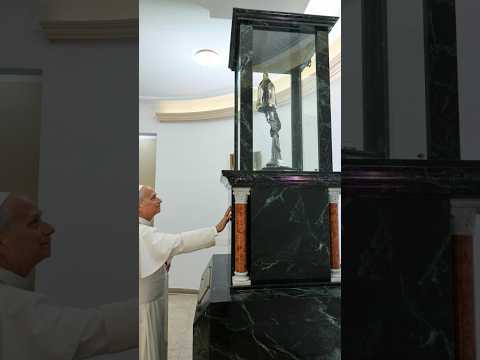
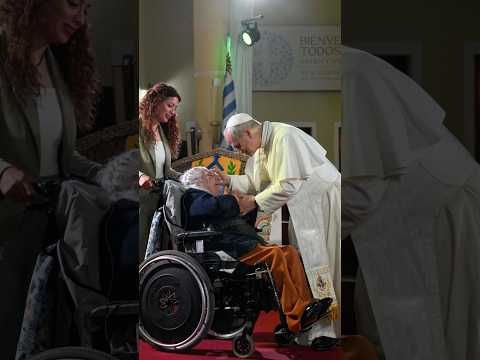
The Pope visited the staff and residents of the Pequeño Cottolengo Don Orione in Claypole, accompanied along the route by about 100,000 people and welcomed by about 3,000 people on site. After praying in the Chapel of the Heart before the relic of the heart of Saint Luigi Orione, he listened to the testimonies of two residents, Marta and Norma, and gave a greeting on the three “cities of charity” of Jesus — Bethlehem, Nazareth and Bethany — stating that people with disabilities “are not a burden for society” but “a blessing”. Before leaving he privately greeted people with disabilities and addictions housed near the Shrine.
🎥 Videos
▶
Visit to Don Orione Care Center in Claypole (full, English)
▶
Highlights from Pope Leo's visit to the Don Orione Care Center
▶
Pope Leo visits the Don Orione Care Center in Claypole
▶
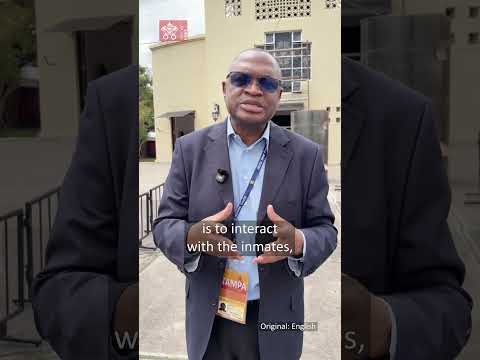
Our correspondent reports ahead of Pope Leo's visit to the Don Orione center in Argentina
▶
Pope Leo to 'find a family' at Don Orione center in Claypole
▶
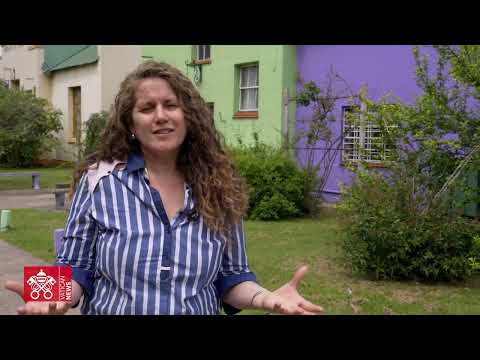
Marta Griselda Torres shares her story with Pope Leo
📷 Photos
Pope Leo during his visit to the Don Orione Cottolengo in Argentina (Vatican Media)
The Pope prays before the reliquary with the heart of Saint Luigi Orione (Vatican Media)
The Pope addresses the Cottolengo in Claypole (Vatican Media)
Pope Leo listens to the testimony of Marta Torres (Vatican Media)
The Pope greets one of the residents (Vatican Media)
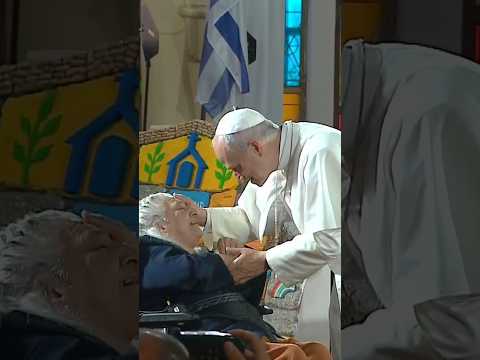
Leo XIV caresses one of the residents of the Pequeño Cottolengo (Vatican Media)
Pope Leo during his visit to the Don Orione Cottolengo in Argentina (Vatican Media)
Pope Leo during his visit to the Don Orione Cottolengo in Argentina (Vatican Media)
Pope Leo during his visit to the Don Orione Cottolengo in Argentina (Vatican Media)
Pope Leo during his visit to the Don Orione Cottolengo in Argentina (Vatican Media)
Greeting to the staff and residents of the Pequeño Cottolengo Don Orione in Claypole
Dear brothers and sisters, good morning!
I am happy to be here with you today. I am grateful for the kind words of Bishop Jorge Lugones of the Diocese of Lomas de Zamora and of Brother Jorge Silanes, Director of this center. I would also like to thank Marta and Norma for sharing their testimonies. Thank you very much. Thank you all for the music,…
Dear brothers and sisters, good morning!
I am happy to be here with you today. I am grateful for the kind words of Bishop Jorge Lugones of the Diocese of Lomas de Zamora and of Brother Jorge Silanes, Director of this center. I would also like to thank Marta and Norma for sharing their testimonies. Thank you very much. Thank you all for the music, and for welcoming me with such enthusiasm and joy.
There are places, like this Home, where charity is not only expressed through deeds, but is clearly visible in every gesture, face and smile, and, we might even say, in the very air we breathe. Such is the “Little Cottolengo,” a fraternal community whose doors are always open, where everything speaks of God’s love.
Saint Luigi Orione, its founder, wanted this place to be known as a “city of charity.” He prayed and worked for many years to build it, trusting deeply in divine providence and driven by love for the weak and poor of society, who were often ignored and left to fend for themselves. As I reflected on the longing in the heart of Don Orione, a father and shepherd, three “cities” came to mind — places where Jesus, too, breathed the fresh air of freely given charity. They are Bethlehem, Nazareth and Bethany.
In Bethlehem, which means “House of Bread,” Jesus was lovingly welcomed, kept warm and nourished by Mary and Joseph. He was recognized with affection and admiration by the wise, as well as by the humble and simple. We can say that in Bethlehem, one senses a love for life, and that love transforms the cold poverty of the setting into the warmth of a home. It is a place that respects the dignity of every human person, valuing and welcoming all as a gift from God.
Years later, Nazareth became the city where Jesus learned to be part of a family and integrate into the community. Here he grew “in wisdom, and in years, and in divine and human favor” (Lk 2:52), and cultivated the value of work and responsibility. It is a place that does not exclude others, but rather incorporates them into social life, appreciating their talents and abilities and helping them fulfill their potential — as we have seen in Marta’s life and in the book she has written.
Finally, it was in Bethany, through the gift of friendship with Martha, Mary, and Lazarus, that Jesus experienced the value of authentic and sincere human relationships. In such relationships, no one is marginalized or abandoned. Instead, there is companionship, listening, and counsel; faith and service are shared, along with sorrows and joys. In short, Bethany is a place that helps us move beyond individualism, a place where one feels loved and desires to love others in concrete ways. As Norma shared in her testimony, places like this make people feel accepted, cared for and loved just as they are.
As we can see, Jesus lived in places where he could breathe the air of charity; where he experienced the love of a family, integration into a community, and fraternal friendship, sharing life with his loved ones. I hope this brief reflection will encourage us to consider and give thanks for so many “cities of charity,” such as this Little Cottolengo, where the Gospel remains alive and active, here and now, in this beautiful country.
In this regard, I would like to recall some words which my predecessor Saint John Paul II addressed to a group of people with disabilities. He said that God’s love “is the foundation of our hope and the breath of our life. God has shown us in an unsurpassable way through Jesus Christ how much he loves every person and how immense is the dignity he has bestowed upon them through him. Precisely those who suffer from a physical or spiritual disability must recognize themselves as friends of Jesus, as those whom he loves in a special way” (Angelus, Osnabrück, 16 November 1980).
Dear brothers and sisters, many residents and staff members, religious men and women, family members and volunteers who contribute to this great work have come to today’s gathering. In their radiant eyes I can see such warmth; in their open hands I can recognize countless deeds of selfless service; in their generous hearts I can sense great tenderness and understanding. Thank you all for your examples of self-sacrifice and love of neighbor.
The noble work that you carry out here every day, with such affection, effort and dedication, is building a solid foundation for a new city: a city of charity, of fellowship and of peace. It is certainly a “slower, less visible and less spectacular” building project than that of other kinds of cities, but it “is this prospect of commitment, this construction site of hope, that we call the ‘civilization of love’ (Magnifica Humanitas, 185).
The values of dignity, belonging, and fraternal friendship that distinguish places like this have much to say to our societies, which are often driven solely by the pursuit of economic success or the cult of outward appearance. Today I would like to affirm that your lives are not a burden on society. They are a blessing, because you can help us to remember the foundation of the dignity of every human being and what is truly important in life. A nation’s progress is also measured by how it welcomes all people with disabilities and particular needs.
In this special moment, I would like to share with you all my hope for this country: that Argentina may be capable of performing great works of charity, such as we see here, where the love of Christ triumphs over individualism and exclusion. I dream of thousands of young people volunteering to contribute to the great legacy of charity that the sincere and simple faith of the Argentinian people has built up over the centuries. I dream that a new generation of saints devoted to charity might be forged in Argentina! Indeed, why shouldn’t all of you be among them? The love of Christ urges us on! (cf. 2 Cor 5:14).
Dear friends, let us continue to respond with faith and hope to the universal call to holiness (cf. Lumen Gentium, 11). Our beloved Pope Francis shared this same desire, and for this reason he wrote: “We are all called to be holy by living our lives with love and by bearing witness in everything we do, wherever we find ourselves” (Gaudete et Exsultate, 14). Let us place the gifts we have received at the service of the least among us and those in need, each according to our ability, so that the city of charity may grow stronger, spread and succeed in breaking down the barriers of selfishness.
Finally, I would like to draw attention to the relic of Don Orione’s heart that is kept here, in this community’s chapel — a testament to the deep bond that united this holy Italian priest to the land of Argentina. His incorrupt heart continues to remind us that “charity will save the world,” because “God is love” (1 Jn 4:8) and “love never ends” (1 Cor 13:8). The secret to Don Orione’s life, lived out of love, was revealed by Saint John Paul II, during his homily at the canonization of this tireless apostle: “The heart of this strategy of charity was ‘without limits because it was opened wide by the charity of Christ’ (Saint Luigi Orione, Writings, 102, 32). Passion for Christ was the soul of his bold life, the interior thrust of an altruism without reservations, the always fresh source of an indestructible hope” (Homily, 16 May 2004, 2).
May God bless you all, and may he also pour out abundant blessings upon your families, benefactors and your loved ones. I carry you in my heart. Thank you.
In the afternoon, at the Nunciature, before leaving for the Catholic University, the Pope met five people who were abused by members of the clergy and Church institutions in Argentina, presented by the local Church. He spoke with each individually, listening to their stories and proposals for consolidating paths of healing in the Church; he then blessed them together, expressing to them and to other victims his closeness and his desire to strengthen pathways of protection, welcome and accompaniment. The meeting lasted more than an hour.
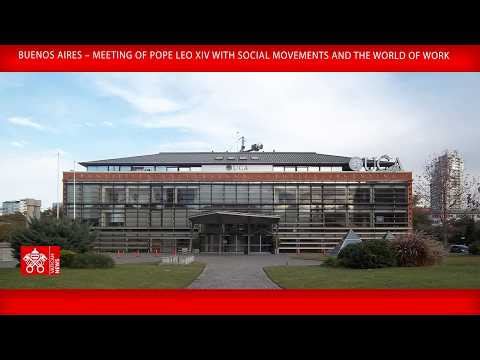
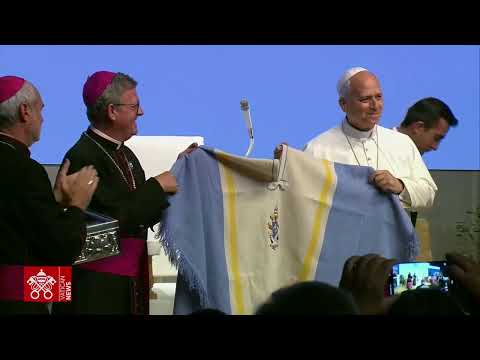
On arrival at the San José Building of the Catholic University of Argentina (UCA), the Pope was welcomed by the Archbishop of Buenos Aires and Grand Chancellor, Archbishop Jorge Ignacio García Cuerva, and by Rector Miguel Ángel Schiavone. In the Aula Magna, after the Archbishop's introduction, a greeting from Bishop Dante Gustavo Braida (President of the Episcopal Commission for Social Pastoral Care), an artistic moment and testimonies from a businessman, a trade unionist, a cooperative worker, a rehabilitation-centre worker and a teacher, Leo XIV gave his address: work is not an instrument of conflict but a share in the Creator's work, and human dignity must always prevail over profit. The meeting ended with his blessing and an exchange of gifts.
🎥 Videos
▶
Meeting with Social Movements and the World of Work (full, in English)
▶
Meeting with the world of work — highlights
📷 Photos
Pope Leo during his address at the Catholic University of Argentina (Vatican Media)
The Pope embraces Verónica San Martín, a cardboard collector (cartonera) (Vatican Media)
The testimony of Catholic businessman Juan Martín Allende (Vatican Media)
Soledad Cuellar, of the Ava Guaraní community, greets Leo XIV (Vatican Media)
The gift of a poncho (Vatican Media)
The Pope gives a painting of Our Mother of Good Counsel (Vatican Media)
Pope Leo during his address at the Catholic University of Argentina (Vatican Media)
Pope Leo during his address at the Catholic University of Argentina (Vatican Media)
Good afternoon, and thank you for your warm welcome. I deeply desired to meet with all of you, representatives of the work community in Argentina: workers and business leaders; members of trade unions and popular movements; teachers and other members of the academic community of the Catholic University of Argentina. I warmly greet…
Dear friends,
Good afternoon, and thank you for your warm welcome. I deeply desired to meet with all of you, representatives of the work community in Argentina: workers and business leaders; members of trade unions and popular movements; teachers and other members of the academic community of the Catholic University of Argentina. I warmly greet the Grand Chancellor, the Archbishop of Buenos Aires, and the President of the Episcopal Commission for Social Pastoral Care, and I thank you for the words addressed to me on behalf of everyone present. In a particular way, I thank those who have shared their testimonies and artistic talents with us, bearing witness to the greatness of God in their lives.
Just as music helps us lift our souls to God and transcend the everyday realities of our lives, work invites us to take part in the Lord’s marvelous and harmonious activity. In this regard, Saint John Paul II reminded us that “men and women, created in the image of God, share by their work in the activity of the Creator and, within the limits of their own human capabilities, in a sense continue to develop that activity, and perfect it as they advance further and further in the discovery of the resources and values contained in the whole of creation” (Laborem Exercens, 25). Work, therefore, is not an instrument of conflict. Rather, it helps build society through the contribution of all and respect for the order of Creation.
This conviction remains valid, however much the circumstances around us, and even the very structure of work itself, may change (cf. Magnifica Humanitas, 150). Today, the anthropological underpinnings and the global dimension of work are not only confronted by the foundations of the economy, but are also challenged by the ecological crisis and the irresponsible use of the planet’s resources. Wherever the domination of a few becomes the rule, work is turned into the exploitation of all components of the work community, and workers end up being valued solely for their efficiency. This reality takes on an unprecedented urgency when viewed from the perspective of integral ecology articulated by Pope Francis, according to which work contributes to the responsible stewardship of creation, in which technological development must be harmonized with respect for the rhythms of nature and the limits of the various ecosystems (cf. Laudato Si’, 11). This is an insight that remains valid even now, amid profound changes in the structure of work, when the interests of a few seem to prevail, forgetting that “true progress is not what increases the wellbeing of some by degrading ecosystems, shifting costs onto the most disadvantaged communities, or compromising the living conditions of those who will follow us” (Magnifica Humanitas, 84).
All work, and every aspect of the work community, must always bear this distinctive mark: it must be carried out by people, who bring all their potential to bear, and it must likewise be directed toward the full development of those who perform it. Here we encounter the first and most fundamental of the principles of the Church’s Social Doctrine: the dignity of the human person. The human person is the author, the center and the goal of all economic and social life. The economy, therefore, must be at the service of the person, and not the person at the service of the economy. Although this statement may seem theoretical, it is a central point of the Church’s social thought dating back to my predecessor Leo XIII. In order to foster harmony between all parties and eliminate conflicts in the workplace, he reflected upon the need to establish a proper balance between economic principles, the outlook of employers and the needs of workers and their families (cf. Rerum Novarum, 20). This is why unemployment is a genuine tragedy in the life of those affected by it. To deprive a person of work is not simply to deny that person an income. It severely wounds their dignity, deprives them of the ability to contribute to society and plunges them into social exclusion, thereby fragmenting the unity of society and undermining the communal activity that is aimed toward the common good.
As Pope Francis reminded us, “In a genuinely developed society, work is an essential dimension of social life, for it is not only a means of earning one’s daily bread, but also of personal growth, the building of healthy relationships, self-expression and the exchange of gifts. Work gives us a sense of shared responsibility for the development of the world, and ultimately, for our life as a people” (Fratelli Tutti, 162). Here we see how the principle of dignity is directly linked to the principle of the common good, defined as the sum total of social conditions which allow people, either as groups or as individuals, to reach their fulfilment more fully and more easily. The common good requires us to overcome sterile individualism and corporatist utilitarianism, and to promote a culture of encounter in which economic growth is translated into genuine integral human development.
From a Christian perspective, moreover, we see work as a means of sanctification, since through it we fulfil the will of the Most High. As we read in the opening pages of the Bible, “The Lord God took the man and put him in the garden of Eden to till it and keep it” (Gen 2:15). This biblical mandate is the foundation of the principle of the universal destination of goods. Although the Church recognizes and defends the right to private property, this right is always subject to a social mortgage: the earth and its fruits have been given by God for the sustenance of all humanity (cf. Laudato Si’, 93). To “till” and “keep” means that we are not lords, but stewards of an inheritance that must be shared with equity and justice, eliminating the structural inequalities that marginalize the weak and taking into account our responsibility towards future generations. Such situations of inequality affect individuals, communities and nations, and even have an impact on relations between States, undermining mutual trust and each people’s sense of belonging to the one human family, as well as the awareness of the duty of States to cooperate in resolving problems through joint decisions. We can therefore say that, from the very beginnings of our existence on earth, work has belonged to the way in which the human person cooperates with God’s action in bringing the world to perfection.
Human dignity, the common good, and the universal destination of goods: these principles speak to us of an intrinsic relational dimension and converge in the principle of solidarity. Solidarity is not a superficial feeling of compassion, but the responsibility of each person and each institution for the good of all. In a globalized economic structure that tends towards a “throwaway culture,” solidarity becomes a force capable of building a social structure that can redefine market needs and labor relations according to criteria of justice and the logic of reciprocity. In this way, in the hands of those who know how to use them, talents become a privileged means of contributing to an effective common good that adapts to technological advances without leaving anyone behind. For Christians, this also means recognizing that it is God who acts within us — if we are humble enough to acknowledge it.
The ingenuity with which the people of Argentina have applied themselves to work, contributed to the common good and developed innovations useful to society is undeniable. To mention only a few examples, we can think of areas such as astronomy, agriculture and medical science, where the contributions of Argentinians have led to significant advances. We can also think of the quiet and sacrificial work involved in household tasks, the unpaid hours devoted to preparing mate for neighborhood children, or the long days spent ploughing, cultivating and harvesting a field. Here the principle of subsidiarity is clearly manifested, by which it is established that neither the state nor large corporations should absorb the initiatives and capacities of local communities and intermediate associations, but rather support and strengthen them. In the tradition of the Church’s social thought, the State is not expected to do everything. Rather, it has the task of fostering the activity of intermediate bodies: families, local authorities, social groups and movements, while retaining its regulatory power for the common good and taking on those tasks that lower-level associations cannot fulfil. Today, this principle, which Pope Pius XI was the first to incorporate into social doctrine (cf. Quadragesimo Anno, 80), has become the framework for government action and for the regulation of forms of economic integration between States. At the same time, popular movements, the popular economy and informal workers — waste-pickers, farmers and artisans — are living expressions of this active subsidiarity, which Pope Francis defended in his addresses to popular movements. They do not passively wait for State assistance; they organize themselves from the grassroots to build community-based solutions. Through their demand for social inclusion, they advocate the three “Ts”: tierra, techo y trabajo — land, housing and work — which Pope Francis often identified as requirements of social justice.
This is why it is so encouraging to hear your testimonies, dear friends, and to discover how God has been growing within you. Through the path of humility, we come to realize that we are not self-sufficient, that we need others and that only by opening ourselves to collaboration with those around us can we build a better world together. Just as God created each of us in a unique way, he also counts on each one of us as individuals. At the same time, however, he invites us to communion, to enter into relationship with him and with others. This is the path toward building the united Argentina that we desire for the future, a genuine “social friendship,” in the words of Fratelli Tutti, which overcomes dialectical polarization and shapes an architecture of peace founded on justice and dialogue, at both the national and multilateral levels.
In the business world, the life of Venerable Enrique Shaw, a Catholic entrepreneur who underwent a conversion after discovering the beauty of the Gospel as expressed in the Church’s Social Doctrine, speaks to us with particular force. The future Blessed, with his Christian understanding of the human person, “understood that industry was not just a productive mechanism or a means of accumulating capital, but a true community of people called to grow together” (Message to the Participants in the 31st Argentine Industrial Conference, 8 September 2025). His thought, thoroughly studied at this University, which he himself helped to found, is clearly expressed in his own words: “It is necessary to form Christian business leaders and provide them with a specific way of living: that of contributing to a better world, principally through the action of each Christian business leader in his own sphere… This is a mission of religion and life: seeking to sanctify ourselves through our profession and to sanctify the profession” (Notas y apuntes personales, p. 58).
Business leaders, whose capital creates jobs, often put their own assets at risk, for it is impossible to create wealth in a country without personal involvement, without accepting the uncertainty that the future brings, whose parameters are entirely beyond our control. At the same time, we must remain alert to the danger of greed which, as Pope Francis said, “is a sickness of the heart” (General Audience, 24 January 2024). The business vocation is a noble task when it is guided by the principle of the social function of property and capital. When economic profit is established as the sole criterion of success, a business becomes dehumanized and turns into a structure of sin that generates exclusion. Business leaders are called to overturn this technocratic mentality through ethical investment that gives priority to the dignity of work and environmental sustainability, recognizing that financial success must be measured in terms of the common good (cf. Laudato Si’, 109).
In this regard, trade unions and workers’ associations find an important area for growth and development by becoming more directly involved in ensuring that workers’ conditions are dignified. “The initiatives which emerged from that tradition, including associations, trade unions, cooperatives and welfare organizations, have contributed decisively to improving labor legislation, protecting the most vulnerable and promoting more humane conditions” (Magnifica Humanitas, 155). Their specific mission is to be instruments of solidarity and cohesion, channels of cooperation between workers and businesses. From this perspective, trade unions are indispensable institutions when they defend those who have no voice and resist the commodification of labor. To maintain this moral authority, however, the trade union movement must keep its gaze fixed on the existential peripheries, welcoming and reaching out to precarious workers and those excluded from the formal system, while taking into account the profound transformations affecting the work community.
The challenges posed by artificial intelligence and unregulated automation can put countless jobs at risk and become a real threat to proper integral human development. Technology must always be subject to ethics; an algorithm cannot replace human discernment or the intrinsic value of a worker’s physical presence and effort (cf. Laudato Si’, 107). Public authorities must ensure that this does not happen. On the contrary, “access to work for all must be a high priority for public policies and economic processes, serving as a criterion for evaluating the human quality of any development model” (Magnifica Humanitas, 154). The commitment of public authorities is indispensable in promoting stable policies that foster full employment and social inclusion within an ethical framework in which the economy, the market and the State act according to the principle of subsidiarity in the just redistribution of opportunities.
God calls each of us to be attentive to the needs of those around us, serving others through our work. Recognizing the face of those who suffer in urban and rural peripheries is the key to the political love proposed by Fratelli Tutti. Fraternity is not an abstract utopia, but a political and theological category that obliges us to regard one another as equals, breaking down the walls of globalized indifference (cf. Fratelli Tutti, 73). Let us not shy away from our daily encounter with Christ in the tasks of each day, however banal and insignificant they may seem to us. No work is trivial in the eyes of God: the greatness of a task lies not in what is done, but in the love invested in every gesture, every word and every thought.
Dear brothers and sisters, in a world undergoing profound change, I leave you with the principles that gave rise to the Church’s Social Doctrine as a task to be undertaken: defend the dignity of the human person, promote the common good, recognize the universal destination of goods, practice effective solidarity and responsible subsidiarity, so that together we may build the civilization of love. Let us “work perseveringly, placing God at the forefront of our actions and the human person at the center of our choices” (Magnifica Humanitas, 16). Only in this way can we be sure that we are following on earth the path that God has prepared for us in heaven. Indeed, only in this way can our work bear fruit, fruit that will last (cf. Jn 15:16). Thank you.
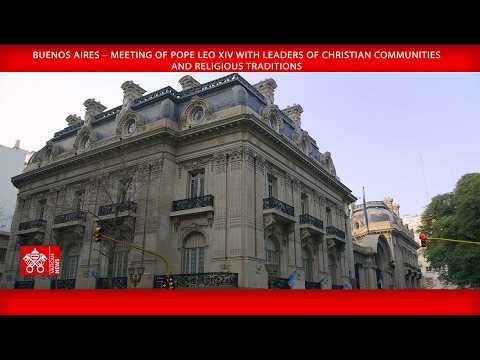
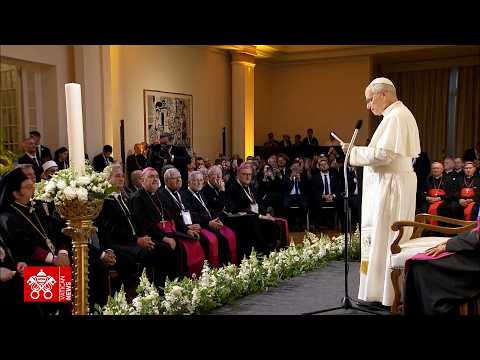
At 5.40 pm the Pope arrived at the Palacio San Martín, welcomed by Foreign Minister Pablo Quirno, Archbishop Marcelo Daniel Colombo, President of the Bishops' Conference, and the Archbishop of Buenos Aires. In the Salón Libertador, after a hymn, the Minister's introduction and a greeting from the President of the Episcopal Commission for Ecumenism and Interreligious Dialogue, Leo XIV gave his address: religions in Argentina have never been a cause of division but a meeting point, and today they are called to build bridges and protect human life threatened by poverty and violence. He then lit a candle and observed a minute of silence for peace. The meeting ended with a group photo in the palace courtyard.
🎥 Videos
▶
Meeting with Leaders of Christian Communities and Religious Traditions (full, in English)
▶
Meeting with religious leaders — highlights
📷 Photos
The Pope's address at the Palacio San Martín (Vatican Media)
Leo XIV lights the candle for peace (Vatican Media)
Pope Leo XIV and Bishop Ángel Macín (Vatican Media)
Meeting with the religious confessions (Vatican Media)
The Pope with participants in the meeting at the Palacio San Martín (Vatican Media)
The Pope's address at the Palacio San Martín (Vatican Media)
Address to Leaders of Christian Communities and Religious Traditions
Dear brothers and sisters in Christ, Dear friends who worship the one God, Esteemed representatives of various religious traditions,
I am pleased to greet you during this Apostolic Journey. Our meeting rests on the pillars of dialogue and friendship, which were fundamental in the life of Pope Francis and which we now wish to strengthen by…
Dear brothers and sisters in Christ, Dear friends who worship the one God, Esteemed representatives of various religious traditions,
I am pleased to greet you during this Apostolic Journey. Our meeting rests on the pillars of dialogue and friendship, which were fundamental in the life of Pope Francis and which we now wish to strengthen by building new bridges, that is, new paths of cooperation in the society in which we live. I am here among you as the Successor of the Apostle Peter, and as I profess with him faith in Christ, “the Son of the living God” (Mt 16:16), true God and true man, I acknowledge the baptismal unity with our brothers and sisters of the Christian confessions. In accordance with the teachings of the Second Vatican Council, I wish to reaffirm the spiritual ties that unite the Church to the Jewish people (cf. Nostra Aetate, 4) and our sincere respect for whatever is holy and true in the different religious traditions (cf. ibid., 2).
The identity of the Argentinian people has taken shape like a melting pot of different races, cultures and religions. It has been formed by the native peoples and by countless immigrants from different parts of the world who arrived in this land over the centuries, bringing with them their dreams and their faith —Catholics, Evangelicals and Jews at first, and later many others. In all their diversity, they learned to work together, form families and communities, and build settlements and villages, “in an admirable symbiosis with the local traditions” (Saint John Paul II, Homily, Paraná Airport, 9 April 1987). In this way they gave unity to the nation and carried forward common projects. Religions were never a cause of division, but rather a meeting point and a source of commitment to society.
Today, too, each of us bears witness to a creed which we have chosen to live by, making it an outstretched hand with which to share cultural values and good works. Our meeting is founded on listening, which makes mutual understanding possible and allows us to reflect together on an action that we perform every day, namely prayer. In the various religions, people pray raising their voices to God. In keeping with our respective traditions, countless languages, songs and gestures converge heavenward, as though gathering before the ineffable mystery of our existence (cf. Nostra Aetate, 1).
It is precisely this particular form of human language called prayer that invites us to listen to one another’s voices, and not only to the words we utter. When we speak to God, it is we ourselves who speak: prayer therefore expresses who we are before God. The religious dimension of the human person is like a mirror reflecting our being, our thoughts, affections and relationships. In the digital age especially, prayer helps us overcome distractions, discovering in silence the value of listening.
Focusing on this experience, I would like to consider with you today three aspects that emerge from sincere prayer, in which our beliefs find a voice: religions as guardians of human dignity, religions as expressions of our freedom, and religions as places in which to cultivate hope.
First of all, every religion bears witness to the fact that the human person is defined by need and desire: we are all yearning for life. Our lungs seek air as our conscience seeks goodness. Every day we seek water as we seek truth; we need nourishment as we need justice. In this regard, religions remind everyone that we are made of more than matter. Indeed, our very flesh bears the imprint of an abundance of life and meaning. This same desire, which becomes a cry and a plea, bears witness to the fact that we do not come from nothing and were not made for death. In this way, then, religions safeguard human dignity. In prayer, which expresses our faith, the ideals of goodness and justice, health and peace are not empty words to be filled with selfish interests, but testimonies to our common will, which is directed toward joy. Whenever we pray, therefore, we must care for those who live alongside us, making the words we utter authentic through renewed fraternity. As we praise God for the gift of life, let us defend it, always and for everyone, from conception to its natural end, especially when it is threatened by poverty and violence. In this way religions promote the dignity of every man and woman in the family, in education, in work and in the environment.
Second, when human beings speak to God, they know that they themselves are not God. We did not make the earth. So let us not destroy with our own hands the “garden” that the Creator has entrusted to us! In this regard, insofar as religions safeguard the wisdom of peoples, they build up society, educate consciences and free us from idols: the idol of domination, because we are not the god of others; the idol of vainglory, because the things we possess do not make us divine; and the idol of war, because there is only one Lord and Judge of history. He continually gives us life and cares for all peoples. The true name of his power is love, a love that knows no end. As we praise God for the gift of salvation, let us commit ourselves to being a sign of this gift for the world. In this way, religions give the fullest expression to our freedom.
Third, when human beings speak to God, they open themselves to the future. Yes, the future is the time of faith. Religions are a bond between generations, an age-old memory, prophecy, expectation and promise. That is why believers always look to the future with hope. When the light of faith pierces the darkness of death, hope is restored to the future of every man and woman, of society and of the whole world. Our waiting together then becomes productive, because hope encourages us to weave bonds of a good life, which free us from solitude and bring peoples together in harmony. The very word “religion” shows this, for religare means to connect, to bind people to one another. This relationship sustains our journey through history. Therefore, as we praise God for the gift of hope, let us share it with those who suffer in poverty, with those who have lost the meaning of life and with all who wish to commit themselves to renewing the world in justice. Becoming prayer and proclamation, our language is thus transformed into eloquent charity, which inspires every action.
Herein lies our service to humanity: to build a better future for all, as we await the blessed fulfilment of history. We are indeed certain that the more genuinely men and women come to know themselves, caring for their own dignity, the closer they draw to God. Thus, every good word spoken to someone we meet, every good gesture directed toward our neighbor, rises like a prayer ever pleasing to the Author of justice, who invites everyone to peace. In this regard, as Saint John Paul II said, together “we wish to show the world that the genuine impulse to prayer does not lead to opposition and still less to disdain of others, but rather to constructive dialogue, a dialogue in which each one, without relativism or syncretism of any kind, becomes more deeply aware of the duty to bear witness and to proclaim” (Address to the Representatives of the World Religions, 24 January 2002). These words, spoken in Assisi on a day of prayer for peace, remain urgently relevant. Today they are a reason for gratitude for the commitment of us all and a source of encouragement for each person’s journey. Dear brothers and sisters, may every day be a time of prayer, so that everyone’s life may reflect the dignity and goodness that we have received from God to share with one another.
Let us make our own the prayer left to us by my predecessor Pope Francis, which commits us to doing good:
Lord, Father of our human family, you created all human beings equal in dignity: pour forth into our hearts a fraternal spirit and inspire in us a dream of renewed encounter, dialogue, justice and peace. Move us to create healthier societies and a more dignified world, a world without hunger, poverty, violence and war. May our hearts be open to all the peoples and nations of the earth. May we recognize the goodness and beauty that you have sown in each of us, and thus forge bonds of unity, common projects and shared dreams. Amen.
(Fratelli Tutti, “A Prayer to the Creator,” No. 287.)
May the Almighty bless our enthusiasm for humanity and inspire our commitment to peace: the peace that will be fulfilled forever in the holy name of God. Thank you.
📍 Metropolitan Cathedral of the Most Holy Trinity, Buenos Aires, Argentina
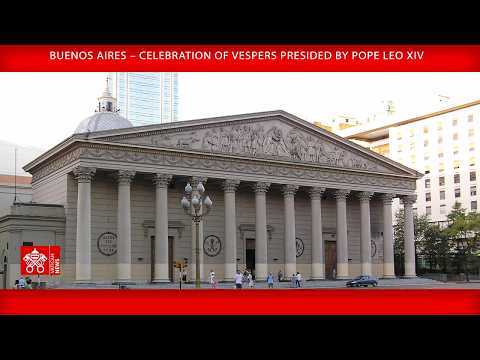
At 6.45 pm the Pope reached the Metropolitan Cathedral, welcomed by Archbishop Colombo, Archbishop García Cuerva and the rector, Fr Alejandro Russo. After a moment of prayer in the Blessed Sacrament chapel, he paid tribute to the memory of Pope Francis, laying flowers with some children at the commemorative plaque. In his homily at Vespers he journeyed in thought through Argentina's regions and its Marian devotion, recalling the motto of the trip ("Everyone is welcome. Go and proclaim!") and urging unity in diversity. Afterwards he greeted the bishops in the sacristy.
🎥 Videos
▶
Celebration of Vespers in Buenos Aires (full, in English)
▶
Vespers in Buenos Aires Cathedral — highlights
📷 Photos
The Pope presides at Vespers in Buenos Aires Cathedral (Vatican Media)
The Pope's homily during Vespers (Vatican Media)
Leo XIV prays before the Blessed Sacrament (Vatican Media)
Leo XIV prays before the plaque commemorating Pope Francis, Archbishop of Buenos Aires from 1998 to 2013 (Vatican Media)
Leo XIV with Archbishop Marcelo Colombo of Mendoza, President of the Argentine Bishops' Conference (Vatican Media)
The Pope presides at Vespers in Buenos Aires Cathedral (Vatican Media)
The Pope presides at Vespers in Buenos Aires Cathedral (Vatican Media)
Homily at Vespers with the Argentine Episcopate and Synodal Teams
Your Eminences, Your Excellencies, Dear members of the synodal teams, Brothers and sisters in Jesus Christ,
During this moment of prayer, I would like us to journey together imaginatively through the different regions of this beautiful country. In each of its provinces, our faith has taken root in diverse peoples and cultures, giving rise to…
Your Eminences, Your Excellencies, Dear members of the synodal teams, Brothers and sisters in Jesus Christ,
During this moment of prayer, I would like us to journey together imaginatively through the different regions of this beautiful country. In each of its provinces, our faith has taken root in diverse peoples and cultures, giving rise to unique expressions of Christian life, but without losing the unity that comes from following Christ. Let us think of the northwest, with its simple faith and deep devotions. Let us go to the coast, with its great rivers and fields sown with the promise of the future. Let us cross over to the northeast, to marvel at its marvelous waterfalls and vast yerba mate fields, which characterize the customs of the entire Southern Cone. Let us turn to the Cuyo region, where the vines bring joy to the human heart. Let us pass through the plains and appreciate the wisdom of those who work the land. Let us climb the mountain ranges and, from on high, appreciate the gifts of creation. Let us go south, where the cold and the deserts do not prevent the warm welcome of faith.
Amid this geographic and cultural diversity, we find a maternal presence that accompanies its inhabitants and toward whom the people express their affection through processions and pilgrimages, on journeys of faith and promises made, traveled on foot or on horseback, as well as in poems, prayers and songs that rise up in honor of her name. I am speaking of the Immaculate Virgin Mary, whom this people venerates under various titles: the Most Holy Virgin of the Miracle, Our Lady of the Valley, the Virgin of the Rosary, Mary of Itatí and Our Lady of Luján. She, who remained united with the apostles in prayer, also accompanies the Church today who proclaims her son (cf. Acts 1:14). In every corner of this Marian land, from the largest cities to the smallest villages, there are brothers and sisters waiting to hear the Good News of the Gospel. That is why the motto of this Apostolic Journey takes on special meaning: Everyone is welcome. Go and proclaim!
Having traveled through the country in our imagination and renewed our desire to go out and evangelize, let us now turn our gaze to this Cathedral where we are gathered. It is providential that we are able to celebrate the Second Vespers of the Dedication of Saint John Lateran, “mother and head of all the Churches of the City and the World,” in this splendid Cathedral of the Holy Trinity, the mother church of Buenos Aires, where the remains of General José Francisco de San Martín, the father of the Nation, are buried.
The feast of the Dedication of the Lateran Basilica invites us to contemplate the mystery of the Church, built upon Christ, the cornerstone, in which all of us, as living stones, are called to form a spiritual dwelling place (cf. 1 Pet 2:4–5). The status of Saint John Lateran as the Cathedral of the Bishop of Rome gives this celebration a special significance of communion with the See of Peter, and that bond becomes especially close as we celebrate it in this Cathedral, whose see was occupied by our beloved Pope Francis before he was called to shepherd the universal Church. It is also an invitation to all the faithful to live out the unity of faith and love, and to recognize that, through Baptism, each person has received gifts that must be placed at the service of the entire Church.
This communion, which has its source in the mystery of the Holy Trinity, unites the bishops among themselves and with the Successor of Peter, and is also manifested in every particular Church, where the bishop, together with his presbyterate and the faithful entrusted to him, is called to preserve unity in faith and charity (cf. Lumen Gentium, 23).
In this regard, I would like to highlight the witness of distinguished Argentine bishops who knew how to work for unity and peace, such as Blesseds Mamerto Esquiú, Enrique Angelelli, and Eduardo Pironio. “Their lives reveal how the same mission can take different forms according to times and circumstances and they form a school of shepherds born of our ecclesial history. Indeed, the saints continue to form saints (cf. Heb 13:7)” (Letter to the Bishops of Latin America and the Caribbean, 8 September 2026).
The Church, founded by Jesus Christ, is, in him, “a sacrament — a sign and instrument, that is, of communion with God and of the unity of the entire human race” (Lumen Gentium, 1). This unity, which we receive as a gift, also commits us to reconciliation. The relief on the façade of this Cathedral, depicting Joseph’s reunion with his father Jacob and his brothers, reminds us how God opens paths of life even where human beings have sown division. Joseph, who had suffered at the hands of his brothers, forgives them and becomes an instrument of salvation for those who had harmed him. He himself recognizes God’s providential action in the midst of that painful story: “Even though you intended to do harm to me, God intended it for good” (Gen 50:20). Reconciliation requires acknowledging wounds, letting go of resentment and allowing God’s grace to transform our relationships with one another. Our pastoral mission consists in working tirelessly so that all people, both those who are near as well as those who are far away, may come to know Christ and recognize one another as brothers and sisters.
The diversity of this land is also evident in its particular Churches, each with its own traditions and pastoral expressions. In all of them, “the Church of Christ is truly present and operative” (Christus Dominus, 11). This diversity finds its unity in the same faith, in the sacraments and in ecclesial communion. All share in the Church’s mission so that the joy of the Gospel may reach everyone. Therefore, let us cultivate communion, welcoming our legitimate differences with charity and fostering fraternity, so that our unity may make Christ’s love visible and help many to encounter him.
Dear Bishops, as I recently wrote to you, “amidst the many duties that fill our day, we have been sent to proclaim the Good News” (Letter to the Bishops of Latin America and the Caribbean, 8 September 2026). May the proclamation of Jesus Christ therefore remain at the center of all our pastoral work. Let us continue to promote the formation of pastoral workers who are responsible for preliminary evangelization and catechesis, the liturgy and charitable works. We must work together to foster priestly and religious vocations, to accompany families and to care for those living in poverty, who are unemployed or who lack decent housing. “The love of Christ urges us on!” (2 Cor 5:14).
The Church’s maternal concern finds a beautiful example in Mary, who at the wedding at Cana recognized the needs of that married couple and went to Jesus to bring them to his attention, then inviting the servants to obey his word (cf. Jn 2:3–5). That same concern must be evident in the ministry of Pastors, who are called to discern human realities in the light of the Gospel, listening to and understanding the specific circumstances of those entrusted to them. These include the unemployed, young people forced to emigrate, the elderly who have been neglected, and marginalized communities, as well as those who, even though their material needs have been met, experience a deep longing for God, for meaning and for hope. In situations that call for our help, there are many faces that challenge us and call us to share in the joys and sufferings of our people, inviting us to respond with the closeness and deeds demanded by the Gospel.
Dear brothers, I encourage you to support initiatives that benefit the people entrusted to your pastoral care. Rejoice in whatever promotes the life of your people: honest work, care for those most in need, and institutions that responsibly serve the common good. I likewise ask you to accompany those who, whether within the Church or in civil society, work for the integral development of every person. As we await that heavenly Jerusalem which we have contemplated in the brief reading, the hope of eternal blessings encourages us to seek justice and to cultivate fraternity on the earth (cf. Gaudium et Spes, 39).
I would like to encourage you, together with your synodal teams, as fellow disciples of the one Teacher, to continue listening to one another and discerning together what the Holy Spirit is asking of you in the light of the word of God and the Magisterium of the Church. In this way, you will be able to serve Argentina today. May he enlighten and strengthen you to translate into concrete decisions respect for the dignity of every person, the commitment to the universal destination of goods, the preferential option for the poor, and care for creation (cf. Magnifica Humanitas, 14).
Pope Francis, while visiting the Shrine of Our Lady of Aparecida and recalling his experience at the Fifth General Conference of the Latin American and Caribbean Bishops, said that he had been able to see firsthand “how the Bishops — who were discussing the theme of encountering Christ, discipleship and mission — felt encouraged, supported and in some way inspired by the thousands of pilgrims who came here day after day to entrust their lives to Our Lady” (Homily, Holy Mass in the Basilica of the Shrine of Our Lady of the Conception in Aparecida, 24 July 2013). In this regard, I would like to encourage you to continue working on the basis of the teachings of the Aparecida Document, as a guiding light to continue walking together in this time.
Dear brothers and sisters, Mary, Mother of Christ and our mother, is, par excellence, the dwelling place of God among humanity, for in her womb she welcomed the Eternal Word who became flesh. In her — who is the image and beginning of the Church, which will reach its fullness in glory — we catch a glimpse of the joy that has been promised to us, when God will dwell forever with his people in the heavenly Jerusalem (cf. Lumen Gentium, 68). From her we learn to be attentive to God’s will and obedient to his word, as well as to be attentive to the needs of his children (cf. Saint Paul VI, Apostolic Exhortation Marialis Cultus, 2 February 1974, 21). With her we long to dwell one day in that holy city, where nothing impure will have a place (cf. Rev 21:27).
Let us entrust to her our concerns and hopes, our ministry and our pastoral mission. Let us also ask her to intercede with her son, as she did at the wedding at Cana, so that he may grant us what we need, especially the grace of constant conversion, which purifies our hearts and prepares us to share in the eternal joy of his kingdom. Amen.
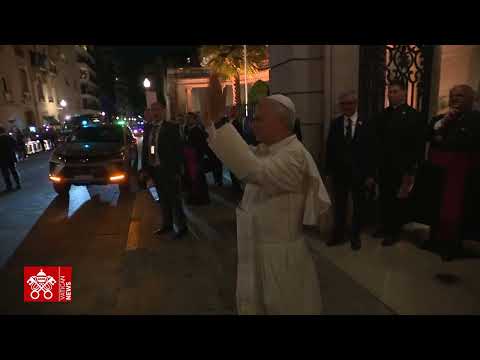
At about 7.45 pm the Pope walked to the Archbishop's House for a private dinner with the Argentine episcopate. Before dinner, from the balcony of the Archbishop of Buenos Aires's office, he briefly greeted the people gathered in the square. His words, as reported by Vatican News: "May the Lord's blessing reach the hearts of each of you and all your loved ones […] Everyone is welcome, and everyone is sent forth to proclaim the Good News with joy", echoing the motto of the journey. Back at the Nunciature, he greeted those present with a "good night" gesture.
🎥 Videos
▶
The Pope's greeting to Argentina: "Buenas noches, Buenos Aires"
▶
Highlights from Pope Leo XIV's second day in Argentina
📷 Photos
The Pope greets the faithful of Buenos Aires (Vatican Media)
"Thank you, Argentina": the Pope's greeting (Vatican Media)