Tuesday 10 November 2026 — Córdoba: Holy Mass at the Military Aviation School and vigil with young people
10:00
Escuela de Aviación Militar, Córdoba, Argentina
⛪ Holy Mass
Holy Mass at the Military Aviation School
📍 Escuela de Aviación Militar, Córdoba, Argentina
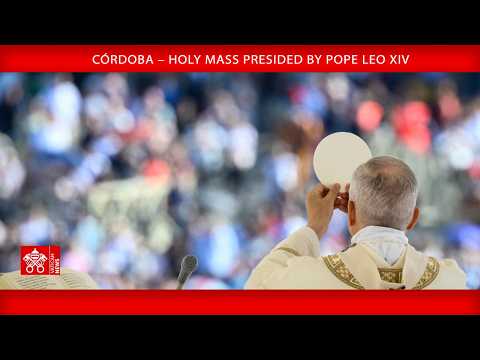
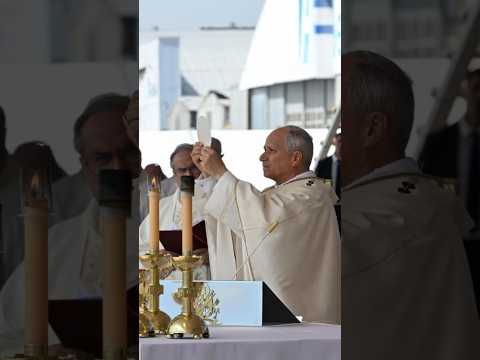
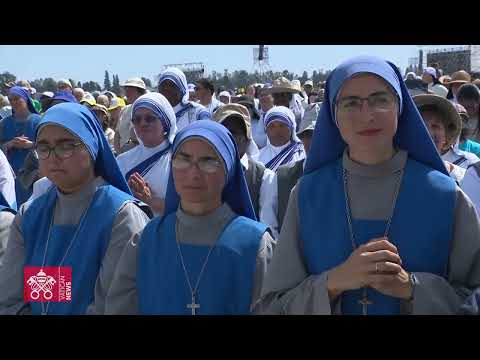
On the esplanade of the Military Aviation School, before some 650,000 people according to local authorities, the Pope rode among the faithful in an open car and presided at Mass on the memorial of Saint Leo the Great. The statue of Our Lady of the Rosary of the Miracle, patroness of the city, stood on the stage. In his homily he recalled Argentina's saints and blesseds, from Cura Brochero to Mama Antula, and urged: "Go and bring the Gospel!". At the end, Cardinal Ángel Sixto Rossi, Archbishop of Córdoba, thanked the Pope.
Peter's profession of faith, which resounds throughout history in his successors, reveals to us the mystery of God revealed in Christ for our salvation. This message of salvation remains vital today, upheld by the intercession of so many of our brothers and sisters in the faith, who accompany us today from heaven. It is…
Dear brothers and sisters,
Peter's profession of faith, which resounds throughout history in his successors, reveals to us the mystery of God revealed in Christ for our salvation. This message of salvation remains vital today, upheld by the intercession of so many of our brothers and sisters in the faith, who accompany us today from heaven. It is not surprising that the land that now welcomes us has borne rich fruits of holiness. The example of those who have gone before us on this path continues to inspire us to follow in their footsteps and to give our lives as Christ gave his for us, just as they so faithfully imitated him.
The city of Córdoba, the natural heir to the first episcopal see established in Argentina, has indeed been a home of saints. Through its convents and churches, streets and hospitals passed men and women who, filled with love for Jesus, gave their lives for the Gospel. Argentina was home to men and women such as Father Brochero and Mama Antula, to name but two, who were called by the Lord and sent on mission, without even realizing how extraordinary their evangelizing work would be. Indeed, we too, like all Christians, are merely humble servants, and all we must do is fulfil our duty (cf. Lk 17:10).
It is, then, a joyful duty to fulfill the mission that the Lord entrusts to each of us. Yes, dear brothers and sisters, we are all called to holiness. This is our task here on earth: to attain perfect union with God. Moreover, this calling is always missionary: we must make known to others the beauty that we have come to know in Christ (contemplata aliis tradere). As Christians, we must “teach what is consistent with sound doctrine” (Titus 2:1). For this reason, I now make my own the exhortation of Saint Leo the Great, whose liturgical memorial we celebrate today and to whose protection I entrust myself: “Christian, recognize your dignity and, now that you share in God’s own nature, do not return to your former base condition by sinning. Remember who is your head and of whose body you are a member. Never forget that you have been rescued from the power of darkness and brought into the light of the Kingdom of God” (Sermon 1, in Nativitate Domini, PL 54, 192-193).
There is no better way to teach than by setting an example with one’s own life, for “the world expects from us a lifelong commitment and a witness of prayer” (Saint John Paul II, Homily, “Vélez Sarsfield” Stadium in Buenos Aires, 10 April 1987). This demands unwavering, wholehearted commitment to Jesus Christ. This is the example the saints have given us, and it is something that inspires us to live with hope, even amid difficulties.
Today, here in Córdoba, at the geographic heart of the country, we wish to give thanks to God for the diverse fruits of holiness borne by the men and women whom the Lord sent to this land of Argentina — whether they were born here or spent most of their lives here. Just as Córdoba’s mountains are renowned for the beauty and harmony of their varied shapes and colors, so too are the Saints and Blesseds characterized by the different charisms and missions they received. They offer a polyphonic witness to the universal call to holiness of every baptized person: the call to be conformed to Christ. These saints, marked by their Argentinian identity, embody the unity between a passion for the Gospel and a commitment to building a fraternal and compassionate homeland. All of them knew how to rise to the challenges of their time, transforming them into opportunities to proclaim the Good News — not theoretically, but by shaping their lives to become credible and effective witnesses to Christ’s love.
Let us begin by gratefully honoring the memory of Saint José Gabriel del Rosario Brochero. This priest was truly in love with the Lord and knew how to draw strength for his life from prayer. The Spiritual Exercises of Saint Ignatius of Loyola changed his life forever and conformed him to Christ, making him a concrete example of what we prayed in the responsorial psalm: “Trust in the Lord, and do good” (Ps 37:3). Only those who have experienced friendship with Jesus Christ are capable of undertaking the task of evangelization; only those who know they are loved by the Lord are capable of extending his kingdom of charity and justice, devoting all their energies to proclaiming the Gospel, armed with nothing but the crucifix and the holy rosary.
Similarly inspired by Ignatian spirituality, Saint María Antonia de Paz y Figueroa, later known as Mama Antula, knew how to combine contemplation with service to neighbor. She recognized that the greatest act of fraternal charity is to bring others closer to God. As my revered predecessor Pope Francis reminded us, the poor need God and people who express the power of Christian love in their lives (cf. Message for the Third World Day of the Poor, 13 June 2019, 8). Following this same inspiration, Mama Antula tirelessly traveled the length and breadth of this country to show countless people the path to heaven. Indeed, her guiding principle was to go wherever God was unknown, in order to make him known.
Two saints, two examples, two ways of identifying oneself with Christ, were inspired by the Lord himself in this region where we gather today to worship him.
Together with them, we also give thanks to God for the martyrs who confessed their faith even to the point of laying down their own lives. Among them, we remember Saint Héctor Valdivielso Sáez and the Argentinian Blesseds who suffered martyrdom during the Spanish Civil War and in the Argentine provinces of La Rioja and Salta.
We thank the Lord for the gift he has given to the Church of shepherds after his own heart, such as Blessed Friar Mamerto Esquiú and Blessed Cardinal Eduardo Pironio.
We are particularly grateful for consecrated life, remembering the foundresses of religious congregations, such as Saint Nazaria Ignacia, Blessed María del Tránsito Cabanillas and Blessed Catalina de María Rodríguez. We also remember the many other religious women, such as Blessed María Ludovica de Angelis and Blessed Crescencia Pérez, who, moved by ardent charity, dedicated their lives to the education of children and the care of the sick.
Lastly, the faithful People of God rejoice in the laypeople who, having received the proclamation of the Gospel, lived out their baptismal vocation to the fullest, loving God and their brothers and sisters in the simplicity of daily life. Among them are Saint Artémides Zatti, Blessed Ceferino Namuncurá and Blessed Laura Vicuña.
Dear brothers and sisters, these Saints and Blesseds have already fulfilled their mission on earth. Today, it is our turn to follow the radiant example of holiness they have left with us. We celebrate this Holy Mass for the sanctification of the people of Argentina, for the sanctification of all of you. Open your hearts, and with God’s grace, go forth and be holy (cf. 1 Thess 4:3): at school and in the town square, in family life and with friends, in the countryside and in the city, on the farm and in the office. Go and evangelize!
Presiding over this celebration is the image of the poor Christ. Father Brochero himself had it carved while lying on his sickbed, and the features of the people of this land are artistically reflected in Christ’s face. Let his gaze challenge us, for in the shadow of his cross, we will find salvation and life, and the path to our own sanctification. Through the intercession of Saint Leo the Great, I ask God to continue to bless us and to give us the grace to always proclaim: “You are the Messiah, the Son of the living God” (Mt 16:16).
At 7:10 the Pope left the Nunciature for Aeroparque Jorge Newbery, where he took leave of some local authorities. He departed at 7:43 on an Aerolíneas Argentinas Boeing 737-MAX and landed at 8:57 at Córdoba's «Ingeniero Aeronáutico Ambrosio Taravella» International Airport, where he was welcomed by local authorities.
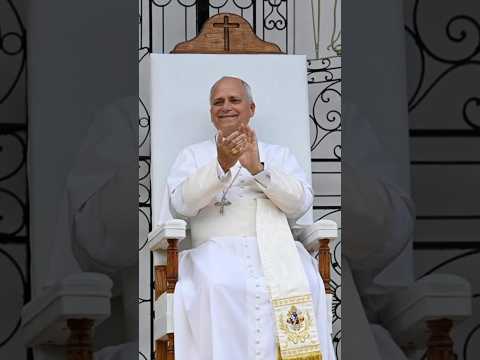
After Mass the Pope drives to the Archbishop's House in Córdoba, greeted along the route by thousands of people, and appears on the balcony for brief off-the-cuff remarks, as John Paul II did in 1987. "Look how many people have come out into the streets. Thank you for welcoming me... When we are united, we can accomplish anything. God is close to you and will always be present," he said, as reported by Vatican News. He then went inside for lunch.
📷 Photos
Leo XIV appears on the balcony of the Archbishop's Palace in Córdoba (Vatican Media)
Faithful gathered outside the Archbishop's Residence (Vatican Media)
📍 Cathedral of Nuestra Señora de la Asunción, Córdoba, Argentina
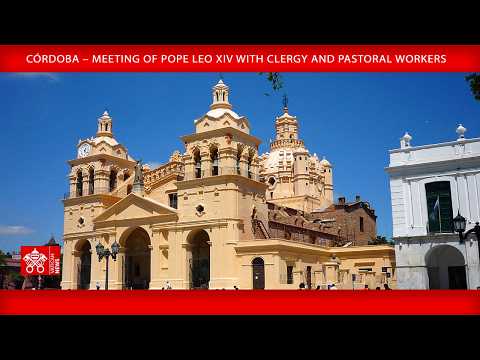
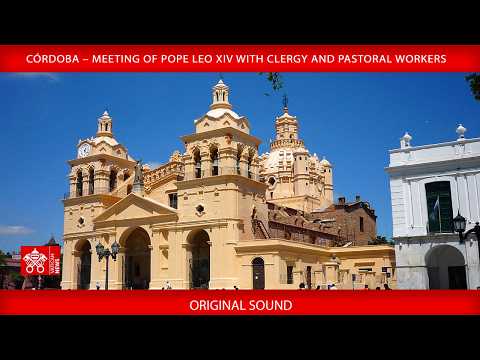
At 2:50 pm the Pope leaves the Archbishop's House and travels in an open car to the Cathedral of Nuestra Señora de la Asunción, where on the forecourt, before some twenty thousand faithful according to Vatican News, he meets bishops, priests, deacons, religious, seminarians and pastoral workers. After a welcome by Cardinal Ángel Sixto Rossi, Archbishop of Córdoba, and testimonies from a consecrated woman, a seminarian, a priest and a woman religious, he gives an address in Spanish structured around the stages of Saint Ignatius' Spiritual Exercises: "why are we here?", conversion, readiness to be sent, fidelity in trial. He recalls Mama Antula, Cura Brochero, Blessed Ceferino and Saint Héctor Valdivielso, mentions his "recent stay in hospital", encourages the use of technology to witness to the faith ("be creative") and invites them to dream of a Church that keeps "making a mess", as Pope Francis asked. The meeting ends with the blessing, a gift to the Pope and a final hymn; at 4:13 pm the Pope leaves for the airport.
🎥 Videos
▶
Meeting with clergy in Córdoba (full, English commentary)
▶
Highlights from the Pope's meeting with clergy and pastoral workers
▶
Highlights of the meeting with clergy in Córdoba
▶
Meeting with clergy in Córdoba (full, original audio)
▶
Pope to Argentina's clergy and religious: 'Let us not give up!'
📷 Photos
The Pope arrives on the forecourt of the Cathedral of Our Lady of the Assumption (Vatican Media)
The Pope meets bishops, priests, deacons, religious, seminarians and pastoral workers (Vatican Media)
The Pope, with Cardinal Sixto Rossi, listens to Laura Sampallo's testimony (Vatican Media)
The Pope greets seminarian Julián Pereyra after his testimony (Vatican Media)
Leo XIV blesses Father Martín Carranza after his testimony (Vatican Media)
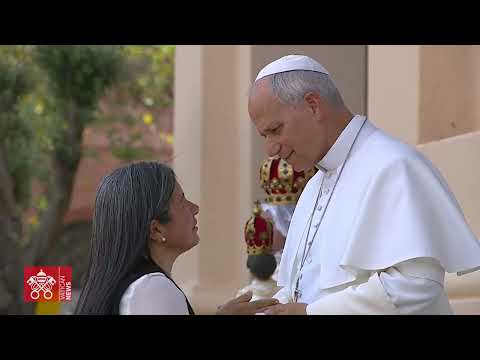
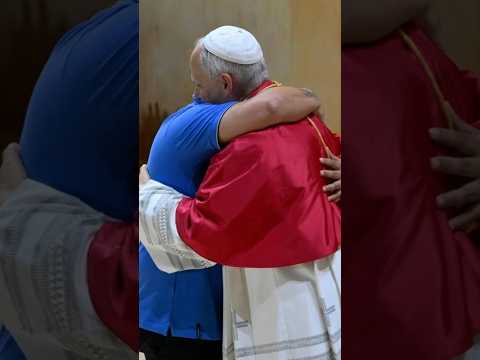
The Pope embraces Sister María Elisabeth Torres (Vatican Media)
The Pope delivers his address to the clergy (Vatican Media)
Taking his leave, the Pope greets the faithful and women religious (Vatican Media)
The Pope arrives on the forecourt of the Cathedral of Our Lady of the Assumption (Vatican Media)
The Pope arrives on the forecourt of the Cathedral of Our Lady of the Assumption (Vatican Media)
Address to bishops, priests, consecrated persons, seminarians and pastoral workers in Córdoba
Dear brothers and sisters in Christ Jesus,
I would like to begin by thanking Cardinal Rossi for his words, as well as those who have shared their testimonies and everyone for their warm welcome. I am very pleased to be here today with all of you, those of you in consecrated life, seminarians, priests, and all the baptized, who have dedicated your
Dear brothers and sisters in Christ Jesus,
I would like to begin by thanking Cardinal Rossi for his words, as well as those who have shared their testimonies and everyone for their warm welcome. I am very pleased to be here today with all of you, those of you in consecrated life, seminarians, priests, and all the baptized, who have dedicated your lives to the service of the Lord and his people.
During that last song, many of you had your hands in the air — perhaps to greet me, perhaps to sing along. These are the hands that Jesus is looking for, and he wants your hands to carry on his mission.
As I was preparing these remarks, the Spiritual Exercises — so deeply rooted in the history of this land — came to mind. It was a happy coincidence to hear Sister María Elisabeth recall one of her meditations. When the practice was in danger of being lost, Mama Antula traveled great distances to keep it accessible to everyone. Decades later, Saint Joseph Gabriel of the Rosary made them a central part of his ministry. He crossed the mountain ranges alongside his fellow countrymen all the way to this city so that they might encounter God personally. More recently, an Argentine Jesuit, Pope Francis, brought with him the richness of Ignatian spirituality and shared it with the universal Church.
Even today, priests, seminarians, religious communities and laypeople set aside time to observe silence and ask themselves anew before God what he wants from their lives. I would therefore like to allow some of the questions from the Exercises to accompany us this afternoon. Saint Ignatius begins with the Principle and Foundation (cf. n. 23). The first question is this: Why are we here? Before we undertook any responsibility, ministry or task, there was a call. Christ passed through our lives one day and called us, and we realized that it was worthwhile to follow him. Everything that comes afterward should continue to spring from that first “yes.”
Over the years, something paradoxical can happen: we work hard for God yet spend less and less time with him. We continue serving, celebrating and attending to so many necessary tasks, but we may end up relying more on what we do than on the One for whom we do it. The Principle and Foundation then puts everything back in its proper place: our life belongs to God and finds its order only when everything else has him as its center. Let us therefore simply return to the Eucharist, to listening to the word and to that relationship with the Lord that sustains everything else. Let us tend to the fire that once kindled our vocation and not allow the pressures of daily life, weariness or routine eventually to extinguish it.
During the Exercises, we are faced with questions we cannot avoid: What has become disordered within us? In what ways have we failed God? (cf. nos. 32–43). After a few or many years of having said “yes” to the Master, we may have grown accustomed to things that would once have troubled us, such as harshness toward others, resistance to being corrected, rivalries, attachments, sins or clinging to things that gradually rob us of our freedom. Something even more serious can happen: that we learn to justify everything, finding “pastoral reasons” or communal or personal motives for doing what we know is wrong.
We also fail when we do not do the good that is required of us, when we no longer listen patiently, when we choose comfort or when we remain silent in the face of something we should address. There is no age at which conversion is unnecessary. We need to examine our consciences, go to confession and be humble enough to allow ourselves to be corrected. Dear brothers and sisters, let us have the courage clearly to acknowledge where we have been unfaithful to God and to place this before his mercy.
It is precisely only after we have clearly confronted our own sin that Saint Ignatius places us before Christ, the eternal King (cf. nos. 91–98), who continues to call and to send us forth. The Lord knows of what we were made, and yet he still chooses to count on us (cf. 2 Cor 4:7). The question, therefore, is not how much we have failed him, but whether we remain available to him. At the start of our vocation, we tend to offer everything. Then the years go by, and our own preferences set in. We find the places where we feel comfortable and we adopt a certain idea of how our own story should unfold. Can the Lord still send us where we had not planned to go? Can he ask us to leave behind something to which we have devoted years, or to accept a task we would never have chosen?
It is this freedom that is purified through the meditations on the Two Standards, the Three Classes of Persons, and the Election (cf. nos. 136–189). We learn to recognize what binds us, what conditions our decisions and to what extent we are willing to let God work in our lives. Indeed, we have been sent to a people, and we must ask ourselves what we are called to offer them. Dear seminarians, learn to see through God’s eyes and to allow yourselves to be evangelized by his people. Even those who have the least can teach us a great deal, as Julian discovered at Mass.
The pilgrim Church in Argentina is enriched by a deep sensitivity to the social needs of its children. From this sensitivity have sprung so many generous efforts to stand alongside those who suffer. However, this closeness must take us even further, because every person we serve is called to encounter Christ and to be transformed by him. Pope Francis expressed this in words that deserve to be remembered: “the worst discrimination which the poor suffer is the lack of spiritual care” (Evangelii Gaudium, 200).
Hunger and injustice are pressing and demand a response. So too do illness, loneliness, unemployment and the lack of dignified housing. Christian charity is deeply committed to addressing all of these. At the same time, we must not forget that those who suffer need to receive from us the greatest gift the Church possesses, namely Jesus Christ. My beloved predecessor expressed this with particular clarity: “The Church is not a business; it is not a humanitarian agency; the Church is not an NGO; the Church is sent to bring Christ and his Gospel to everyone… If, hypothetically, it were ever to happen that the Church did not bring Jesus, she would be a dead Church” (General Audience, 23 October 2013). Therefore, how great is our vocation! We are called to make it possible for people to encounter Christ through the word, the sacraments and a closeness that helps them to recognize his presence in their own lives. The people entrusted to you long to receive from you what the Church has been preserving for them for centuries.
After the Election, the Spiritual Exercises lead the retreatant to remain with Christ in his Passion (cf. nos. 190–217). Those who have chosen to follow the Lord now learn to be with him, even when following him means enduring the cross (cf. Lk 9:23). Our vocation also has such moments, for example, when there is no visible fruit of our efforts, when service is difficult and when fidelity is no longer sustained by the enthusiasm of the early years. Many of you are well acquainted with this form of exhausting fidelity: continuing to pray when prayer becomes arid and continuing to serve when, no matter how hard you work, it seems that nothing changes. There are stages in priestly and consecrated life in which simply persevering is already a very concrete form of self-giving. Even amid doubts and weariness, one continues to say with one’s life: “Here I am.”
Saint Héctor Valdivielso Sáez, the first Argentine saint, is a model of that fidelity. He was only twenty-four years old and had barely completed his annual Spiritual Exercises when what he had just placed before God became what sustained him in the trial. Prayer became his witness, and that witness led him to the point of shedding his blood.
There are also other ways to bear witness, including by persevering in the midst of suffering. Laura and Father Martín have made me reflect on my recent hospitalization. I also recall Father Brochero, who, though blind and suffering from leprosy, continued to serve his people. In our day, the idea of using technology to continue bearing witness is wonderful; be creative and find new ways to keep preaching. Dear friends, remember that the way we live out our vocation is what evangelizes. Neither age nor physical limitations can extinguish our zeal. Our strength may run out, but God’s power never will.
That power is revealed in the Lord’s Resurrection. Saint Ignatius leads the retreatant to the risen One and asks him to contemplate how Christ exercises the “office of consoler” (no. 224). There he teaches us to discover where the Master is at work and to receive from him the strength to return to the mission. The pilgrim Church in Argentina also needs to look at herself, gratefully recognizing what God is already bringing about within her and asking herself where he wishes to open new paths. The risen One is already there, and he goes before us (cf. Mt 28:7).
At the end of the Spiritual Exercises, the Contemplation to Attain Love invites us to reflect on how much we have received from God (cf. nos. 230–237). In the face of so many gifts, Saint Ignatius proposes this response: “Take, Lord, and receive…” (no. 234). The retreat’s journey ends where it all began, with a life once again placed at God’s disposal, with all of its possibilities and limitations. Perhaps the question we should try to answer today is: Can the Lord still make use of me? If the answer remains “yes,” then there is much ahead of us. Let us not give up! Jesus continues to walk with his Church and to make fruitful the lives of those who place themselves in his hands.
Argentina knows well what God can do with a life that is open to him. Mama Antula arrived in Buenos Aires barefoot and with nothing but a crucifix. She carried little, but it was enough to get started. Father Brochero kept preaching, even though often only God and his mule were witnesses to his weariness. Blessed Ceferino died before he turned nineteen; he did not have time to grow old, but he did have time to make it very clear for whom he wanted to live. God continues to pour out his grace and wants to count on you to spread it from La Quiaca to Ushuaia, and to the very ends of the earth (cf. Mk 16:15).
Dare to look at Argentina through the eyes of God! Dream of young people asking themselves if Christ is calling them; of parishes that are vibrant communities of faith; of religious families that have the boldness of their founders; of seminaries and novitiates where saints are formed. Dream of a Church that continues to make noise, just as your fellow countryman Francis asked you to! (cf. Meeting with Young People from Argentina, Rio de Janeiro, 25 July 2013). A noise that brings the Church into every corner and makes the Gospel of Jesus Christ resound everywhere.
Dear brothers and sisters, if the Spiritual Exercises teach us anything, it is that after examining our own lives before God, we must return to them transformed. Let us return to our communities with hope, freedom and a desire to continue serving. Perhaps we will not see all that God will do with what we sow today; nor did those who came before us see it, but without their dedication, we would not be here today.
May God find in us men and women willing to follow him and to be shaped by his love — people who do not “give up” until they become holy. The Lord has done great things in this land, and I am convinced that he will do many more. May Our Lady of Luján accompany us on this journey and help us to tell the Lord, through our lives, that he can continue to count on us. Thank you very much.
At 4:13 pm the Pope leaves the Cathedral for Ingeniero Aeronáutico Ambrosio Taravella International Airport, where he takes leave of some local authorities. He departs at 4:59 pm on an Aerolíneas Argentinas Boeing 737-MAX and lands at Aeroparque Jorge Newbery in Buenos Aires at 6:03 pm, then travels by car to the Apostolic Nunciature.
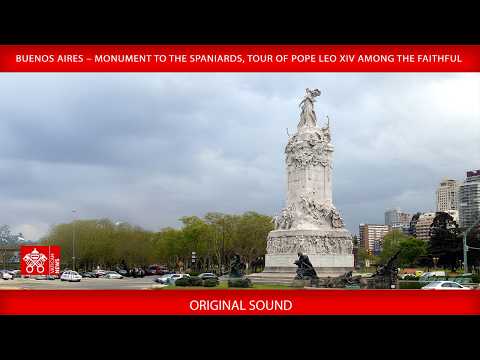
📍 Monumento de los Españoles, Buenos Aires, Argentina
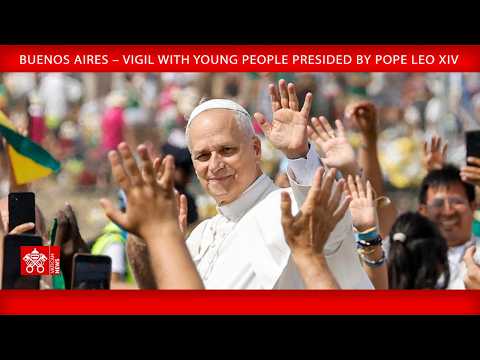
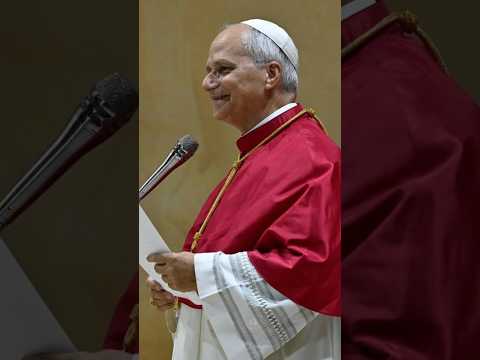
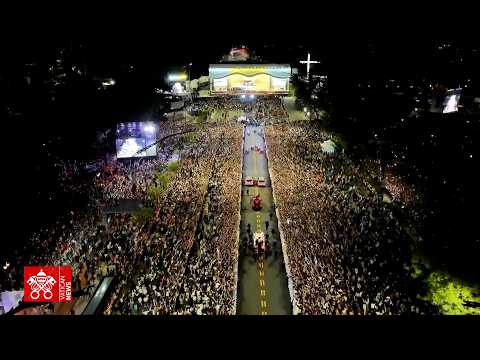
At 7:45 pm (11:45 pm Rome time) the Pope leaves the Nunciature and drives to the Monumento de los Españoles where, after an open-car tour among the faithful, he is welcomed by the Archbishop of Buenos Aires, Jorge Ignacio García Cuerva. According to the Holy See Press Office bulletin, about one million people attended. After the Archbishop's greeting and the testimony of Cristian, a young man recovering from addiction, the Pope answers a question from Agustina, who serves people in difficulty; after the testimony of Guadalupe, who is in vocational discernment, he answers Franco. Then come songs, folk dances, a tango performance and the gesture of light with candles. In his address, in Spanish, the Pope starts from the three young men thrown into the furnace in Babylon for refusing to worship the golden statue and invites young people to remain "standing" before today's idols (success at any cost, money, appearance, pornography and drugs). He takes up Pope Francis' "todos, todos, todos" from Lisbon: everyone towards Christ, everyone with Christ, everyone like Christ. He repeats the question that changed Guadalupe's life ("Who told you it was too late?"), invites them to Reconciliation and holiness, and entrusts them with the motto "Go and proclaim!". He blesses the cross that will travel through Argentina's communities; the vigil ends with the Our Father and the blessing. At about 10:10 pm the Pope returns to the Nunciature.
🎥 Videos
▶
Vigil with young people in Buenos Aires (full, English commentary)
▶
Pope to Argentine young people: 'Who told you it was too late?'
▶
Highlights of the vigil with young people
▶
Vigil with young people (full, original audio)
▶
Popemobile tour at the Monumento a los Españoles
▶
Young people wait for the prayer vigil with the Pope
▶
Highlights of Pope Leo XIV's prayer vigil in Buenos Aires
📷 Photos
The stage for the vigil with the Pope at the Monumento a los Españoles (Vatican News)
The long popemobile tour among the young people (Vatican Media)
Pope Leo on stage during the vigil (Vatican Media)
The Pope with the Archbishop of Buenos Aires, Jorge Ignacio García Cuerva (Vatican Media)
Guadalupe, who shared her vocational choice (Vatican Media)
The cross blessed by the Pope, which will travel through Argentina's communities (Vatican Media)
The Pope and the Archbishop bless the youth cross (Vatican Media)
An artistic performance during the vigil (Vatican Media)
Enthusiasm as the Pope passes by (Vatican Media)
The Pope blesses a little girl outside the Nunciature (Vatican Media)
The long popemobile tour among the young people (Vatican Media)
The long popemobile tour among the young people (Vatican Media)
The long popemobile tour among the young people (Vatican Media)
Address of the Holy Father at the Vigil with young people in Buenos Aires
Thank you very much! Thank you, everyone!
Dear young people, dear friends, welcome, everyone!
It is a joy for me to be here once again, this time to meet with all of you. Good evening! The Monument of the Spanish features sculptures representing four great regions of Argentina: the Andes, the Chaco, the Pampas and the Río de la Plata. How beaut
Thank you very much! Thank you, everyone!
Dear young people, dear friends, welcome, everyone!
It is a joy for me to be here once again, this time to meet with all of you. Good evening! The Monument of the Spanish features sculptures representing four great regions of Argentina: the Andes, the Chaco, the Pampas and the Río de la Plata. How beautiful that there are so many young people who come from these regions! I greet you all.
Thank you for this warm welcome, as well as for your questions and testimonies. I also thank Archbishop García Cuerva, Archbishop of this city, for his kind words. We wanted to begin this gathering with a sign: the flame of our candles. Let us listen to Jesus’ words: “I came to bring fire to the earth, and how I wish it were already kindled!” (Lk 12:49). It is the fire of his love, communicated through the Holy Spirit, which purifies our hearts and makes us capable of loving.
I would also like to speak to you about another fire: the one in a furnace in Babylon. The Book of the Prophet Daniel (cf. 1:3-7, 17-20; 2:49; 3:1-93) tells us the story of three young men: Hananiah, Azariah and Mishael. They were living in exile in that land, where they learned another language, received new names and found a place in the administration of the kingdom. They had a future ahead of them. Then came the day when they had to decide to whom they would give their hearts. King Nebuchadnezzar had erected an immense golden statue and ordered everyone to bow down before it. Anyone who refused would be thrown into a blazing furnace. Imagine the scene: a multitude bowing before the colossal statue, while only three young men remain standing.
The king offered them one last chance. All it would take was a single gesture for them to continue living their lives in peace. The young men replied that God could deliver them from the fire, but they added: “But if not” (3:18), they would still not worship the statue. What freedom there is in that response! They did not know what was going to happen. They knew the punishment that awaited them, but they also knew that they would find happiness only in God.
Dear friends, today too, idols arise and demand our worship: success at any cost, money, an obsession with appearance, popularity or the unrestrained pursuit of pleasure. Sometimes, in order to win the approval of others, we may go so far as to lie, betray or humiliate someone on social media. Envy can prevent us from rejoicing in the good of another, while selfishness can lead us to treat people as objects. There are also those who make a business of offering pleasures that ultimately enslave us, such as pornography and addictive substances. Agustín told us: “Today I stand firm.” How powerful those words become when we remember the three young men in Babylon! You too are called to stand firm before the idols of our time. Do not bow down before anything that cannot give you life. And if you have ever fallen, get back up. Do not allow anything or anyone to take away the freedom God has given you.
During World Youth Day in Lisbon, Pope Francis spoke words that spread throughout the world: “Everyone, everyone, everyone!” (Welcome Ceremony, 3 August 2023). He repeated them with his characteristic insistence, as though he wanted to make sure that no one had failed to hear them. I would like to draw inspiration from those words to speak about what it means to live as disciples of Jesus: everyone toward Christ, everyone with Christ, everyone like Christ.
First of all, everyone toward Christ. Some of you have grown up close to Jesus, and others are only now beginning to seek him. Others still have not prayed for a long time, or have drifted away from the Church, or have been hurt by people who should have accompanied them. To each of you I would like to say that there is a place for you in the Church, with your questions, your wounds and your story. This is your home too. You do not have to pretend that everything is fine or wait until you have your life sorted out before drawing near. And to you, who think it is already too late to begin again, I would like to say: welcome. Whoever you are and whatever you may have done, Jesus Christ knows you, Jesus Christ loves you and wants you to be close to him.
As we have heard, one question changed Guadalupe’s life: “Who told you it was too late?” Tonight, I would like to repeat that question to those who believe they have strayed too far and to those who have at some point perceived from others that there was no place for them in the Church. The Lord is seeking you! Remember Zacchaeus. He climbed a tree to see Jesus and discovered that Jesus was also looking for him. Jesus called him by name and wanted to stay at his house. That encounter led Zacchaeus to make amends for the injustices he had committed (cf. Lk 19:1-10). No one has fallen so low that Christ cannot raise them up. May our communities always keep their doors open; may they know how to welcome those who arrive with questions, assist those who suffer and patiently accompany those who are seeking God.
Now let us return to Babylon. The three young men were bound and thrown into the furnace. The flames rose with such violence that they reached those who were carrying out the sentence. But the king saw something beyond comprehension: he had thrown three men into the furnace, yet now he could make out four, walking freely amid the flames, for the Lord had sent his angel to protect them. They had been thrown in bound, but now they were walking freely! The king had condemned them to the fire, but God had not abandoned them. Here we find our second “everyone”: everyone with Christ.
We know the full meaning of that gesture. Humanity had been subjected to death because of sin, but God came to meet us. The Son of God became man, shared our sufferings and took our sins upon himself. Out of love for us, he gave his life on the Cross and rose again on the third day. Jesus Christ is alive! Jesus Christ He has conquered death and set us free from its power. Dear young people, Christ loves us and wants us to share in his own life. He has promised to remain with his disciples until the end of the age (cf. Mt 28:20). Christ offers you a life that not even death can take away.
There is one detail in the story that moves me deeply. From within the furnace, Azariah raised a prayer: “With a contrite heart and a humble spirit may we be accepted” (Dan 3:39). That young man had stood up to the king, yet he acknowledged before God his need for mercy. What an admirable prayer! We too need to pray it. We all know the distance that sometimes exists between the good we desire and the choices we make. And we all need conversion.
Christ loves us as we are, but his love is too great to leave us prisoners of sin, of what destroys us. The fire he came to bring has the power to break our chains and restore our freedom to love. There are wounds to be healed, failings to be acknowledged and, whenever possible, wrongs to be made right. Allow Christ to transform you. Do not be afraid to approach the Sacrament of Reconciliation. How wonderful it is to know that our sins can be forgiven. Pray, read the Gospel and draw near to the Eucharist. The One who gave his life for us awaits us.
In the midst of the furnace, the three young men began to sing. They invited the heavens and the stars, the mountains, the rivers and all living creatures to bless the Lord. They even said: “Bless the Lord, fire and heat” (3:66). They were inviting the very fire that surrounded them to join in their praise. Their song grew ever wider until it embraced all of creation. I like to think that this song continues to this day, and that every generation can add its own voice to it. How beautiful it would be if everything we do could become an act of praise. Perhaps today we could sing: Art and culture, bless the Lord. Games and sports, bless the Lord. Science and technology, bless the Lord. Social media and screens, bless the Lord. Music and soccer, bless the Lord. Let everything that exists bless the Lord and praise him with hymns forever!
At the beginning of the story, the king had ordered everyone to worship his statue. At the end, those young men invited everyone to bless the Lord. The king needed threats to make people bow down; the young men, who had no power other than their faith, invited the entire universe to share in their joy. And so we arrive at the third “everyone”: everyone like Christ.
Dear young people, whoever encounters Christ is called to live as he did (cf. 1 Jn 2:6). And that is what I would like to invite you to do tonight: become saints. The saints too knew their weaknesses, but it was God’s grace that transformed their lives and taught them how to love. Jesus showed us the way: “Just as I have loved you, you also should love one another” (Jn 13:34). Behind that “just as” lies an image we should never forget: Jesus kneeling before his disciples to wash their feet. The Lord of everyone became the servant of everyone.
You too can wash the feet of your brothers and sisters. Share your bread with those who are hungry, open your doors to those who have no home, visit the sick and those whom no one wants to visit. There are also forms of suffering that cannot be seen: some need guidance or correction, others await words of consolation, and still others need to know that they are loved. The Lord gives us so many opportunities to be like him. May your lives become pages of the Gospel, written in the ink of mercy, so that those who meet you may recognize in you something of the love and joy of Jesus.
Our joy is born of friendship with him and impels us to bring him to others. Remember the disciples on the road to Emmaus. When they recognized the Risen Lord in the breaking of the bread, they said to one another: “Were not our hearts burning within us while he was talking to us on the road?” (Lk 24:32). That very night they returned to Jerusalem. They could not keep to themselves the joy of knowing that Christ was alive! At the beginning, I said to you: “Welcome, everyone!” Now, as the Successor of Peter, I entrust to you the second part of our motto: “Go and proclaim!” Go to your cities and towns, to every corner and every periphery. May those who feel far from God discover through you that Christ is seeking them.
In a little while, I will bless the cross that will travel through your communities. As that cross passes from one pair of hands to another, may the fire of Christ’s love also pass from one heart to another. May Our Lady of Luján accompany you and always guide you along this path: everyone towards Christ, everyone with Christ, everyone like Christ! Go and proclaim!
The Holy Father's answers to young people during the Vigil
1. Agustina Flores: Holy Father, how can we cope with frustration and our own limitations when we reach out to those who are most excluded, yet are unable to accompany them as we would wish? How can we continue walking by their side when we feel that what we do is not enough?
First of all, good evening, and thank you! What a wonderful welcome — o
1. Agustina Flores: Holy Father, how can we cope with frustration and our own limitations when we reach out to those who are most excluded, yet are unable to accompany them as we would wish? How can we continue walking by their side when we feel that what we do is not enough?
First of all, good evening, and thank you! What a wonderful welcome — one that perhaps only Argentina can give!
Thank you for your question, Agustina, and for the affection you show those young people. I understand how you feel. I know it is difficult, but do not lose hope. Saint Ignatius of Loyola used to say: “Act as if everything depended on you, knowing that in reality everything depends on God” (cf. P. de Ribadeneira, Life of Sain Ignatius, V, XI). Do all that you can, put your whole heart into it and join your efforts to those of others. When you come to the end of your strength, remember that God’s strength never runs out. Jesus spoke to us of a seed that grows while the sower sleeps (cf. Mk 4:26-27). We will not always see the fruits of what we sow, but we can trust that God continues to look after them. So keep Saint Nazaria’s words close to your heart: “Onward, always onward!” The Lord walks with you!
2. Franco Pugliese: Holy Father, how can I bring together these two aspects of my life: the love I experience in the parish and at home, and my work responsibilities and the other demands of everyday life?
I would like to thank you for your testimonies and your questions. After listening to Guadalupe, I would like to take the opportunity to say that I know there are many young people who feel called to give their lives to Christ, in the consecrated life, in the priesthood and also in family life. Indeed, Christ continues to call. Do not be afraid to respond!
Thank you for this question, Franco. Think of the years Jesus spent in Nazareth, working with his hands and sharing in family life. The Son of God chose to live in this way! He taught us that we can encounter him even in the ordinary things of life. That is why we do not have to live two separate lives, one for God and another for our daily occupations, as if they were somehow at odds with one another. When you work, study or spend time with your friends, do so with love and offer it to the Lord. In this way, your work too becomes prayer and a path to holiness. So, Franco, bring your whole life to the altar each time you take part in the Eucharist. Then return to your daily occupations with joy, knowing that Jesus is waiting for you there too. Thank you very much.
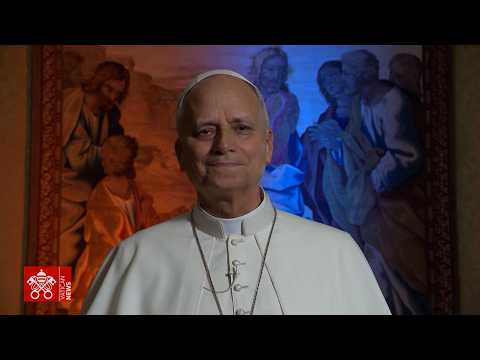
Video message in English to participants in the Council of the International Catholic Migration Commission (ICMC), meeting in Rome from 10 to 12 November on the 75th anniversary of its founding by Pius XII. The Pope quotes Dilexi Te ("In every rejected migrant it is Christ himself who knocks at the door") and calls for new ways to care for displaced children.
Video message to participants in the Council of the International Catholic Migration Commission
Dear brothers and sisters in Christ,
I warmly greet all of you who are taking part in the plenary meeting of the Council of the International Catholic Migration Commission, which happily coincides with the seventy-fifth anniversary of the Commission’s founding by my predecessor, Pope Pius XII.
As representatives of Episcopal Conferences and Churc…
Dear brothers and sisters in Christ,
I warmly greet all of you who are taking part in the plenary meeting of the Council of the International Catholic Migration Commission, which happily coincides with the seventy-fifth anniversary of the Commission’s founding by my predecessor, Pope Pius XII.
As representatives of Episcopal Conferences and Church institutions from around the world, accompanied by the Dicastery for Promoting Integral Human Development, you will have the opportunity in these days to share perspectives on the Church’s pastoral care of migrants and refugees. Together, you will discern the challenges and opportunities that human mobility presents to our societies and to the Church’s mission.
In this regard, I would recall the words of my Apostolic Exhortation Dilexi Te: “In every rejected migrant it is Christ himself who knocks at the door” (no. 75). I invite you, therefore, to deepen your reflection on the Gospel’s call to recognize the face of our Savior in every person, especially in each migrant, refugee, displaced person or survivor of human trafficking.
Your meeting takes place at a difficult time. Wars, violence, injustices, natural disasters and widening social and economic inequalities are forcing millions of people to flee their homes and nations. This creates humanitarian and social challenges for communities in countries of origin, transit and destination alike. Moreover, such circumstances are compounded by a marked decline in funding for international protection and assistance. This makes it all the more important to foster the values of understanding, dialogue and solidarity.
Faced with these challenges, I urge you to persevere in your noble and important mission of strengthening the Church’s services to welcome, protect, promote and integrate migrants, refugees and returnees. I likewise encourage you to advocate courageously for the recognition and respect of their God-given dignity, in cooperation with other faith-based organizations and civil society in general.
In particular, I pray that your efforts will help find new ways to care for displaced children. Indeed, since their number tragically continues to grow, it is necessary to work with their countries of origin in order to remove the causes that compel them to flee, while also offering them protection and welcome in the countries of transit and destination (cf. Message for the 112th World Day of Migrants and Refugees, 27 September 2026).
In conclusion, dear friends, I entrust your deliberations to the maternal intercession of the Blessed Virgin Mary, Solace of Migrants, and I willingly impart my Apostolic Blessing to each of you, your families and the worldwide ICMC family.
May Almighty God bless you, the Father, and the Son, and the Holy Spirit. Amen.