Wednesday 11 November 2026 — Devoto prison, Mass in Luján before two million faithful, farewell to Argentina and arrival in Lima
10:00
Square in front of the Basilica of Our Lady of Luján, Argentina
⛪ Holy Mass
Holy Mass in front of the Basilica of Our Lady of Luján
📍 Square in front of the Basilica of Our Lady of Luján, Argentina
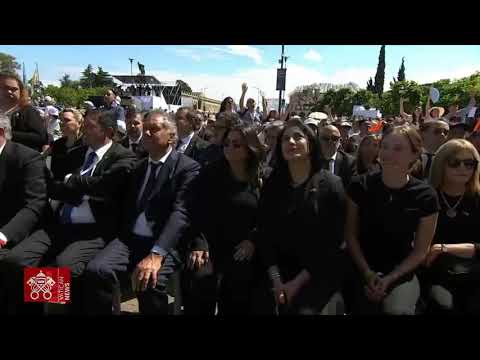
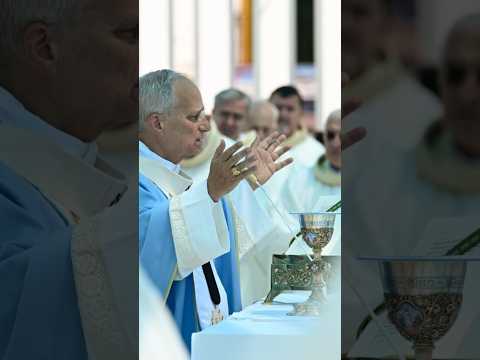
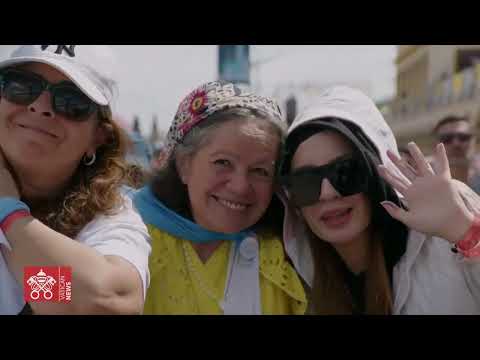
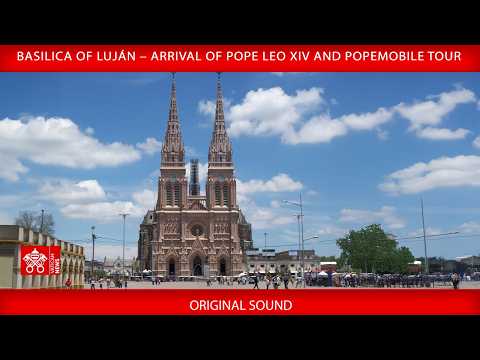
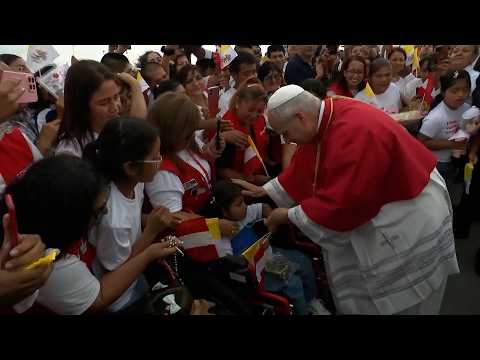
After an open-car tour among the faithful, at 10:00 a.m. the Pope presided over Mass on the square of the Basilica of Our Lady of Luján, attended – according to local authorities – by more than two million people, with the statue of the Virgin brought onto the stage. In his homily he remembered Pope Francis and proposed a four-step journey, the same as in every Eucharist: reconciliation, enlightenment through the word of God, communion and being sent on mission ("Argentina, rise up and walk"), closing by entrusting the country and his pontificate to the Mother of Luján. After words from Archbishop Jorge Eduardo Scheinig of Mercedes-Luján, the Pope thanked Argentina and bade farewell; at about 11:55, after presenting his gift and the Golden Rose, he left the Basilica.
The reading from the prophet Isaiah that we have just heard invites us to imagine different types of terrain: the desert, the steppe and the mountain. All of them are called to bloom and sing for joy as they reflect the glory of God. Let us also consider today this beautiful country and the varied geography with which
Dear brothers and sisters,
The reading from the prophet Isaiah that we have just heard invites us to imagine different types of terrain: the desert, the steppe and the mountain. All of them are called to bloom and sing for joy as they reflect the glory of God. Let us also consider today this beautiful country and the varied geography with which the Creator of the universe has adorned it: vast plains and mighty rivers, numerous mountain ranges, green plateaus and broad plains, deep seas, majestic glaciers and vast deserts. In all of its splendor and beauty, the entire land at the “end of the world” sings of the Lord’s glory.
Isaiah goes on to say that just as God causes water to spring forth in the parched land, making it more fertile, so too does he quench the deep thirst of human beings and heal them of their illnesses, opening the eyes of the blind and the ears of the deaf. Dear brothers and sisters, these images speak to us of a new era and a promise of liberation. Do not be afraid, God is with us. Rejoice and be strong with the strength that comes from the Lord.
During these days, I have been able to see the richness of Argentina — not only in its geography but also in its people, in each one of our encounters, in the squares and streets and in the creativity, the spontaneity and the life that overflows at every turn. In the Magnificat that we have proclaimed as the Responsorial Psalm, the Virgin Mary likewise overflows with joy in the Lord and praises him for the wonders that he works in her. I thank God for the opportunity to meet this beloved people who open their doors to everyone and who share their bread as well as their music. In this country there is always a place at the table for the newcomer, time is set aside to chat “between sips of mate,” and a helping hand is extended to those in need.
Today, at the house of Our Mother of Luján, my thoughts turn in a special way to our beloved Pope Francis, who always carried the Patroncita morena in his heart. He taught us through his life always to love and venerate her. He continues to teach us this lesson from the place he chose for his burial, which is located so close to an icon of the Blessed Mother. In fact, his parting words were often: “May Jesus bless you and may the holy Virgin watch over you.”
With a heart full of gratitude for the many gifts that God has poured out upon this country, on this occasion I would like to propose to you a journey that is the same as the one we experience in the celebration of every Eucharist. It consists of four steps: reconciliation, enlightenment through the word of God, communion, and being sent forth on mission. Mary, standing at the foot of the Cross, unites herself to the Eucharistic Sacrifice and accompanies us on this journey (cf. Saint John Paul II, Ecclesia de Eucharistia, 56-58).
Many of our brothers and sisters — or even we ourselves and our families — may currently be living through moments of Calvary, suffering from illness, poverty, unemployment, discrimination or family breakdown, among other problems. In those dark moments, we understand Mary’s experience at the foot of the Cross, with her mother’s heart torn with grief. In that most terrible moment of her life, Mary received a new mission from her Son, embracing all humanity in her mother’s heart. We are likewise called to receive God’s grace and to undergo processes of forgiveness and reconciliation that renew peace, hope and charity within us. Let us be sincere, acknowledge our faults and ask the Lord for forgiveness; forgiveness for that beggar, for that tear I caused to fall; forgiveness for those eyes that, when they met mine, I refused to look at (cf. Zamba del perdón). We also need to reconcile ourselves with our past and present, in order to build a new future where love has the final word.
Let us also recall the experience of the disciples on the road to Emmaus. They were walking along with sad faces, and were discouraged and weighed down by the harsh reality of the Lord’s death. At that moment, the risen Jesus appeared and explained the Scriptures to them. When they shared a meal together, they recognized his presence, which had set their hearts on fire (cf. Lk 24:13-35). Dear brothers and sisters, that is often our experience too, for we also can feel tired, disappointed or disoriented. We need a compass, a guide, and indeed we already have it in Sacred Scripture! Let us allow ourselves to be enlightened by it, for the word of God is a lamp for our steps and a light to our path (cf. Ps 119:105).
As a third step, after reconciliation and enlightenment through the word, we are called to communion. Christ himself invites us to his table, and at that table we are all welcome (cf. Mt 22:9-10). There is a place for everyone, especially for those who are most in need: the poor and the hungry, migrants, the sick and prisoners, with whom the Lord identifies (cf. Mt 25:35-40). Indeed, “the Eucharist, which is the sacrament of unity, nurtures our belonging to the Body of Christ and teaches us how to share. The diverse sensibilities present in the Church and the strong convictions that animate each person are a source of richness if they remain anchored in the certainty that unity is a gift received and a responsibility to be fulfilled” (Magnifica Humanitas, 88). Communion with Christ does not cause us to withdraw into our personal affairs, nor does it lead us to take advantage of others’ needs or allow us to shirk our responsibilities. Rather it impels us to be an active part of a community, to share the gifts we have received freely, and to offer what little we have for the good of many.
We are invited to demonstrate charity in the manner of Christ. Mary also teaches us that way at the foot of the Cross, for there on Calvary, both she and her Son loved to the end (cf. Jn 13:1). Loving like Christ is not a matter of doing great things, but of remaining faithful at the Lord’s side, just as his mother did, both in times of suffering and in times of joy, glory and light. It is a matter of looking at life through heavenly eyes and painting each of our days with the color of hope. We know that there are many difficulties, but the Lord also inspires heroic acts of charity in our people. These include the father who rises early every day to bring bread home, the mother who stays by her sick child’s side during long nights in the hospital and the good friend who shares his time with those in need.
Dear brothers and sisters, the final step is the sending forth on mission, just as we are encouraged at the end of Holy Mass. Go and proclaim (cf. Mk 16:15), because “we cannot keep from speaking about what we have seen and heard” (Acts 4:20). Go and evangelize; proclaim the joy of the Gospel through words and good deeds. Argentina, rise up and walk! As Saint Augustine tells us: “Love and do whatever you please: if you are silent, be silent out of love; if you cry out, do so out of love; if you correct, correct out of love; if you forgive, forgive out of love. May the root of charity dwell within you; from that root, nothing but good can spring forth” (cf. Saint Augustine, Homily on the First Letter of Saint John to the Parthians, 7:8).
Mother of Luján, my Pontificate began on 8 May, your feast day. Like millions of Argentines who come to your home to implore your maternal protection, I too wish to take refuge under your mantle. Guide me, Mother, in the apostolic mission the Lord has entrusted to me, and guide and accompany the Argentine people on their journey. Help them to build bridges of charity and networks of solidarity; inspire in them the desire to continue along paths of reconciliation, communion and mission, illuminated by the word of your son Jesus Christ and firmly grounded in him, “the cornerstone” (Acts 4:11). Amen.
Words of thanks at the conclusion of Mass: farewell to Argentina
Dear brothers and sisters, I give thanks to God for the experiences I have had during my visit to this country, the birthplace of our beloved Pope Francis. I thank all those who made my visit possible: the civil and religious authorities, the organizers and volunteers, as well as the many individuals, families and communities who took part in each
Dear brothers and sisters, I give thanks to God for the experiences I have had during my visit to this country, the birthplace of our beloved Pope Francis. I thank all those who made my visit possible: the civil and religious authorities, the organizers and volunteers, as well as the many individuals, families and communities who took part in each of the events or followed them through the various means of communication. Thank you, Argentina, for welcoming me with open arms!
The image of Our Lady of Luján, which accompanies us today, arrived in this nation on a cart and did not wish to continue its journey; it remains with you always. The Successor of Peter must now continue his mission elsewhere, wherever the Lord sends him, but he would like to tell you that he carries all of you in his heart.
May God bless this land of Mary Immaculate, whose sky-blue and white mantle is reflected in the colors of its flag. May the peoples of the north, with their hills and valleys; of the south, with their imposing glaciers; of the east, with their rivers and jungles; and of the west, with their majestic mountain ranges, give glory to the Lord for so many gifts received. In his name, may you all go forth and proclaim the Gospel with joy and gratitude.
Thank you for welcoming me so warmly; I have indeed felt at home. Let us remain united in Christ, praying for one another and entrusting ourselves to the maternal protection of Our Lady of Luján. Farewell, beloved Argentina!
📍 Federal Penitentiary Complex of Buenos Aires, Argentina
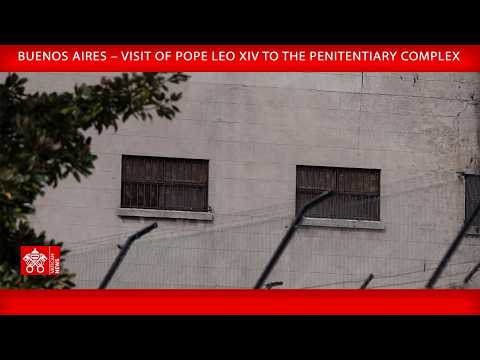
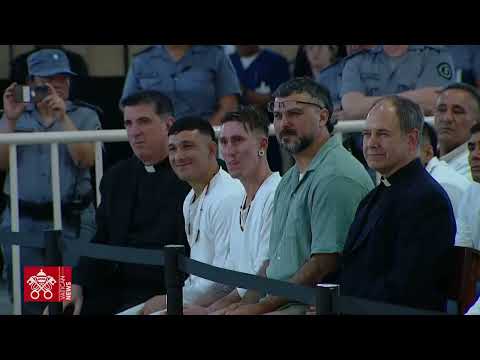
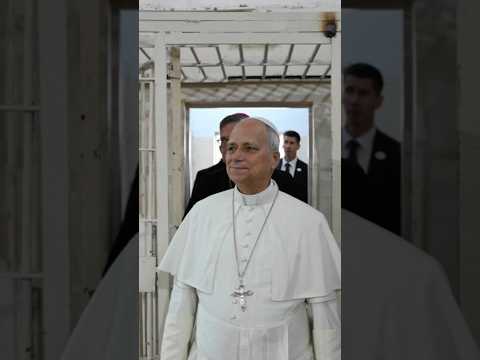
At 7:10 a.m. the Pope left the Nunciature for the last appointment of the Argentine leg: a visit to the Federal Penitentiary Complex of Buenos Aires, known as the Cárcel de Devoto, where Archbishop Bergoglio used to celebrate Holy Thursday. Accompanied by Archbishop Jorge Ignacio García Cuerva, he reached the stage set up in the gym, listened to the director's welcome and to the testimonies of two inmates and a former inmate (Cristian, Maximiliano and Reinaldo), and delivered his greeting, opening with a few off-the-cuff words. At its heart was the experience of human limitation, with quotations from the encyclical Magnifica humanitas: human beings do not flourish in spite of their limitations, but often through them. After signing the Book of Honour and exchanging gifts, he left for Luján at about 8:30.
🎥 Videos
▶
Visit to the Penitentiary Complex (full, in English)
▶
Highlights of the prison visit
▶
Highlights of Pope Leo XIV's visit to a prison in Argentina
▶
Pope Leo: Human beings flourish through limitations, not in spite of them
📷 Photos
The Pope arrives at the prison (Vatican Media)
First greeting to inmates, prison staff and pastoral workers (Vatican Media)
Cristian's testimony (Vatican Media)
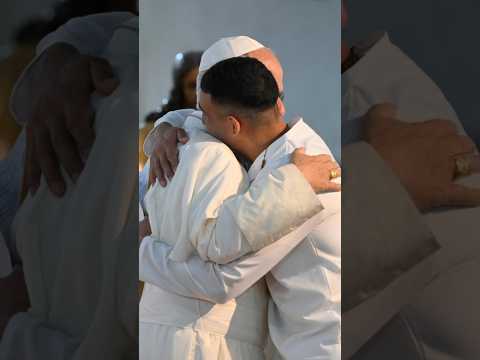
The Pope embraces an inmate after his testimony (Vatican Media)
The Pope listens to another testimony (Vatican Media)
Pope Leo XIV addresses those present at the penitentiary (Vatican Media)
Visit to the Federal Penitentiary Complex of Buenos Aires (Vatican Media)
The Pope's tenderness towards the inmates (Vatican Media)
Greeting to inmates of the Federal Penitentiary Complex of Buenos Aires
Good morning to all of you!
I am happy to be here with you today. Thank you for welcoming me and giving me the opportunity to have this encounter with you. I thank the Archbishop of Buenos Aires, Jorge García Cuerva, the Minister of Security, the Minister of Justice, the Chief of the Prison Service, as well as the Chaplain, Father Matías and al
Good morning to all of you!
I am happy to be here with you today. Thank you for welcoming me and giving me the opportunity to have this encounter with you. I thank the Archbishop of Buenos Aires, Jorge García Cuerva, the Minister of Security, the Minister of Justice, the Chief of the Prison Service, as well as the Chaplain, Father Matías and all of you - especially those who have shared their testimonies. I hope that all of us, myself included, can carry in our hearts this message that a new life is possible. It is the hope we need. I am deeply grateful to Cristian, Maximiliano and Reinaldo, who have shared these testimonies. Thank you.
I would like to share with you a reflection on something we all have in common by virtue of being human: the experience of our limitations. Society often presents everything that constitutes a limitation — incapacity, illness, old age and suffering — as if they were a defect to be corrected, while offering an abundance of possibilities that, in some way, can make us feel “immortal” (cf. Magnifica Humanitas, 118). We can see this in certain troubling realities that are all too familiar to us: the sense of omnipotence produced by drugs, the false power that comes from easy money, the cowardly sense of security that comes from inflicting violence upon the weakest, and the impunity that results from corruption.
We often become aware of our limitations through sin and its consequences, whether by making a mistake, suffering from an illness or experiencing the death of a loved one. For this reason, “over the years, we carry within us lessons that leave their mark like scars, the memories of a journey shaped by freedom and failure, dreams and disappointments” (ibid., 120).
Certainly, the evil that assails the human heart wreaks havoc on society and on the lives of many people, sometimes reaching extremes of inhumanity. Nevertheless, “even when persons dehumanize themselves and bring about tragedy, a small light continues to shine […] one that can be rekindled, with God’s grace, along paths of conversion and reconciliation” (ibid., 121).
Dear brothers, this means that even amid the evil, pain and deepest failures you may have experienced or caused, your present circumstances can become an opportunity to begin your lives anew, as you have shared with us in your testimonies. Indeed, human beings do not flourish in spite of their limitations, but often through them (cf. ibid., 118). It is precisely when our limitations become tangible in our lives that we can discover a new wisdom, experience the closeness of others, and encounter the presence of the Lord (cf. ibid., 119).
Your time in this institution can be an opportunity to begin anew, making peace with God and returning without fear to the embrace of your families and society. For the experience of our limitations, “when truly accepted, does not diminish us but opens us to recognizing the face of God and others” (ibid., 122).
I know that this place, both in its structure and in its organization, makes the harsh reality of limitation painfully clear: being unable to leave freely, being unable to embrace your children each day and even having to endure other forms of deprivation. I can imagine your sleepless nights, while you miss your loved ones or think about those you may have hurt. I know that you are disappointed that you did not find a friendly hand, someone who trusted you, helped you get back on your feet and encouraged you to move forward when you needed it most. And it may seem that all of this is an open wound that can never heal.
For this very reason, I would like to emphasize all the more that prison is also a witness to profound changes and conversions, to growth, learning and the acquisition of new skills and knowledge. After experiencing human fragility in its most painful form, many have learned to transform the desert of their own existence into a fruitful garden. Indeed, with God’s grace, it is possible to move beyond total darkness and kindle small lights of hope. These glimmers of light also radiate beyond these walls: into your families, among those who work here and throughout society.
First of all, let us consider your families. They too are waiting for and need these glimmers of light to help them carry on. I would like to address a few words to them. Dear fathers and mothers, dear wives and children, dear families of those who are incarcerated: I would like to remind you that Jesus Christ, when speaking of the importance of charity, identified himself with a prisoner (cf. Mt 25:36). He himself, before giving his life to save us, was deprived of his freedom despite being entirely without sin (cf. Jn 18:12). That is why we must turn to him and implore him on behalf of our loved ones who are in prison. Let us ask Jesus, who was himself a prisoner, to grant them all strength and wisdom, so that this time of solitude and isolation will not be in vain, but will become a time of grace and salvation (cf. Titus 2:11).
I would like to offer a word to the penitentiary service personnel and all the professionals and volunteers who carry out their work in the prisons of this country, as well as those engaged in prison ministry. Dear brothers, you may be tempted to think that nothing will ever change for the better, or to feel powerless in the face of the “structures of sin” (Saint John Paul II, Sollicitudo Rei Socialis, 36) and of death, in the face of deception and corruption that do not disappear but are reinforced through various forms of aggression. I would like to remind you that your work is also an opportunity for growth and personal development. Dear brothers, let us remember that visiting those in prison is a work of mercy to which we are all called. I encourage you to be firm in faith and to anchor your lives in Christian hope, so that you may face the many challenges that arise each day and help make this environment more humane and respectful, one that truly fosters rehabilitation and reintegration into the community.
Finally, to the authorities and the whole of Argentinian society, I would like to say that it is precisely within our limitations that compassion, sincere concern for the needs of others and generosity find a place (cf. Magnifica Humanitas, 119). We are part of the same human family. Let us promote whatever contributes to the good of all. Let us accompany especially our children and young people, educating them in authentic values, caring for them and protecting them, so that they do not fall into the pernicious networks of criminality. The Lord will call us to account for what we have done for each of our brothers and sisters.
May Our Lady of Mercy shelter you all beneath her heavenly mantle. And may the blessing of almighty God, the Father, and the Son, and the Holy Spirit, come down on you and remain with you forever. Amen.
After leaving the Basilica, the Pope stopped at Villa Marista San José de Luján, on the way to the airport, to thank the volunteers of the Argentine leg gathered in the garden. According to Vatican News he said the time had come for "the conclusion of these beautiful, pleasant days in which we celebrated life, celebrated faith" and blessed all those who worked "to help all the Argentine people in these days, and to help me too".
📷 Photos
Pope Leo XIV greets volunteers who helped organize his visit (Vatican Media)
Volunteers at Villa Marista San José de Luján (Vatican Media)
Pope Leo XIV greets volunteers who helped organize his visit (Vatican Media)
Impromptu greeting to the volunteers of the journey at Villa Marista San José de Luján
Thank you! Good morning!
Good morning, Argentina. Good morning, Luján.
Well, the time has come. These beautiful, wonderful days are coming to an end — days in which we have celebrated life, celebrated our faith, and recognized the great value of human life, as well as the great gift the Lord has given us: faith. In the presence of Jesus Christ,
Thank you! Good morning!
Good morning, Argentina. Good morning, Luján.
Well, the time has come. These beautiful, wonderful days are coming to an end — days in which we have celebrated life, celebrated our faith, and recognized the great value of human life, as well as the great gift the Lord has given us: faith. In the presence of Jesus Christ, who gave his life for us, and his Mother Mary, Our Lady of Luján, we have celebrated the Eucharist.
There is no better word to say than “Thank you!” The Eucharist, which is an act of thanksgiving, is a recognition that everything is a gift.
Just as Jesus came to give his life, you too, as volunteers, have given of yourselves to help all the people of Argentina during these days — and to help me as well. Thank you very much. May the Lord bless you always.
The Lord be with you…
Blessed be the name of the Lord…
Our help is in the name of the Lord…
And may the blessing of almighty God, the Father, and the Son, and the Holy Spirit, come down upon you. Amen.
Long live Christ! Long live the Virgin Mary!
Thank you.
📍 "Ministro Pistarini" International Airport, Buenos Aires, Argentina
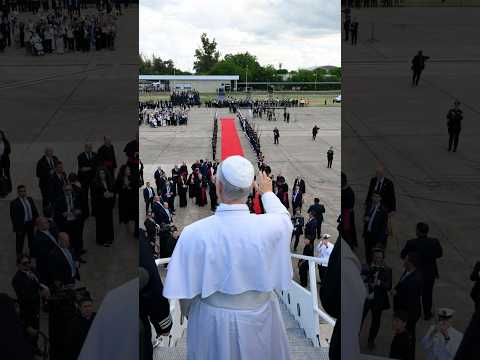
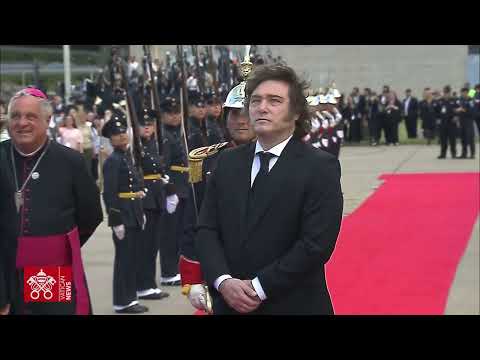
At Ministro Pistarini International Airport the Pope was welcomed at the entrance of the protocol pavilion by President Javier Milei. After music, military honours and the greeting of the delegations, the President bid farewell to the Holy Father, who boarded an Aerolíneas Argentinas A330-200 bound for Lima.
🎥 Videos
▶
Farewell ceremony in Buenos Aires (full, original audio)
▶
Highlights from Pope Leo XIV's farewell ceremony in Argentina
▶
Highlights – Buenos Aires farewell ceremony
📷 Photos
Pope Leo bids farewell to Argentina (Vatican Media)
The plane carrying the Pope took off at 14:38 (18:38 Rome time). On leaving Argentina, the Pope sent President Milei a telegram of thanks for "the kind welcome and many gestures of fraternity". Flying over Chile, he sent a telegram to President José Antonio Kast, invoking upon the nation "Almighty God’s gifts of peace and concord".
Telegram to the President of the Argentine Republic
His Excellency Javier Milei
President of the Argentine Republic
Buenos Aires
At the conclusion of my Apostolic Journey to Argentina, I wish to extend my gratitude to Your Excellency, the Authorities and all Argentinians for the kind welcome and many gestures of fraternity extended to me during these past days. As I now begin my Apostolic Journey t
His Excellency Javier Milei
President of the Argentine Republic
Buenos Aires
At the conclusion of my Apostolic Journey to Argentina, I wish to extend my gratitude to Your Excellency, the Authorities and all Argentinians for the kind welcome and many gestures of fraternity extended to me during these past days. As I now begin my Apostolic Journey to Peru, I willingly invoke upon your country Almighty God’s blessings of peace and wisdom.
Telegram to the Head of State of Chile while flying over the country
His Excellency José Antonio Kast
President of the Republic of Chile
Santiago
As I fly over Chilean airspace on my Apostolic Journey to Peru, I offer cordial greetings to Your Excellency and your fellow citizens, invoking upon the nation Almighty God’s gifts of peace and concord.
Leo PP. XIV
His Excellency José Antonio Kast
President of the Republic of Chile
Santiago
As I fly over Chilean airspace on my Apostolic Journey to Peru, I offer cordial greetings to Your Excellency and your fellow citizens, invoking upon the nation Almighty God’s gifts of peace and concord.
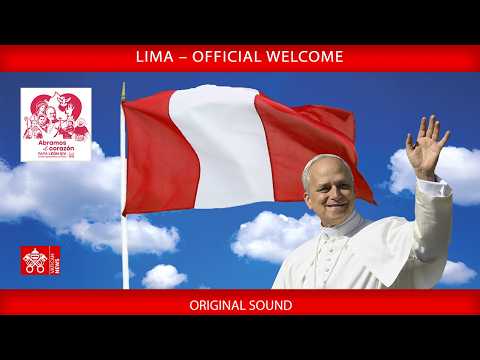
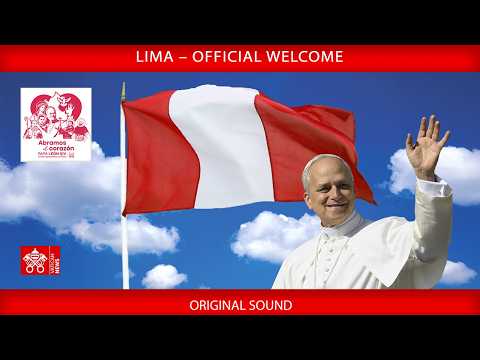
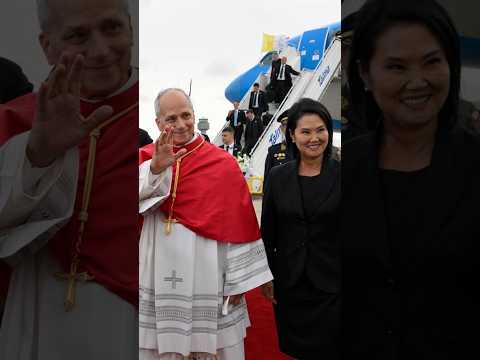
The plane landed at Callao Air Base (Grupo Aéreo N.° 8 of the Peruvian Air Force) at 17:01 (23:01 Rome time); the control tower greeted him with "Welcome home". At the foot of the steps he was welcomed by the President of the Republic Keiko Sofía Fujimori Higuchi, Foreign Minister Carlos Espá and the Commander General of Air Wing No. 2, Julio César Gutiérrez Gonzales; two children offered him flowers while the children's choir Sinfonía por el Perú sang. A brief private meeting with the President followed in the VIP lounge. This opens the third and final leg of the journey, in the country where he served as a missionary and Bishop of Chiclayo.
🎥 Videos
▶
Lima Awaits Pope Leo XIV
▶
Lima, Official Welcome (full, original audio)
▶
Highlights - Lima, Official Welcome
▶
Lima, Official Welcome (full, Vatican News - English)
▶
Pope Leo arrives in Peru for the final leg of his Apostolic Journey to South America (Vatican News report)
📷 Photos
Pope Leo arrives at Callao Air Base (Vatican Media)
Children greet Pope Leo as he arrives in Peru (Vatican Media)
Pope Leo arrives at Callao Air Base (Vatican Media)
Pope Leo arrives at Callao Air Base (Vatican Media)
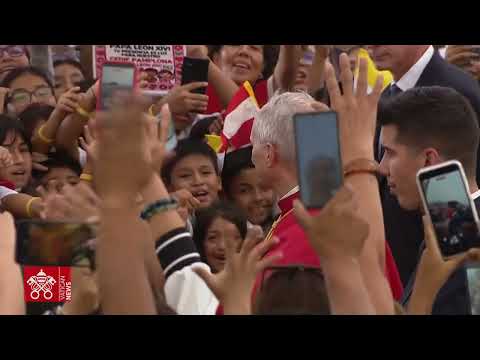
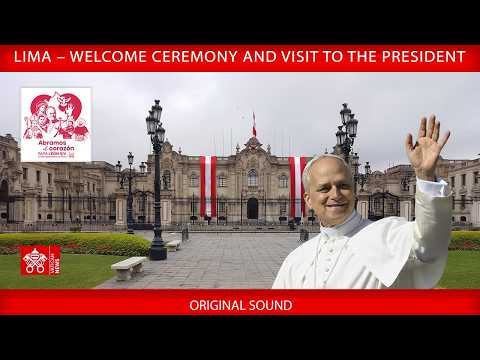
From Callao the Pope travelled by car and, on the last stretch, in an open car to the Palacio de Gobierno (Casa Pizarro), arriving at 18:56 (00:56 Rome time). According to local authorities' estimates, about 3 million people lined the route and the Plaza de Armas. On arrival he was welcomed by the President of the Republic, Keiko Sofía Fujimori Higuchi; after the honours to the flag, military honours and 21 peals of bells, the Pope and the President walked to the central staircase of the Palace, facing the Patio de Honor, where a youth choir sang the national anthems. The delegations were then presented in the main hall.
🎥 Videos
▶
Lima, Welcome Ceremony and Visit to the President (full, original audio)
📷 Photos
The Pope greets Peruvian faithful from the popemobile (Vatican Media)
The Pope arrives at the Palacio de Gobierno (Vatican Media)
The Pope arrives at the Palacio de Gobierno (Vatican Media)
The Pope arrives at the Palacio de Gobierno (Vatican Media)
📍 Salón de Embajadores, Palacio de Gobierno, Lima, Peru
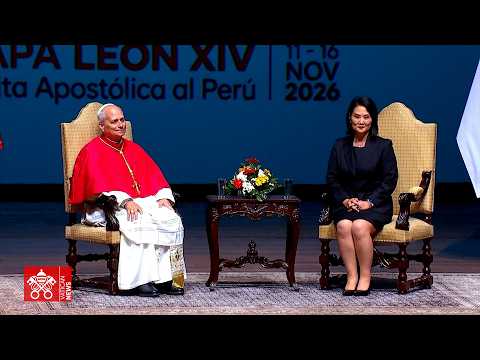
At 19:09 (01:09 Rome time) the Pope and President Keiko Sofía Fujimori Higuchi withdrew to the Salón de Embajadores for their private meeting, the exchange of gifts and the presentation of her family. The Pope then greeted the fourteen spouses of Peruvian ministers and, in the Gran Comedor, addressed some off-the-cuff words to the Palace staff: "I feel at home", he said, urging them to "overcome differences" through dialogue and patience, and he gave his blessing at the President's request. At 19:57 he left for the Gran Teatro Nacional.
🎥 Videos
▶
Lima, Welcome Ceremony and Visit to the President (full, original audio)
Off-the-cuff words to the staff of the Palacio de Gobierno
Thank you very much! Good evening, everyone.
It is a joy for me — as you can perhaps imagine — to return to Peru after some years and visit you all. First, because I feel at home. Second, because as Pope, it is an honor to come and walk alongside all men and women of goodwill: Catholics, Christians… everyone. Together, we want always to seek the go
Thank you very much! Good evening, everyone.
It is a joy for me — as you can perhaps imagine — to return to Peru after some years and visit you all. First, because I feel at home. Second, because as Pope, it is an honor to come and walk alongside all men and women of goodwill: Catholics, Christians… everyone. Together, we want always to seek the good of all the people. I am deeply convinced of the great values of the Peruvian people: a spirit of community, a spirit of being together. I also believe it is very important that we always seek ways to work together, overcome our differences, and make use of dialogue, understanding and perhaps a lot of patience. May we also be convinced that it is possible to achieve a great deal if we walk together in unity. As the President requested, I gladly offer God’s blessing to you, your loved ones, your families, and all the people of Peru, tonight, in these coming days and in the future.
The Lord be with you.
May the blessing of almighty God, the Father, and the Son, and the Holy Spirit come down on you today and always. Amen.
Thank you. Thank you all!
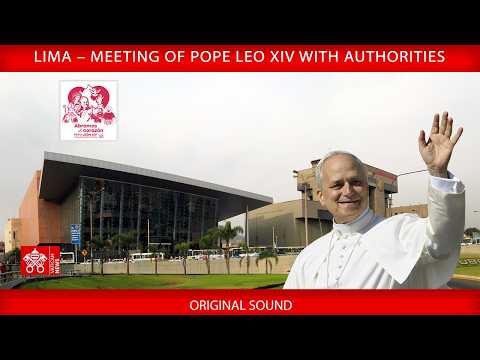
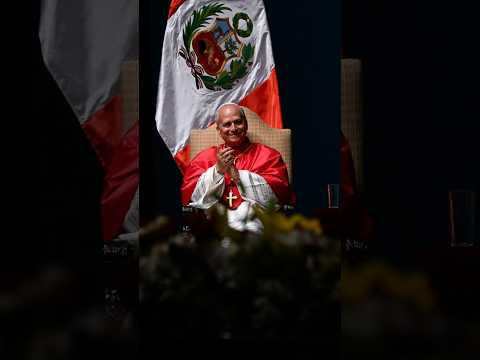
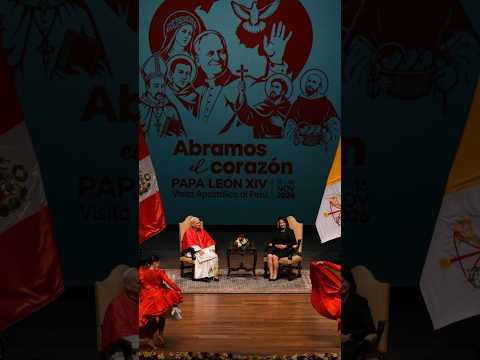
At 20:30 (02:30 Rome time) the Pope, welcomed by the President of the Republic, met political and religious authorities, business leaders and representatives of civil society, culture and the diplomatic corps at the Gran Teatro Nacional. After two traditional Peruvian songs (Hanacpachap cussicuinin and a Lima baroque villancico) and the President's speech, he gave his first address in Peru, in Spanish: "I am also returning to my homeland", he said, recalling his missionary years, the Peruvian citizenship he received in 2015 and "some good ceviche". He asked the authorities for listening, honesty and dialogue; spoke of peace in families, work, schools, health, the women of the "ollas comunes", the environment, artificial intelligence (citing Magnifica Humanitas) and Peruvians abroad; and concluded by entrusting the country to Saint Rose of Lima, letting his prayer fall "into that blessed well". The evening ended with a marinera ("Que viva Chiclayo"), then the return to the Nunciature.
🎥 Videos
▶
Highlights of the meeting with the Authorities (Vatican News)
▶
Meeting with the Authorities in Lima (full, Vatican News Español)
▶
Meeting with the Authorities in Lima (full, Vatican News Italiano)
▶
Lima, Meeting with Authorities (full, original audio)
▶
Lima, Meeting with Authorities (full, Vatican News - English)
▶
Pope in Peru: “Distance does not necessarily diminish love for one’s homeland” (Vatican News report)
▶
Highlights of Pope Leo's Meeting with Authorities, November 11, 2026 – Lima, Peru (Vatican News - English)
📷 Photos
The Pope is welcomed at the Gran Teatro Nacional in Lima (Vatican Media)
Leo XIV delivers his address (Vatican Media)
The Marinera dance (Vatican Media)
The Pope is welcomed at the Gran Teatro Nacional in Lima (Vatican Media)
Address to the Authorities, Civil Society and the Diplomatic Corps
Madam President of the Republic, Distinguished Authorities and Members of the Diplomatic Corps, Ladies and Gentlemen,
I am very pleased to be back in Peru. I thank you, Madam President, for your warm words of welcome. I also express my gratitude for the kind invitation to visit this beloved land and to all those who have organized this trip, making
Madam President of the Republic, Distinguished Authorities and Members of the Diplomatic Corps, Ladies and Gentlemen,
I am very pleased to be back in Peru. I thank you, Madam President, for your warm words of welcome. I also express my gratitude for the kind invitation to visit this beloved land and to all those who have organized this trip, making it possible for me to meet with communities from different regions of the country.
This return visit holds a very special meaning for me. My history with Peru began long before the Lord entrusted me with the Diocese of Chiclayo. For years decades, I shared in the lives of its people, listened to their concerns, and learned from their faith. Many opened the doors of their homes to me, shared their table with me —and, of course, some good ceviche — and made me feel like one of their own. In 2015, I received Peruvian citizenship. That act symbolized a bond that this people had been weaving into my life long before. Today I understand how much of this land remains with me and how much of my own story also belongs to you.
Now I return as the Successor of Peter, called to serve the universal Church. In light of this responsibility, I recognize in those years a part of the journey through which the Lord was forming me as a shepherd. If I were granted the chance to relive those years, I would do so with joy, embracing both their happy moments and their difficulties. That is why I can tell you, with deep gratitude, that I am also returning to my homeland.
Peru has a history stretching back thousands of years, shaped by peoples of diverse languages and traditions. Part of that history continues to be told in Quechua, Aymara, and the languages of the Amazon. Over the centuries, other heritages have been woven into it, including the Afro-Peruvian and Asian-Peruvian traditions, which have also helped shape the country’s identity. Nearly five hundred years ago, the proclamation of the Gospel opened a decisive chapter in that history. As Benedict XVI recalled, “from the encounter between that faith and the indigenous peoples, there has emerged the rich Christian culture of this continent” (Inaugural Address at the Fifth General Conference of the Bishops of Latin America and the Caribbean, 13 May 2007). The faith took deep root in these lands and found expression in their traditions and in countless works of charity. Suffice it to recall that the first flower of Latin American holiness bore the name Rosa, and that this Rosa was Peruvian.
The regions of Peru preserve their own traditions, and each contributes something distinct to national life. The unity of a people is strengthened when these differences find their place and each person contributes from their own history and convictions. Peru preserves everyday expressions of solidarity: communal work projects in which neighbors join forces to carry out a task that benefits everyone, the help families offer one another in times of difficulty, and the hospitality I have witnessed so many times. In these gestures, one discovers a way of loving one’s homeland that is manifested, above all, in caring for those who live there.
To love a people is to desire that everyone may live with dignity among them, to take an interest in them, and to be willing to offer something of oneself for their good. It is a sentiment that I have come to understand better thanks to you, and which I wish to share today with those who hold public office.
Madam President, distinguished officials: this concern for the good of others is admirably embodied in public service. Pope Francis, who visited this beloved land in 2018, recalled that politics is “a lofty vocation and one of the highest forms of charity, inasmuch as it seeks the common good” (Fratelli Tutti, 180). Democratic life brings together people of diverse convictions and aspirations, united by a shared national destiny. Institutions provide channels through which these differences can find expression and paths to understanding can be forged. Public decisions also affect those who live far from the places where they are made, and this should never be forgotten.
To understand the needs of those who are far away, we must begin by listening to them. I recall seemingly simple conversations in which the difficulties of a family or the hopes of an entire community came to light. In a country where so many languages are spoken, listening also requires ensuring that everyone can make themselves understood. Those who turn to public institutions hope to be heard, to understand the decisions that affect them, and to find someone they can turn to with confidence. Behind the files, routine paperwork, or the abstract national census number, there are real people awaiting answers on which much of their peace of mind depends.
Listening requires special patience when dealing with disagreements or painful experiences. Peru, too, has gone through difficult times that have tested the ability of its people to live together in harmony. Past events deserve to be treated with justice and sensitivity, leaving room for harmony to grow and for differences to be addressed with respect. Democratic life implies recognizing that no one has all the answers and that differences do not prevent us from sharing a sincere concern for the good of the country. I would like to encourage everyone to cultivate honesty, integrity, and a willingness to engage with others — qualities that sustain trust among people and give strength to the life of institutions.
For families, peace has a very concrete meaning: going out to work without fear, caring for one’s children, and returning home with peace of mind. These are simple aspirations, but no one should be deprived of them. The Church is aware of the suffering caused by violence and wishes to remain close to those who endure it, encouraging the efforts of all who work to protect the life, dignity, and rights of people through law and justice.
Providing for one’s family with dignity is also part of that everyday peace. I think of those who cultivate the land, the fishermen who go out to sea, small business owners, and those who keep cities running. Each of these jobs contributes to the life of the nation and deserves to be recognized in its dignity. Saint Paul VI taught that authentic development must promote “all people and the whole person” (Populorum Progressio, 14). Such development encompasses material well-being as well as the cultural, moral, and spiritual aspirations of every person. There are goods that no economic prosperity can replace: peace of conscience, the certainty of being loved, and the freedom to seek the truth and to guide one’s life according to it.
The desire to seek the truth begins to manifest itself very early on, in the questions through which a child discovers the world. A school capable of embracing that search can open up horizons that once seemed distant and help the child recognize his or her own abilities. I think with gratitude of the teachers in the various regions of Peru, who accompany this discovery and pass on to their students the values of their land, so that they may learn to know and love it. But the horizons that open up in the classroom must later be matched by real opportunities. I extend a word of affection to young people, especially those seeking their first job or preparing for new responsibilities. Let us work so that they may develop their talents and generously place them at the service of others, especially those most in need.
When a person falls ill or needs ongoing care, the lives of those around them also change. Anyone who has cared for a loved one knows how much timely medical care, a friendly presence and a word of comfort mean. I think of the elderly, people with disabilities, and those suffering from loneliness or mental health challenges. Many families quietly shoulder this burden, often with great sacrifice. I encourage the authorities to support this dedication by providing them with accessible health services and strengthening preventive medicine. Those who devote their energy to caring for others also need to find someone to care for them.
I also think of the many Peruvian women who have run soup kitchens and community meal programs, and of those who, through their professions and public responsibilities, contribute to the good of the country. May all of them be able to freely develop their abilities, participate fully in their communities, and live free from violence and any form of exploitation.
In Peru, the rivers of the Amazon, the Andean highlands, and the extensive coastline shape the lives of numerous communities and the work of their inhabitants. The use of these resources — through agriculture, fishing, or mining — requires caring for nature and respecting the communities that depend on it (cf. Laudato Si’, 183). Understanding each territory allows us to anticipate the risks posed by natural phenomena and better protect the population. The solidarity that Peruvians demonstrate in the face of emergencies deserves to be matched by equally committed institutions, capable of preventing disasters and acting in a timely manner when a life is in danger.
Science and technology help us anticipate many of these risks. Their advances also make it possible to improve health care and bring educational opportunities to remote communities. Artificial intelligence expands these possibilities and transforms the way we work and interact. As I noted in Magnifica Humanitas, these new capabilities call for discernment and a responsible orientation toward the common good (cf. n. 5). May their benefits reach everyone, and may their development remain at the service of human dignity. There must also be adequate legal safeguards to prevent potential abuses and protect people from their consequences.
Environmental protection and the responsible use of new technologies also require collaboration among nations. Due to its location in the Andes and the Amazon and its access to the Pacific, Peru maintains ties with neighboring nations and with peoples from other continents. Numerous issues affecting the lives of its inhabitants — from environmental protection to migratory movements — are best addressed through dialogue and cooperation.
Furthermore, I think of the many Peruvians living abroad who, while building their lives in other lands, maintain their affection for their families and contribute to their communities of origin. In cities far away, the image of the Lord of Miracles continues to bring Peruvians together, who find in that devotion a way to maintain ties with their homeland. I myself have seen Rome decked out in purple! Distance does not necessarily diminish love for one’s homeland; at times, it allows us to recognize more clearly how much we have received from it. Those who come to Peru also bring stories and hopes that deserve to be welcomed and respected. Their stories show that relations between countries have very concrete consequences for the lives of families.
The wars and tensions that afflict so many peoples call for patient diplomacy — diplomacy that keeps dialogue open, respects international law, and seeks agreements that protect the lives and dignity of people. Every nation has legitimate aspirations, but none can regard the fate of others as extraneous to its own concern. I encourage Peru to continue contributing to regional and international cooperation and to foster understanding even when positions seem irreconcilable. May we never give up on seeking ways to alleviate the suffering of peoples and move toward peace.
Relations between Peru and the Holy See are rooted in this spirit of cooperation. The Peruvian Constitution recognizes the Catholic Church as an important element in the historical, cultural, and moral formation of the nation and provides for collaboration between the State and the Church, within a framework of independence and autonomy, while also respecting other religious denominations (cf. Art. 50). The Church, mindful of this recognition, wishes to continue offering the Peruvian people what it has received as its mission: to proclaim the Gospel, to accompany those who suffer, and to serve the dignity of every person. This commitment is evident in its communities, in its educational and charitable works, and in the many lay faithful who, moved by their faith, participate in the life of the country through their professions and civic responsibilities. May this relationship continue to develop with mutual respect, always seeking the good of all Peruvians.
Ladies and gentlemen: there are many ways to serve Peru. I thank those who do so through their institutions and all those who, through their daily work, contribute to the good of their communities. I have received so much from you. There are faces, conversations, and gestures of affection that, even after so many years, continue to stay with me. From the See of Peter, I wish to reciprocate such affection with my prayers and my closeness. I would also like to propose to you the Social Doctrine of the Church as a guide to enlighten and direct the efforts of all who work for the good of this nation.
At the well of Saint Rose of Lima, generations of Peruvians have placed their petitions and hopes. Today, from here, I too would like to place my prayer into that blessed well. Through the intercession of the Blessed Virgin Mary, Saint Rose, and all the saints and blessed of this land, I ask the Lord that the love of Christ may help you to recognize in every Peruvian a brother or sister, and in each one, yet another reason to love your homeland. May God bless Peru and all its people. Thank you very much.
After the meeting at the Gran Teatro Nacional and dinner, the Pope stepped out at the Apostolic Nunciature, where he is staying in Lima, to greet the faithful who had gathered to wish him goodnight. According to Vatican News he said: "I have returned home. Here I am at home." Pointing to the dove statue in front of the Nunciature, a sign of peace, he asked for prayers for peace in the world and urged everyone to be builders of unity and reconciliation. He also asked for a special prayer for families, then led the Our Father and gave his blessing, closing with "see you tomorrow".
🎥 Videos
▶
Highlights of the fourth day in Argentina and the first in Peru (Vatican News)
📷 Photos
The Pope greets the faithful at the Lima Nunciature (Vatican Media)
Pope Leo XIV's greeting in Lima (ANSA, via Vatican News)
Impromptu remarks from the balcony of the Apostolic Nunciature in Lima
Good evening, Lima! Good evening, Peru!
I cannot thank you enough for this warm welcome as I come home today. How wonderful it is to find you all here with such enthusiasm, such joy and so much prayer.
I am deeply grateful for all your prayers, especially during this time. Thank you!
Here in front of the Nunciature is this beautiful dove, a symbol
Good evening, Lima! Good evening, Peru!
I cannot thank you enough for this warm welcome as I come home today. How wonderful it is to find you all here with such enthusiasm, such joy and so much prayer.
I am deeply grateful for all your prayers, especially during this time. Thank you!
Here in front of the Nunciature is this beautiful dove, a symbol of peace. All of us indeed want to be promoters and builders of peace. So, I sincerely ask for your prayers for peace in the world, for peace in every country. May we learn to build unity, promote reconciliation and believe deeply in peace.
Now, I have been asked to say one more thing. Some people have their windows on this side and want to sleep — and they would like a little peace.
So, the celebration can go on for a little while longer, but not all night. Otherwise, there will not be any peace tomorrow.
Now we are going to bless you and all your loved ones. A special prayer for your families. It is very important to think about families and to find ways to promote unity within our own families.
So, let us pray together as Jesus taught us.
Our Father…
The Lord be with you…
Blessed be the name of the Lord…
Our help is in the name of the Lord…
And may the blessing of almighty God, the Father, and the Son, and the Holy Spirit come down on you and remain with you forever. Amen.
Thank you. Good night! See you tomorrow.