Thursday 27 August 2026 — Audience with participants in the Pontifical Commission for Latin America meeting on addiction · Credential letters of the Ambassador of Belgium · Telegram for the floods in Nepal · Close of the Catania Liturgical Week
11:30
Apostolic Palace, Hall of the Consistory
🤝 Audience
Audience with participants in the meeting on situations of addiction in Latin America
📍 Apostolic Palace, Hall of the Consistory
In the morning Pope Leo XIV receives in audience the participants in the meeting promoted by the Pontifical Commission for Latin America — together with CELAM (the Latin American and Caribbean Episcopal Council), the Organization of American States (OAS) and the Pontifical Academy for Life — on the theme "A faith-based response to drugs and to the criminal recruitment of young people: a dialogue from Latin America and the Caribbean toward the world," held in Rome from August 25 to 27. In his address, delivered in Spanish, the Pope calls addictions "a complex phenomenon that reveals the failure of a dehumanized world" and asks for integral responses: community prevention, scientific care, justice "with a human face," and close pastoral accompaniment. He points to four "bridges" of collaboration — between the Church and international bodies, between science and faith, among the Churches of the various continents, and in the ecumenical sphere — and dwells on the family, the "domestic church," stating that "there is no better prevention against drugs than a good family." He closes with the image of the Good Samaritan: to build "a Church that stops, draws near, is moved with compassion, anoints wounds, feeds and becomes a home."
Event detail →🎥 Videos
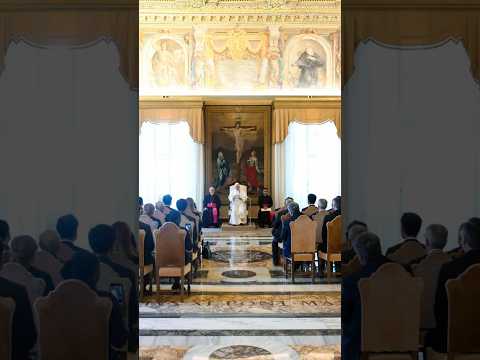
Pope: Church must help broken families heal from drug abuse (Vatican News)
📰 Articles
Vatican.vaOfficial
Address to participants in the Pontifical Commission for Latin America meeting on situations of addiction (August 27, 2026)
The full text of the papal address (in Spanish) published on the Holy See website.
Holy See Press OfficeOfficial
Audience with Participants in the Meeting promoted by the Pontifical Commission for Latin America on situations of addiction in Latin America
Official Press Office communiqué on the audience of August 27, 2026.
Vatican NewsArticle
Desde el Vaticano, América Latina abre un diálogo sobre las drogas
The dialogue among CELAM, the OAS and the Holy See on the pastoral response to addiction in Latin America.
📜 Speech text
Address to the Pontifical Commission for Latin America meeting on addiction
En el nombre del Padre, y del Hijo, y del Espíritu Santo. La paz esté con ustedes. ¡Buenos días a todos y bienvenidos! Saludo con afecto fraterno a cada uno de ustedes. Agradezco de modo particular al Consejo Episcopal Latinoamericano y Caribeño (CELAM) y a la Organización de los Estados Americanos (OEA) por haber propiciado este encuentro…
📋 Daily schedule
27
Aug
🤝 Audiences
Credential letters of the Ambassador of Belgium and the day's audiences
📍 Apostolic Palace, Vatican
Pope Leo XIV receives Caroline Vermeulen, new Ambassador of Belgium to the Holy See, for the presentation of her Credential Letters. During the morning the Pope also receives in audience Bishop emeritus Lucas Van Looy of Ghent (Belgium); Archbishop Tomasz Grysa, Apostolic Nuncio to Uganda; Bishop Virgílio do Nascimento Antunes of Coimbra, President of the Portuguese Bishops' Conference, with the members of the presidency council; and Archbishop Marcelo Daniel Colombo of Mendoza, President of the Argentine Bishops' Conference, with Secretary General Bishop Raúl Pizarro Travers.
27
Aug
The Press Office bulletin announces the day's episcopal appointment: the Pope has given his assent to the canonical election, by the Synod of Bishops of the Syro-Malabar Major Archiepiscopal Church, of Fr Thomas Animoottil — until now pro-protosyncellus of the Archeparchy of Kottayam (India) — as auxiliary bishop of the same Archeparchy of Kottayam, assigning him the titular see of Troina.
27
Aug
On behalf of Pope Leo XIV, Cardinal Secretary of State Pietro Parolin sends a telegram of condolence for the victims of the flash floods that struck Nepal. In the message the Pope expresses deep sadness at the loss of life and the devastation, commends the souls of the deceased to the mercy of the Almighty, assures his spiritual closeness to the bereaved families and to all affected by the tragedy, and prays for the emergency personnel engaged in the rescue operations.
27
Aug
The 76th National Liturgical Week concludes today in Catania, on the theme "A Church that generates. Liturgy and Christian initiation," which opened on August 24 with a greeting from Pope Leo XIV conveyed through Cardinal Secretary of State Pietro Parolin, in which the Pope recalled that the liturgy is the womb that generates faith and that the communion lived at the altar must be translated into fraternal charity and peace in the streets of humanity.
🗓️ Upcoming events
2026-08-29
⛵ Mass and procession at Castel Gandolfo for Our Lady of the Lake
Holy Mass in the Church of Maria Santissima del Lago and procession, for the traditional late-August Marian feast.
Go to page →2026-08-30
🙏 Sunday Angelus at Castel Gandolfo
Pope Leo XIV leads the Marian prayer of the Angelus from Piazza della Libertà, the day after the Mass and lake procession for the Madonna del Lago.
Go to page →2026-09-01
🌱 Mass for the Care of Creation at Castel Gandolfo
The Pope presides over the Mass for the Care of Creation in the Garden of the Madonnina del Borgo Laudato si', at the opening of the Season of Creation.
Go to page →2026-09-05
🌿 First anniversary of Borgo Laudato Si'
The first anniversary of the inauguration of the creation-care center at Castel Gandolfo, opened by Pope Leo XIV on September 5, 2025.
Go to page →2026-09-07
🕯️ Mass at Genazzano for the eve of the Nativity of Mary
The Pope celebrates Holy Mass at the Shrine of Our Lady of Good Counsel, on the eve of the Nativity of the Blessed Virgin Mary.
Go to page →2026-09-14
📚 Opening of the "AQVA" exhibition at the Vatican Library
The Pope visits the Vatican Apostolic Library and opens "AQVA", the first chapter of the exhibition cycle "Catastrophe and Wonder".
Go to page →2026-09-25
✈️ Departure for the apostolic journey to France
From September 25 to 28 the Pope visits Paris (Élysée, UNESCO, Notre-Dame), Lourdes and Metz.
Go to page →2026-10-07
📖 Meeting on the tenth anniversary of Amoris Laetitia
A Vatican meeting (October 7-14) convened by the Pope with heads of the Eastern Churches, presidents of bishops' conferences and some families.
Go to page →2026-10-27
🕊️ To Assisi for the 40th anniversary of the Spirit of Assisi
Interreligious gathering promoted by the Community of Sant'Egidio for the fortieth anniversary of the World Day of Prayer for Peace called by John Paul II in 1986.
Go to page →2026-11-06
✈️ Departure for the apostolic journey to Uruguay, Argentina and Peru
From November 6 to 17 the Pope visits Montevideo, Buenos Aires and Lima, with a special stop in Chiclayo, his former diocese.
Go to page →🔗 Official sources