Monday 14 September 2026 — Inauguration of the "AQVA" exhibition · Audience with Patriarch Youhanna X · Chirograph on the Archive and Library · Motu Proprio on salaries · Sustainability Medal announcement for Czerny
11:00
Vatican Apostolic Library, Vatican City
📚 Vatican Library
Inauguration of "AQVA" — first chapter of "Catastrophe and Wonder"
📍 Vatican Apostolic Library, Vatican City
At 11:00 AM on Monday, September 14 — his 71st birthday — Pope Leo XIV visited the Vatican Apostolic Library and inaugurated "AQVA", the first chapter of the three-year exhibition cycle "Catastrophe and Wonder", supported by Fondazione Roma and Intesa Sanpaolo. The exhibition puts the Pope's Library's collections and spaces in dialogue with the works of three contemporary creatives — artist JR, typographer Bill Moran, and chef Fulvio Pierangelini — in a reflection on water as both threat and resource. The path opens with "Diluvium", JR's monumental installation on the Library's sixteenth-century facade. Curated by Fr. Giacomo Cardinali, Simona De Crescenzo, Francesca Giannetto and Delio Proverbio, the exhibition will be open to the public from September 25, 2026 to May 14, 2027, marking a new chapter in the Vatican Library's centuries-old mission of conservation and outreach.
Event detail →🎥 Videos
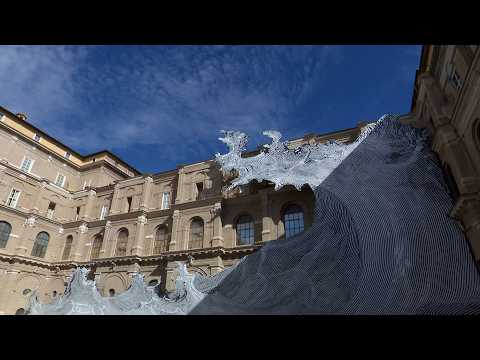
Highlights - BAV: AQVA Catastrophe and Wonder exhibition
📷 Photos

The Vatican Apostolic Library, on the occasion of Pope Leo XIV's visit to inaugurate "AQVA" (@Vatican Media)
📰 Articles
Vatican NewsOfficial
The Pope inaugurates the "AQVA" exhibition at the Vatican Apostolic Library (translated)
Coverage of the inauguration of "AQVA", the first chapter of the "Catastrophe and Wonder" cycle, including JR's "Diluvium" installation on the Library's facade.
Vatican NewsOfficial
Pagazzi: Pope Leo XIV's visit confirms the Vatican Library's mission (translated)
Archbishop Giovanni Cesare Pagazzi, Archivist and Librarian of the Holy Roman Church, explains the significance of Pope Leo XIV's first visit to the Vatican Library and the dialogue between historical heritage and contemporary creativity in the "AQVA" exhibition.
Vatican NewsOfficial
Vatican Library: in September the Pope inaugurates the "Aqva" exhibition
Official announcement of the inauguration of the "AQVA" exhibition and the "Catastrophe and Wonder" cycle.
Faro di Romanews
Pope Leo XIV to inaugurate the "AQVA" exhibition at the Vatican Library on September 14
In-depth look at the program and meaning of the exhibition.
Arte Passantenews
The Vatican inaugurates the "Catastrophe and Wonder" exhibition with JR and chef Pierangelini
Details on the artists involved in the first chapter of the exhibition cycle.
📜 Speech text
Address to the staff of the Vatican Apostolic Archive and Library (tradotto)
Your Excellency, Excellencies, dear brothers and sisters, ladies and gentlemen, before greeting you formally with a short speech I have prepared, I would just like to say that God, in his Providence, and sometimes with a certain sense of humor, always reminds us that he is with us. Many of you may not know that my mother was a librarian, and today I find myself here for my birthday precisely to greet all of you.
📋 Daily schedule
14
Sep
On the same day as his visit to the Vatican Library, Pope Leo XIV signed a Chirograph assigning to the Vatican Apostolic Archive and the Vatican Apostolic Library the area known as the "Fontana dell'Autoparco" and its surroundings, for the construction of a new building following modern architectural and technological standards. The document explains the decision with the significant growth, in recent decades, of the Holy See's bibliographic patrimony and the documentary output of its institutions, which has made the spaces so far available insufficient. The Pope thus preferred to build the new facility within Vatican City State itself, taking advantage of recently emerged opportunities, rather than proceeding with the extraterritorial Lateran-area solution previously identified by Pope Francis. Space in the new building will be divided equally between the two institutions, with part also reserved for other Vatican State services; the Governorate will cover the costs of state services, excluding the relocation of the car park, while the Archive and Library will set up a Vatican instrumental foundation to finance the project. In the meantime, the Library will continue to use storage space at the Pontifical Roman Major Seminary.
📰 Articles
Vatican NewsOfficial
Vatican, new spaces for the Apostolic Archive and Library (translated)
Coverage of Pope Leo XIV's Chirograph assigning the "Fontana dell'Autoparco" area to the new building for the Vatican Apostolic Archive and Library.
AgenSIRnews
Leo XIV: new spaces in the Vatican for the Library and Apostolic Archive (translated)
Details on the Chirograph and the reasons for building the new facility within Vatican City State.
14
Sep
With an Apostolic Letter in the form of a Motu Proprio, signed on September 1 and published on September 14, Pope Leo XIV abrogated, effective from September 1, 2026, the "salary containment measures" adopted by Pope Francis with the Motu Proprio "A Sustainable Future" of March 23, 2021, which had cut the salaries of cardinals, department heads and Holy See personnel and suspended biennial seniority increases during the pandemic. Having heard the opinion of the Secretariat for the Economy, the Pope acknowledged that those extraordinary measures, necessary to address the pandemic challenge, can now be superseded, with the assurance that the institutions of the Holy See and Vatican City State will continue, through different means, their commitment to economic sustainability. The abrogation has no retroactive effect: everything produced by Francis's rule during its five years of application remains definitively acquired, and increases not accrued during the freeze will not be recovered.
📰 Articles
Vatican NewsOfficial
Leo XIV scraps Vatican salary cuts introduced by Francis: Covid-era austerity archived (translated)
The text and context of the Motu Proprio abrogating the pandemic-era salary containment measures.
AgenSIRnews
Leo XIV: pandemic-era "salary containment measures" abrogated (translated)
Details on the decision and the economic reasoning provided by the Holy See.
14
Sep
Before his visit to the Vatican Library, Pope Leo XIV grants private audiences to His Beatitude Youhanna X, Greek-Orthodox Patriarch of Antioch and All the East, with his entourage; Archbishop Arnaldo Catalán, titular Archbishop of Apollonia and Apostolic Nuncio to Rwanda; Archbishop Giorgio Lingua, titular Archbishop of Tuscania, Apostolic Nuncio to Israel and Apostolic Delegate to Jerusalem and Palestine; and a delegation from the Italian Cystic Fibrosis League (Lega Italiana Fibrosi Cistica).
14
Sep
📋 Resignations and appointments
Resignations and appointments: Apostolic Administrator in Belarus and Military Bishop for Bolivia
📍 Vatican City
The Pope accepts the resignation of Archimandrite Jan Sergiusz Gajek as Apostolic Administrator for Byzantine-rite Catholics in Belarus and appoints as his successor Rev. Fr. Liavoncij Tumouski, a Studite monk born in 1973 in Polotsk, ordained priest in 2003 and holder of a doctorate in theology from the Pontifical Oriental Institute. He also appoints Bishop Pedro Luis Fuentes Valencia, C.P., previously titular Bishop of Temuniana and Auxiliary of the Archdiocese of La Paz, as Military Ordinary Bishop for Bolivia; born in 1968 in La Paz, he is a Passionist religious ordained priest in 2004.
12:00
14
Sep
🌱 Press conference
Announcement of the first recipient of the "Pope Leo XIV Sustainability Medal"
📍 Sala San Pio X, Vatican City
In the Sala San Pio X, Villanova University — the Pope's alma mater — holds a press conference announcing that Cardinal Michael Czerny, S.J., prefect emeritus of the Dicastery for Promoting Integral Human Development, is the first recipient of the "Pope Leo XIV Sustainability Medal", a new award — to be conferred every two years — honoring individuals whose leadership reflects an integral approach to sustainability, uniting care for the environment and social justice. Alongside Cardinal Czerny, speakers include Fr. Peter M. Donohue, president of Villanova University, and Manuela Priesemuth-Payan, Villanova Faculty Director for Ethics and Social Responsibility; the event is moderated by Alessandro Gisotti, deputy editorial director of the Dicastery for Communication. The Pope will personally present the medal to Czerny on October 13 at Borgo Laudato si', in the Pontifical Gardens of Castel Gandolfo, during the "Villanova University International Sustainability Conference" titled "Responding to the Cries of the Earth and the Poor", running October 12-15.
📰 Articles
Vatican NewsOfficial
Cardinal Czerny receives the sustainability medal named after Pope Leo XIV (translated)
Coverage of the press conference in the Sala San Pio X announcing Cardinal Czerny as the first recipient of the sustainability medal named after Pope Leo XIV.
AgenSIRnews
Environment: on September 14, the announcement of the first recipient of the "Pope Leo XIV Sustainability Medal" (translated)
Details on the new sustainability medal established by Villanova University and the presentation ceremony planned for October 13 in Castel Gandolfo.
🗓️ Upcoming events
2026-09-25
✈️ Departure for the apostolic journey to France
From September 25 to 28 the Pope visits Paris (Élysée, UNESCO, Notre-Dame), Lourdes and Metz.
Go to page →2026-10-07
📖 Meeting on the tenth anniversary of Amoris Laetitia
Meeting in the Vatican (October 7-14) convened by the Pope with heads of the Eastern Churches, presidents of Bishops' Conferences and some families.
Go to page →2026-10-13
🌱 Presentation of the "Pope Leo XIV Sustainability Medal" to Card. Czerny
At Borgo Laudato si' in Castel Gandolfo, the Pope presents Cardinal Michael Czerny with the first sustainability medal named after him, established by Villanova University.
Go to page →2026-10-27
🕊️ Assisi — 40th anniversary of the Spirit of Assisi
The Pope returns to Assisi to commemorate the 40th anniversary of the historic 1986 interreligious meeting for peace.
Go to page →2026-11-06
✈️ Departure for the apostolic journey to Uruguay, Argentina and Peru
From November 6 to 17 the Pope visits Montevideo, Buenos Aires and Lima, with a special stop in Chiclayo, his former diocese.
Go to page →🔗 Official sources