At 10:00, in St Peter's Square, Pope Leo XIV holds the Wednesday General Audience, continuing the cycle of catechesis on the documents of the Second Vatican Council with a reflection on the third chapter of the first part of the pastoral constitution «Gaudium et spes», dedicated to human activity in the universe. The Pope recalls that «for believers one thing is certain: individual and collective human activity corresponds to God's intentions» (GS 34) and that technical-scientific progress, to become authentic human progress, must be «animated and guided by charity». Among the groups present is a delegation of around 400 pilgrims from the Diocese of Rimini, led by Bishop Nicolò Anselmi, who came to Rome to thank the Pontiff for his pastoral visit to the city on 22 August 2026 and for the opening of the new diocesan pastoral year. The group, which travelled in five coaches and numerous private cars, displays a banner in the square reading «Thank you, Pope Leo!» and presents the Pope with several symbolic gifts from the area, including a book on the Malatesta Temple, a ceramic work by the local Confartigianato association, a lifeguard's uniform, the mitre made for the August visit, and a red-and-white Rimini Calcio football jersey. All participants wear a light-blue cap to be recognisable as a group. At midday the pilgrims from Rimini take part in a Holy Mass in St Peter's Basilica presided over by their Bishop, who stressed his wish that the August visit «continue to generate life, prayer, communion and attention to people». The visit forms part of the diocese's preparations for the pastoral assembly scheduled for 4 October and the start of the new pastoral year. At the end of the catechesis, in his greetings in Italian, the Pope recalls that the following day, in Saint Louis, United States, Bishop Fulton Sheen is beatified, pointing to his example as an evangelizer through the media of his time. He then makes an urgent appeal for the 112th World Day of Migrants and Refugees (27 September), dedicated this year to migrant children: «I appeal to everyone's sense of responsibility: let each of us feel involved in the lives of these children, who must always be protected and assisted», denouncing the «violence, torture, exploitation, traumatic conditions» that many of them face along migration routes, where «not infrequently they lose their lives», and the dignity «too often trampled» even in the places where they arrive. There follow the apostolic blessing for the faithful and pilgrims present in the square, among them the Minister-President of the German federal state of Saxony.
🎥 Videos
▶
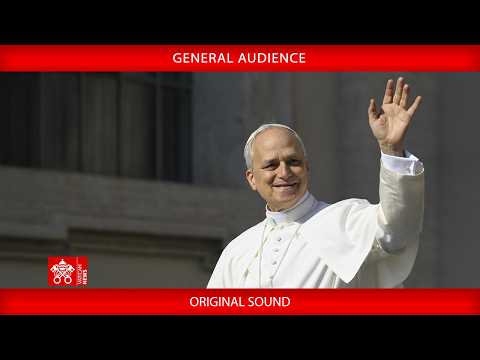
General Audience of 23 September 2026, full video (Vatican News)
▶
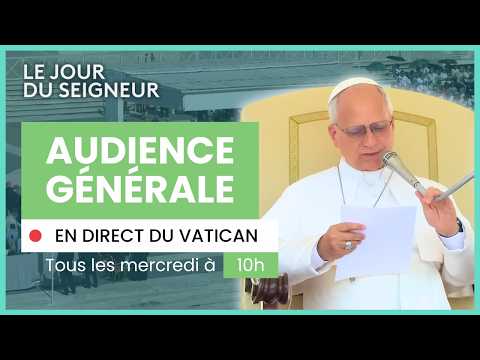
Live broadcast of the General Audience of 23 September 2026 (Le Jour du Seigneur)
📷 Photos
Pope Leo XIV in the popemobile in St Peter's Square during the General Audience of 23 September 2026 (Vatican Media)
The Pope greets and blesses the faithful in St Peter's Square, 23 September 2026 (Vatican Media)
A moment from the Wednesday General Audience, 23 September 2026 (Vatican Media)
General Audience - Gaudium et spes: human activity in the universe
Brothers and sisters, good morning and welcome!
As we continue our journey through the Pastoral Constitution Gaudium et Spes of the Second Vatican Ecumenical Council, we come to the third chapter of the first part, which bears the intriguing title: “Man’s Activity Throughout the World”. The fundamental question is this: what is the value of human…
Brothers and sisters, good morning and welcome!
As we continue our journey through the Pastoral Constitution Gaudium et Spes of the Second Vatican Ecumenical Council, we come to the third chapter of the first part, which bears the intriguing title: “Man’s Activity Throughout the World”. The fundamental question is this: what is the value of human activity in the world, and therefore of technical, social and scientific progress? We may recall that, less than four years after the close of the Council, on the night of 20–21 July 1969, man set foot on the Moon for the first time.
Created in the image and likeness of God, the human being is the agent of progress. With freedom and intelligence, he increases his knowledge, thereby advancing society as a whole. We can easily see this by considering the improvements in living conditions over successive generations. Indeed, the Document states, “many benefits once looked for, especially from heavenly powers, man has now enterprisingly procured for himself” (no. 33).
For this reason, some thinkers have portrayed scientific and technical progress as something that weakens man’s relationship with God, to the point of making it seem superfluous, or even as antagonistic to the Christian faith. And this interpretation has brought about a change in the way contemporary man views the world, compared with previous ages. Such a prejudice is particularly prevalent in that part of Western culture which has lost its reference to Christian Revelation. In post-Christian humanisms, the human being and God are mistakenly presented as rivals: in order to assert his knowledge, his freedom and his progress, man would have to emancipate himself from God. Ultimately, however, by denying the relationship with God, one also loses the possibility of affirming the transcendent value of the human person. This is the “tragedy of atheistic humanism”, well described by a leading theologian of the Second Vatican Council, Henri de Lubac. [1]
The Council wishes to provide a clear answer: Christians, states Gaudium et Spes, “can justly consider that by their labour they are unfolding the Creator’s work, consulting the advantages of their brother men, and are contributing by their personal industry to the realization in history of the divine plan” (no. 34). Indeed, the Constitution continues, “far from thinking that works produced by man’s own talent and energy are in opposition to God’s power, and that the rational creature exists as a kind of rival to the Creator, Christians are convinced that the triumphs of the human race are a sign of God’s grace and the flowering of His own mysterious design” ( ibid.). In essence, God has placed in the hands of men and women a creation that is still in statu viae – that is, on a journey, in the process of growth – so that they may bring it to fulfilment through their wise activity. [2]
Here there is an important reference to the mystery of the Incarnation. Humanity – and with it work, progress and the autonomy of created realities – is not absorbed or nullified by the encounter with God, but rather taken up in its entirety, continuing to be, in Christ, free and active: indeed, it is in Him that it finds full truth and freedom. Furthermore, in the Eucharistic celebration, the fruit of human labour, represented by bread and wine, is placed upon the altar every day to be transformed into the Body and Blood of Christ.
From this perspective, an important truth emerges: to encounter God, the human being must not abandon his earthly occupations, but can live his vocation fully, carrying out his daily work well and sanctifying it. [3] Christians, like everyone else, are involved in building the city of man, striving towards the end of all things and the encounter with God, and reminding those with whom they share the adventure of progress, science and life of this ultimate purpose.
Earthly progress must certainly be clearly distinguished from the development of the Kingdom of Christ; however, the Council affirms that “to the extent that the former can contribute to the better ordering of human society, it is of vital concern to the Kingdom of God. … All the good fruits of our nature and enterprise, we will find them again, but freed of stain, burnished and transfigured” (no. 39).
Finally, let us recall that in order to become authentic human progress – that is, progress for the whole person and for all people – technical and scientific progress must be inspired and guided by charity. Only in this way can it always be placed in the service of human dignity and promote the living conditions of all, especially the most disadvantaged.
Dear brothers and sisters, the Second Vatican Council invites us to share the bread of knowledge and know-how, so that every person and every people may develop their potential, and together, with God’s help, we may build a better future.
[1] Cf. H. de Lubac, Le drame de l’humanisme athée (1944).
[2] Cf. Catechism of the Catholic Church, nos. 302, 306, 307.
[3] Cf. Saint John Paul II, Homily for the Canonization of Josemaría Escrivá de Balaguer (6 October 2002).
***
APPEAL
Next Sunday, 27 September, marks the World Day of Migrants and Refugees. My thoughts go out to migrants and refugees, especially minors compelled to leave their homeland. Children and teenagers are the most vulnerable, and they often endure unspeakable suffering: violence, torture, exploitation, traumatic conditions, and it is not uncommon for them to lose their lives along migration routes. I appeal to everyone’s sense of responsibility: let us all feel a sense of involvement in the lives of these young people, who must always be protected and supported.
Special greetings:
I greet all the English-speaking pilgrims and visitors taking part in today’s Audience, particularly the groups from England, Ireland, Denmark, Norway, Malta, Tanzania, Australia, Hong Kong, India, Malaysia, Singapore, Thailand, Vietnam and the United States of America. Tomorrow in Saint Louis, Missouri, Venerable Fulton Sheen will be beatified. May the example and intercession of this holy bishop, known for his evangelizing work through the media, inspire many others likewise to find new ways of spreading the Gospel message with joyful enthusiasm. Upon all of you and your families, I invoke the peace and joy of our Lord Jesus Christ. God bless you!
Summary of the Holy Father's words:
Dear brothers and sisters, as we continue our series of catecheses on the Second Vatican Council, today we consider the meaning and value of human activity as presented by the Pastoral Constitution Gaudium et Spes. Revolutionary advances in science and technology in the past century have led some to assume that belief in God is now obsolete, and that true human autonomy can be affirmed only by emancipation from God. The Council Fathers emphasized, on the contrary, that “the achievements of the human race are a sign of God’s greatness and the fulfilment of his mysterious design” (n. 34). Indeed, far from inhibiting believers from being engaged in human activity, the Gospel message compels us to contribute to authentic human flourishing through our involvement in society. Let us carry out our daily activities with true charity, offering our work to the Lord both as a means for personal sanctification and as an expression of our desire ever more fully to bring about God’s kingdom, especially through pursuing the common good, caring for the needy and defending human dignity.