Saturday 26 September 2026 — Holy Mass in Paris, Place de la Concorde
15:00
Place de la Concorde and Champs-Élysées, Paris, France
⛪ Holy Mass
Holy Mass in Paris
📍 Place de la Concorde and Champs-Élysées, Paris, France
In the afternoon of the second day of the apostolic journey to France, Pope Leo XIV presides over a large open-air Holy Mass at Place de la Concorde, along the Champs-Élysées, with a crowd estimated at between 700,000 and 800,000 people — the first time a Pope has celebrated the Eucharist in this square. In the homily, centered on the living water of John's Gospel, the Pontiff recalls that "none of us is merely a number in a register" and invokes the intercession of the saints of France, from Blandina to Vincent de Paul, that "springs of living water may well up within the People of God."
Dear brothers and sisters, I give thanks to God for the grace of being here with you today, in the Place de la Concorde, to celebrate the Eucharist. It is truly good and pleasant when brothers and sisters dwell together in unity to proclaim God's greatness. Indeed, I hope that my visit will strengthen you in faith…
Dear brothers and sisters,
I give thanks to God for the grace of being here with you today, in the Place de la Concorde, to celebrate the Eucharist. It is truly good and pleasant when brothers and sisters dwell together in unity (cf. Ps 133:1) to proclaim God's greatness. Indeed, I hope that my visit will strengthen you in faith and encourage you to shine forth ever more brightly, by sharing the life, peace and love of our Lord Jesus Christ.
"If anyone thirst, let him come to me and drink" (Jn 7:37). Brothers and sisters, in our thirst, we turn toward Christ, the source of living water: water that quenches our thirst and makes life flourish, the water of God's love "poured into our hearts through the Holy Spirit who has been given to us" (Rom 5:5).
The desire for God dwells deep within our hearts, and we cry out with the psalmist: "My soul thirsts for God, for the living God" (Ps 42:2). This is the cry of a humble and passionate heart whose deepest, most existential thirst continues to grow. And it is Jesus Christ, through his Incarnation, who comes to meet every person in the midst of his or her own story, and reveals himself as the true source of living water capable of quenching our thirst. This thirst that dwells in every human heart is not so much a thirst for material things, but a thirst for meaning, for truth and fulfilment. Jesus responds to our profound desire for relationship, for communion with God, in whom the fullness of life forever resides.
In the first reading, the prophet Ezekiel saw water flowing out from the Temple and spreading through the desert, purifying and bringing life to everything it touched (cf. Ezek 47:1-2, 8-9, 12). Later, Saint John would see water flowing from the pierced side of Jesus as he gave up his spirit (cf. Jn 19:30-34). Everyone can now drink from this fountain, so as to receive the gift of the Spirit and be born anew, becoming children of God, a new creation.
Brothers and sisters, we must acknowledge that nothing in this world can ever fully satisfy us. When we think that our work is finished at last and our efforts have been rewarded, that inner emptiness often returns, deeper than before. And so, in an attempt to fill it, we may seek new pleasures, want to possess more and more things, or do everything we can to distract ourselves in order to numb that inner restlessness.
Today's Liturgy of the Word invites us to look into our hearts and ask, what is my deepest thirst? What am I really seeking in life? We all long for happiness, love and fulfilment. But from what source do we seek to quench our thirst? Are we content with material goods, immediate satisfactions, the countless little idols that promise us everything but leave our hearts empty? We have been baptized and received the living water of which the Gospel speaks, but have we truly encountered Christ personally? In essence, the human person is a being of desire, and only God can fill the emptiness within us.
Yes, brothers and sisters, Jesus Christ, the Good Shepherd, leads us, as a shepherd leads his sheep, to the source of happiness and peace. He knows each one of us by name. Nothing about us is hidden from him — neither our secrets, nor our intentions nor our weaknesses. He searches the depths of our hearts. He gave his life for us and continues to give it to us through the sacraments. He carries the weary and wounded sheep on his shoulders, and gently brings back those who have gone astray. Jesus reveals God's unconditional love for us. In his eyes, none of us is merely a number or an entry in a register, but a unique and irreplaceable person.
Seeing you gathered here, my brothers and sisters, heirs to France's long and beautiful history of faith, I say to you: drink from the source that is the pierced heart of Jesus. Yes, you thirst for God, for life, for truth, for unity, for peace, for communion and for happiness. You long to rediscover a horizon filled with light and to build a renewed nation upon roots nourished by faith. Do not keep this faith in Jesus Christ to yourselves. Let it overflow, so that those you meet may be refreshed and their thirst satisfied. You are called to bring hope wherever discouragement and spiritual dryness prevail.
Indeed, it is by accepting to live truthfully under the gaze of Jesus that we can be authentic and look honestly at our lives. They are fragile, vulnerable and destined to pass through death; yet they are also wonderful and miraculous, capable of being renewed through our relationships and of opening themselves to true love.
"If any one thirst, let him come to me and drink. He who believes in me, as the scripture has said, 'Out of his heart shall flow rivers of living water'" (Jn 7:37-38). As we drink from the source that is the heart of Christ, we ourselves become, as Origen wrote, wells, springs and rivers for others (cf. Homily 12, 1, 2-3). Indeed, the believer who drinks from this source also becomes a source of life through their living relationship with Christ, and communicates that same life to others.
Dear brothers and sisters, the living water of the Holy Spirit has been poured out in abundance and continues to bear fruit in the Church through missionaries and witnesses in every culture and among every people. It brings life to all those whom it touches and transforms them, enabling them to bear fruit. This is the holiness of those who worship the true God and generously serve their brothers and sisters in charity. In this beautiful country of France, many have drunk from this living water throughout the centuries and devoted their lives entirely to the good of others: the first martyrs, such as Blandina, Pothinus and Irenaeus; the holy founders and foundresses of religious orders; holy bishops such as Martin and Francis de Sales; and men and women whose hearts were attentive to the needs of others, such as Vincent de Paul, Frédéric Ozanam and Jeanne Jugan, and many others. Even today, there are so many people in your society, in parishes and in every sphere of life, who continue to devote themselves to the cause of life, the family, truth, peace, fraternity and justice.
From this beautiful city of Paris, I pray fervently that the living water of the Holy Spirit may flow throughout France. I think of you, dear families, who, despite the many difficulties you face each day, persevere courageously in your vocation and mission. I thank you from the bottom of my heart for all the good that is accomplished through you. May the tangible presence of Jesus within you never run dry. I think of you, dear young people: you are today's Church. How beautiful it is to see your enthusiasm, energy and commitment, and the joy you bring to Christian communities. I think also of you, dear catechumens and newly baptized, who have begun the journey of faith, conversion and Christian initiation. May you bear witness to those around you to the journey you are making, and inspire them to ask themselves questions as well. May the gift of the Holy Spirit make you living witnesses, ready to spread around you a civilization of love.
Brothers and sisters, let us turn to the Mother of God, Fountain of Salvation, who guides us toward her Son, the author of every grace. Through her free and trusting "yes", she became the humble vessel, chosen by God, in which the Father's love took flesh and gave itself to the world.
Let us invoke her with confidence, that through her intercession springs of living water may well up within the People of God and cause seeds of faith, hope and charity to blossom throughout France. Amen.
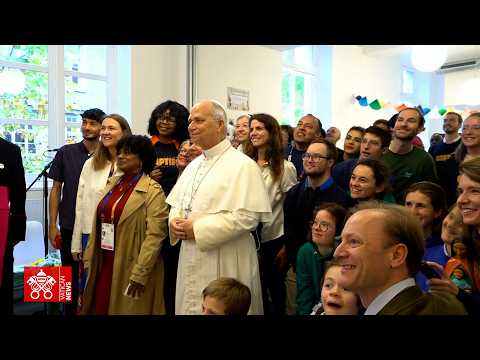
In the morning Pope Leo XIV visits Maison Bakhita, a center for support and social integration of exiled people, greeting the guests and staff of the facility, named after Saint Josephine Bakhita.
🎥 Videos
▶
Visit to the Maison Bakhita Centre
▶
Highlights of the visit to the Maison Bakhita Centre
📷 Photos
The director of Maison Bakhita presents the centre's work to the Pope
Visit to the Maison Bakhita Centre for Social Support and Integration
Dear brothers and sisters, good morning! I am pleased to begin this second day in Paris with you, in a house that bears witness to the whole city that it is possible to encounter one another and to live together in dignity and peace. I thank the Archdiocese of Paris, the Scalabrinian Sisters…
Dear brothers and sisters, good morning!
I am pleased to begin this second day in Paris with you, in a house that bears witness to the whole city that it is possible to encounter one another and to live together in dignity and peace. I thank the Archdiocese of Paris, the Scalabrinian Sisters, and all the staff members and volunteers who bring this place to life and serve those who find here a welcome, a listening ear, formation and friendship. I offer a special word of thanks to those who have shared their testimony.
The name of your Center for Social Support and Integration, which refers to Saint Bakhita, inspires us to recognize the fundamental role of women in building a civilization of love, which is an alternative to a culture that tears communities apart and leaves cities sick with loneliness. When we look closely, the history of the Church and of humanity is not written by those who give the impression of winning by imposing themselves and "dominating the room," but by those who "make room," initiate processes of peace, build trust and encourage life. These are not merely sentiments, but decisions and commitments that run counter to prevailing trends, whose public importance and promise for the future we are recognizing with ever greater clarity. Saint Bakhita invites us to see those who are invisible, to free those whom today's economy and culture enslave, and to honor the immeasurable dignity of every brother and sister, in whom Jesus himself comes knocking at our door.
Dear friends, "for Christians, the poor are not a sociological category, but the very 'flesh' of Christ. It is not enough to profess the doctrine of God's Incarnation in general terms. To enter truly into this great mystery, we need to understand clearly that the Lord took on a flesh that hungers and thirsts, and experiences infirmity and imprisonment" (Apostolic Exhortation Dilexi Te, 110). Christ, poor and crucified, continues to allow himself to be encountered and loved through these men and women, who call us to go beyond ourselves and to dare to practice charity.
Brothers and sisters, a most important insight that inspires your commitment concerns the exchange of gifts, which takes place anew in every encounter. No one is so poor as to have nothing to give; no one is so rich as to have nothing to receive. There is life in abundance wherever each person's limitations become an opening to the mysterious presence of others, in whom the Other par excellence — the God of life — draws near. This does not deny the hardship that sin has introduced into history, but it helps us not to remain imprisoned by it. We proclaim that redemption is possible, that it has begun, that it is ongoing, and that it involves us as living members of the Body of Christ.
Let us also not forget that "the eye cannot say to the hand, 'I have no need of you,' nor again the head to the feet, 'I have no need of you.' On the contrary, the members of the body that seem to be weaker are indispensable" (1 Cor 12:21-22). These words of Saint Paul were addressed to the Christians of Corinth, one of the most prosperous and vibrant cities of his time. There, the Gospel had been embraced by people of diverse origins and social backgrounds, including many who were poor and marginalized (cf. 1 Cor 1:26-29), as is the case for some of you today. "But God," the Apostle continued, "has so arranged the body, giving the greater honor to the inferior member, that there may be no dissension within the body, but the members may have the same care for one another" (1 Cor 12:24-25).
I therefore thank you for your work, as well as all those throughout France who carry out this service in similar institutions. Continue to bear witness to that care for one another which, through fraternal welcome, programs of formation, and dialogue with the city, elevates the spirit and makes the world more humane. May Saint Bakhita, together with the great witnesses of charity who have shaped the presence of the Church in France, especially during periods of tumultuous change, intercede on your behalf.
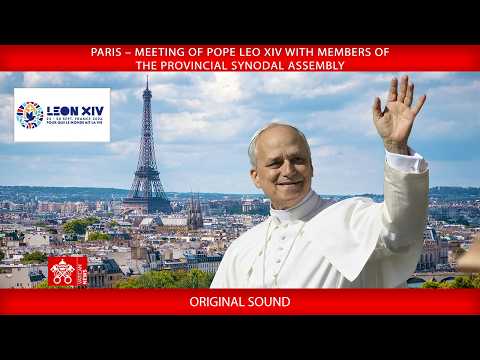
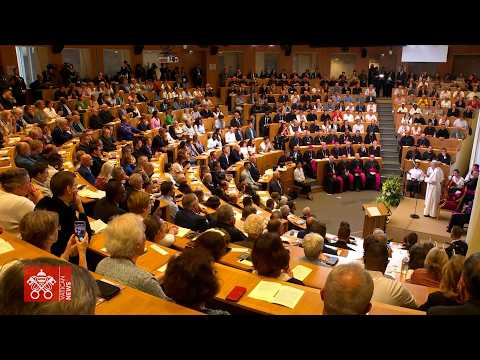
The Pope meets at the Catholic Institute of Paris with members of the provincial synodal assembly, together with catechumens and neophytes, with an address on the synodal path of the Church in France. The Institute occupies the former Discalced Carmelite convent where Brother Lawrence of the Resurrection, author of "The Practice of the Presence of God" and one of the Pope's favorite spiritual writers, entered religious life in 1630; the stop comes amid a notable surge in adult and youth baptisms in France.
🎥 Videos
▶
Meeting with the Provincial Synodal Assembly
▶
Highlights of the meeting with the Provincial Synodal Assembly
📷 Photos
The meeting with the Pope at the Catholic Institute of Paris
Meeting with the Provincial Synodal Assembly, Catechumens and the Newly Baptized
Your Excellencies, dear priests and consecrated persons, dear members of the Synodal Assembly, dear catechumens and newly baptized, brothers and sisters, I am pleased to meet with you and to have this opportunity, as part of my Apostolic Journey, to reflect upon the path you are pursuing in the Provincial Ecclesial Assembly…
Your Excellencies,
Dear priests and consecrated persons,
Dear members of the Synodal Assembly,
Dear catechumens and newly baptized, brothers and sisters,
I am pleased to meet with you and to have this opportunity, as part of my Apostolic Journey, to reflect upon the path you are pursuing in the Provincial Ecclesial Assembly.
I thank His Excellency Archbishop Laurent Ulrich of Paris, who has recalled the historical and spiritual significance of this place, while also drawing our attention to Brother Lawrence of the Resurrection, whose mysticism of everyday life has greatly influenced my own journey of faith. Above all, I express my gratitude for the Instrumentum Laboris that you have presented to me. It is an expression of an ecclesial journey involving the People of God, characterized by mutual listening and synodality.
Today, we are hosted by the Institut Catholique de Paris, an institution situated at the intersection of science and faith that has, for centuries, helped to educate minds and hearts in the service of the Gospel. I would like to greet the faculty, students and staff of this university, as well as all the members of this Provincial Assembly who are involved in reflecting on the pastoral initiatives for welcoming the newly baptized and catechumens, and on the life of the Church.
Having observed your work closely — and, more importantly, having listened to the testimonies of Jaodie Josué, Marielle, and Sophie — I am filled first and foremost with deep gratitude for God's unfathomable work. Like you, and together with you, I am struck by the number of people returning to the threshold of the faith, and by the many adults seeking the sacraments of Christian initiation.
It may seem paradoxical that this phenomenon, in which so many people are rediscovering the Gospel and embracing the faith, is taking place against the backdrop of a society like that of France, which is marked by a deeply secularized culture. Your experience and your testimonies, dear catechumens and newly baptized, are a tangible sign of the action of God's grace, which far surpasses statistical and sociological analysis. This phenomenon, which contradicts every defeatist attitude and what Pope Francis called "sterile pessimism" (cf. Apostolic Exhortation Evangelii Gaudium, 84–86), must be welcomed with a spirit of responsibility.
In fact, we are called to reach out to our brothers and sisters, rediscovering God's own way of acting, which is characterized by closeness, compassion and tenderness. With pastoral tenderness and fraternal charity, we must recognize, welcome and protect the small flame that the Holy Spirit has kindled in the darkness of the night, the tiny seed that strives to grow even amid the thorns.
As we marvel at what is taking place in the lives of so many of our brothers and sisters, we must not become complacent or naively optimistic. On the contrary, we must remain committed, open to searching, asking ourselves questions and implementing concrete pastoral initiatives. It is the Holy Spirit that inspires your Synodal Assembly, and more broadly the life of the Church in France. Filled with wonder at God's surprising work, what is that we must we do, and where is the Spirit leading us with regard to accompanying catechumens, the newly baptized and those "beginning anew"?
First of all, I would like to recall an expression used by the French Episcopate a few years ago, and urge you to envision and embody a Church in a "state of initiation" — one that supports catechumens, the newly baptized and those returning to the faith, offering them, over time, solid and steadfast guidance. Indeed, Christian initiation as a whole has been at the center of pastoral efforts since the years following the Second World War. Even then, there were numerous proposals, and the theological and liturgical developments of those years largely contributed to the renewal of the catechumenate programs during the Second Vatican Council. Although the circumstances today are different, you can draw upon this deeply rooted pastoral tradition regarding the accompaniment of catechumens. Moreover, let us not forget that the practice already in place was further strengthened in 1996, the year in which both the Letter to the Catholics of France and the latest French edition of the Rite of Christian Initiation of Adults were published.
Dear brothers and sisters, being "in the process of initiation" means welcoming those who are newly seeking God, and discovering in them both an opportunity and a mission. The opportunity lies in the fact that, thanks to them, the community of believers can renew its own journey of faith and experience the joy of the Gospel in a new way. The mission, however, consists in nurturing them and offering guidance, even after they have received the sacraments. We must joyfully welcome those who come to us, build on their spiritual experience, respect their personal history, and foster the essential proclamation of the kerygma, even drawing upon the forms they are familiar with from their own personal or communal journey. Moreover, let us not forget that many of these people will later ask the same question we heard in Marielle's testimony: How can one avoid the post-baptismal emptiness?
It is therefore necessary to accompany and fully integrate these people into our communities and prayer gatherings after Baptism, offering them a welcoming environment and a formation that is as comprehensive as possible — one capable of embracing the various aspects of Christian life and fostering harmony between faith and life. As newly baptized persons, they need to deepen their understanding of the foundations of the Christian faith, receive adequate formation in biblical and theological matters, and discover ever more fully the richness of doctrine and the various dimensions of Christian moral action that corresponds to the profession of faith.
Finally, they also need to be initiated and introduced into the liturgical life of the Church. As we have heard in the testimonies, for some, the celebration of liturgical rites has been a point of entry into the mystery of the faith itself. This is a fundamental aspect of the life of the Church, which requires pastoral care that is grounded in the teachings of the Second Vatican Council. Indeed, the liturgy cannot be regarded as something that comes "after" catechesis, where one simply applies what has been learned along the way. On the contrary, it manifests and makes present Christ's Paschal Mystery, and is, therefore, an event capable of revealing the meaning of the Good News and the very life of God. Through its rhythms, languages and rites, the liturgy forms part of the very journey of conversion and preparation for the sacraments.
The role of formators is of fundamental importance in carrying out this mission. As the ancient tradition of the Church teaches us, godfathers and godmothers, representatives of the community, must be prepared and specially trained to initiate the newly baptized. As part of this formation, I would like to recommend a thorough understanding of the Rite of Christian Initiation of Adults. At the same time, pastoral workers must be trained not only in the Bible, theology, liturgy and the spiritual life, but also in human qualities, so they know how to guide and accompany those people whose life journeys are more complex and less straightforward. As we heard just a moment ago, some people come with a simple spiritual thirst, a search for meaning, and an attraction to the Gospel, while others arrive burdened by painful experiences, situations of loneliness, and profound difficulties. It is here that a style of closeness, compassion and tenderness takes on its full meaning, and we must strike a wise balance in order to welcome them and listen to them, while also encouraging them to face the challenging demands of the faith. It is a journey in which we must respect each person's pace, proceeding gradually and carefully with fraternal accompaniment. It means adopting the style of "walking together." Along the pathways of the Christian faith, we enrich one another, we grow together as priests and laypeople, godparents and catechumens, pastoral leaders and the newly baptized.
I am reminded of what happened to Saint Augustine, one of the most famous catechumens in history. He was introduced to the faith by Saint Ambrose, and his faith was but a tiny seed when he was baptized. Yet that seed grew and multiplied, becoming a tree so large that, even today, we can find shelter beneath its branches.
Looking at you, dear catechumens and newly baptized persons, I see not only the fruits of the Holy Spirit, who set you on this path, but also the promise of fruitfulness for the Church in France. In turn, be missionaries of the Gospel in this society!
May the great witnesses of this beloved land sustain you on your journey. I think of Saint Thérèse of the Child Jesus, who teaches us, through her "little way," how trust opens the doors to grace, and of Saint Martin of Tours, an emblematic figure of sharing and fraternal charity. Together with the many other saints from this land of France, they remind us that mission is built today, above all, by remaining faithful to the Lord's presence in daily life.
By welcoming one another, together may you form the living people of the Church in France, capable of passing on the faith. Invoking upon all of you the maternal protection of the Virgin Mary, the principal Patroness of France, and the intercession of Saint Genevieve and Saint Denis, the protectors of this city, I cordially impart my Blessing.
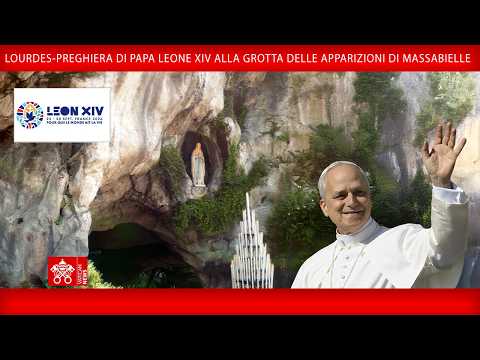
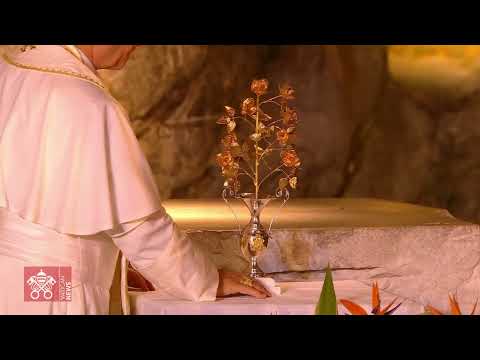
In the evening Pope Leo XIV flies from Paris/Orly and arrives at Tarbes-Lourdes-Pyrénées airport; he arrives in Lourdes at exactly 7pm and, before going to silent prayer at the Grotto of Massabielle, inaugurates the "Leo XIV Bridge", a crossing over the Gave dating back to 1930 and restored in 2026. He then performs the traditional rites of the pilgrim: he prays on his knees, touches the rock, drinks the spring water offered by the Sanctuary's rector Fr Michel Daubanes, lights a candle and presents a Golden Rose, entrusting France and the intentions of the sick and suffering present to Our Lady.
🎥 Videos
▶
Pope Leo XIV's prayer at the Grotto of Massabielle
▶
Highlights of the prayer at the Grotto of the Apparitions
Prayer at the Grotto of the Apparitions of Massabielle
Our Lady of Lourdes, the Immaculate Conception, in this blessed place you spoke with such gentleness and tenderness to Saint Bernadette, a humble daughter of the French people, to convey to the world a radiant message of prayer, conversion and hope. We turn to you with trust…
Our Lady of Lourdes, the Immaculate Conception, in this blessed place you spoke with such gentleness and tenderness to Saint Bernadette, a humble daughter of the French people, to convey to the world a radiant message of prayer, conversion and hope. We turn to you with trust, for you are the Mother whom Jesus has given, and you are attentive to all our needs.
We pray to you, our Mother, for France, for you are her Patroness and have protected her for so many centuries. Grant its people the gift of fraternal harmony, so that they may build a harmonious society that banishes all violence and hatred, and allows everyone to work, to start a family and to live life to the fullest in peace and serenity. May the most disadvantaged and the poorest always be supported. Obtain for France wise and generous leaders, ready to make sacrifices, capable of responding to challenges, and eager to serve the common good. May they keep France at peace within the family of nations, and may they make her voice heard in promoting the defense of fundamental human rights and peace in the world, rejecting the mentality of war once and for all.
Blessed Virgin Mary, we present to you the People of God journeying in this country, which you have so deeply marked with your presence. Renew the faith and fervor of Christian families, who are so dear to your heart, so that they may live day by day in the presence of Jesus, in his grace, and with his support through the difficulties they face. May they be generously open to life, and may God awaken vocations within them, especially to the priesthood and religious life. Grant that your Church in France may show, especially to the youngest among them, the luminous path of the Gospel, so that they may build the just and fraternal society to which they aspire.
Finally, Mother full of love, we entrust to you our most urgent personal intentions, especially those of the sick and suffering, as well as all those who accompany them, who have come together to find strength and healing at the spring of Massabielle. We entrust to you our living and deceased loved ones. We pray that you will remove all the obstacles that still separate us from your beloved Son and that he may reign in all hearts.