Sunday 27 September 2026 — Pilgrimage to the Sanctuary of Lourdes
11:00
Lourdes, France
🕯️ Pilgrimage to Lourdes
Holy Mass and Angelus in the Sanctuary's Prairie
📍 Lourdes, France
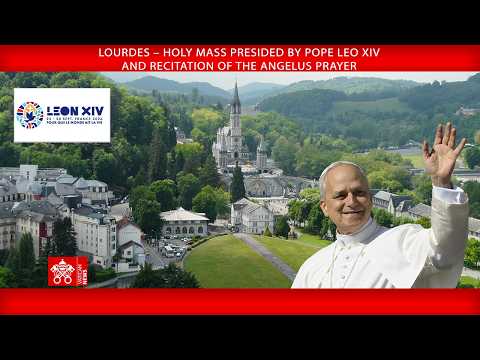
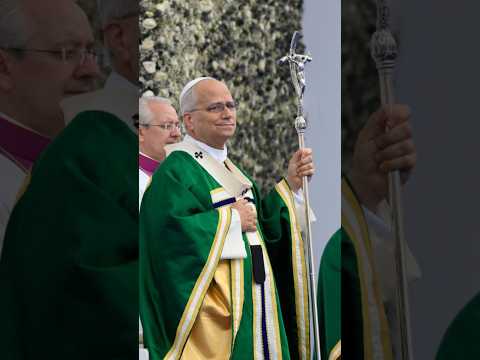
Fourth day of the apostolic journey to France: after the morning meeting with the French bishops, Pope Leo XIV presides at 11:00 AM over Holy Mass in the great Prairie of the Sanctuary of Our Lady of Lourdes, open to all pilgrims, followed by the recitation of the Angelus. About 150,000 faithful are present, including around 7,000 registered sick pilgrims. In the homily the Pope says that "no fragility is rejected" at the Grotto of Massabielle, which stands as "a sanctuary of Christian hope" against "current trends that seek to redefine the value of human life in the face of illness, suffering or old age." At the Angelus he appeals for the Rosary to be prayed throughout October for peace among peoples in conflict.
Brothers and sisters, pilgrims from France and from around the world, looking at you this morning, gathered in the house of our Mother, I see the universal face of the Church. Some of you have crossed continents, endured hardships, and carried your joys and burdens all the way to this holy Grotto. What joy it is to be together, one heart, one family!…
Brothers and sisters, pilgrims from France and from around the world, looking at you this morning, gathered in the house of our Mother, I see the universal face of the Church. Some of you have crossed continents, endured hardships, and carried your joys and burdens all the way to this holy Grotto. What joy it is to be together, one heart, one family!
I wish to extend a special greeting to the pilgrims who have come from every province and diocese of France. Today you walk on the soil of this blessed land that has received so many graces. May this pilgrimage rekindle the flame of faith in your homes and parishes. Bring the comfort of Lourdes to your neighbors, your loved ones, and the whole French people.
The texts the Liturgy offers us this Sunday touch on a central aspect of the message the Virgin Mary came to entrust to Saint Bernadette: an invitation to conversion, at once tender and pressing. In the Gospel, Jesus turns a gaze of truth and deep sorrow on closed hearts: "you did not even repent." Why this wound in the Heart of Christ? Because God does not want the ruin of his children. The prophet Ezekiel reminds us: "If the righteous man turns away from righteousness and commits evil, and dies because of this, he dies for the evil he has committed," while if he converts, if "he has reflected and turned away from all the sins he committed, he shall surely live, he shall not die." This is why calls to penance resound in Sacred Scripture and run through the whole preaching of the Gospel across the centuries. They take on a saving urgency: it is today — not tomorrow — that we must convert; today is the favorable time, the day of salvation. Yes, God desires that man may live, that he may open his eyes and return to Him. To convert means to abandon the paths of error to embrace the Way of Life, thus opening our hearts to the one Joy that does not pass away.
Jesus himself does not mince words when he urges penance, as Saint Luke tells us: "unless you repent, you will all perish." But he broadens the horizon of earthly life to that of eternal life. While happiness here below is a fleeting, relative reality, sometimes sadly inaccessible to some, true happiness is promised to all, in hope, and should be the principal object of our search, our efforts and our choices. Did not the Virgin Mary say to Saint Bernadette: "I do not promise to make you happy in this world, but in the next"?
This promise, proclaimed right here, resounds with particular force in this land of France and shakes our contemporary mindsets. In this historical moment, within a society in search of progress and material well-being, but sometimes tempted to forget the horizon of eternity, Mary comes to remind us of the greatness and scope of our vocation to life, to eternal life. In the face of current trends that seek to redefine the value of human life in the face of illness, suffering or old age, the Grotto of Massabielle stands as a sanctuary of Christian hope. Here, no fragility is rejected. Your crutches, your wheelchairs, your hidden tears are not obstacles: they are the very place where you are fully respected, welcomed and transfigured by God's infinite love. Lourdes is the blessed place of a profession of faith in the beauty and sacredness of life, for here it is received as a precious gift of God, called to flourish for eternity in the Father's love.
"I promise you that"! Yes, eternal life is a solid and certain promise that the Lord makes to us. He has already won it for us through his death on the cross and his resurrection, and he brings it about in us every day through the grace of baptism. It is within our reach, but it is up to us to freely accept it, to grasp it, not to hinder it; but the obstacle to grace and eternal life, the only obstacle to this love, is sin, self-absorption, that refusal of God that shuts us up in our own darkness! Our personal responsibility is therefore at stake, and it is great. God willed us to be free, because freedom is a condition of love; one cannot love by constraint. This freedom given to us, we must commit to a "yes" to Christ and, with the help of his grace, following in Mary's footsteps; a "yes" ceaselessly renewed, to our last breath: "now and at the hour of our death…", as we say in the Hail Mary.
We find again the insistent call to conversion in the words Mary spoke right here: "Penance! Penance! Penance!". She repeats the word three times… And she invites Bernadette to perform certain gestures. Why? Are we perhaps slow to understand? Do we too easily consider ourselves without sin? Do we not practice it enough? The Virgin asks us to do penance, not only for ourselves, who need it, but also "for sinners," for a world that is going badly. How could our hearts not feel challenged in the face of ever more widespread conflicts, which destroy so many innocent lives? Yet the evil that afflicts our age comes from the human heart; God is not responsible for it: "It is not my way that is unjust — he says to the children of Israel — but yours." It is therefore the hearts of men that must change, beginning with our own.
Penance is a work brought about by love in solidarity with humankind: love for God, whose wounded Heart, caused by our sins, we wish to repair; love for all our brothers and sisters who do not heed this call to conversion and whom their faults drag toward death. This need for conversion involves the Church herself in her earthly pilgrimage. She must have the courage to live this conversion first of all. To heal from the deep wounds, the infidelities and the painful failings committed within her, we must humbly place ourselves under the purifying gaze of the Lord. Recognizing our errors is indispensable for spiritual growth, as Saint Augustine wrote: "May you always be displeased with what you are, if you wish to attain what you are not."
Our Mother's call to the duty of prayer and conversion fills us with great hope, for it shows us the way to change the course of things, which is none other than to unite ourselves to the passion of Christ. Dear sick, who know suffering, so numerous here in Lourdes, you have the possibility of living your trials and your pains in this spirit of offering, entering into that redemptive path the world so greatly needs. In this sense you are truly at the heart of the Church, and your role is irreplaceable.
Pilgrims, brothers and sisters, you will not leave Lourdes as you arrived: you will leave as missionaries of hope. This is the miracle of this place: to awaken the joy of hope right in the heart of trial and pain. The Virgin Mary heals our gaze and transfigures our hearts, giving them peace. Be, in your countries, your dioceses and your families, active witnesses of this divine strength and tenderness, which allow us to continue on our way and reach our destination. Sustained by the prayer of the sick and the love of our Mother, walk with confidence toward the future. Do not fear the storms of the world: the Holy Mother of God watches over your path, wraps the Church in her mantle of tenderness and, like a radiant Morning Star, guides your steps so that you may be born, in joy, into the very life of her Son Jesus.
Dear brothers and sisters, I greet with affection all of you who have taken part in this Eucharistic celebration. Thank you for your presence! I extend my greeting to all who, especially the sick, have joined us through the media…
Dear brothers and sisters, I greet with affection all of you who have taken part in this Eucharistic celebration. Thank you for your presence! I extend my greeting to all who, especially the sick, have joined us through the media.
Let us now recite the Angelus prayer, a simple and wonderful prayer that helps us live each day in adherence to God's will, following the example of the Virgin Mary.
Before doing so, I would like to make an appeal that I feel strongly in my heart, being in this place. Here the Immaculate appeared to Saint Bernadette holding the crown of the Rosary, and it seemed to guide her prayer. This is why today I invite all the faithful and all Christian communities to pray the holy Rosary throughout the coming month of October, with the particular intention that wars may cease and peace be made among peoples in conflict. Let us accompany our prayer with concrete acts of penance and mercy and with a commitment to always foster dialogue and reconciliation.
The Pope privately meets the Bishops of the French Bishops' Conference, gathered in Lourdes for the occasion, with an address on the life and mission of the Church in France. In his remarks, the Pontiff addresses the wound of sexual abuse committed by members of the clergy, calling it "a painful scourge," and urges the bishops to maintain "maximum vigilance" through listening to victims, the pursuit of truth, justice and prevention.
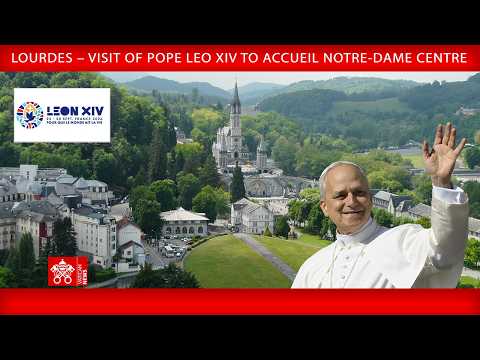
In the afternoon Pope Leo XIV meets the sick, volunteers and staff of the Accueil Notre-Dame, the facility that has welcomed sick pilgrims at the Sanctuary of Lourdes for over 150 years. In his address he says human dignity "cannot be measured or debated" and that "the temptation to take life under the pretext of false compassion must be firmly rejected," reaffirming that "medicine can never become a servant of programmed death." To the sick he says: "you are not a burden, you are the beating heart of our humanity and a precious treasure for the Church." At the end he gives the Accueil a glazed ceramic reproduction of the Annunciation by Andrea della Robbia (1475), then goes up to the fifth floor of the facility to greet more sick pilgrims before walking to the Carmel.
🎥 Videos
▶
Visit to Accueil Notre-Dame in Lourdes
📷 Photos
The Pope's address at the Accueil Notre-Dame in Lourdes
The Pope greets the sick and volunteers of the Accueil
A moment from the meeting with sick pilgrims
The Pope's gift to the Accueil Notre-Dame: the Annunciation ceramic
Meeting with the sick and healthcare workers at the Accueil Notre-Dame
Dear brothers and sisters, dear sick friends, it is a great joy for me to spend this moment with you, here, in Lourdes, where, for over one hundred and fifty years, pilgrims from all over the world have come to entrust to Jesus, through Mary, their sufferings, whether physical, psychological or spiritual…
Dear brothers and sisters, dear sick friends,
It is a great joy for me to spend this moment with you, here, in Lourdes, where, for over one hundred and fifty years, pilgrims from all over the world have come to entrust to Jesus, through Mary, their sufferings, whether physical, psychological or spiritual. Here fragility is not hidden, but becomes the place of a sacred encounter.
This year, the Sanctuary's pastoral theme takes up the angel Gabriel's greeting to Mary: "Rejoice, full of grace: the Lord is with you" (Lk 1:28). It highlights this wonderful exchange between two gazes, that of the Lord's messenger and that of Mary. In this face-to-face encounter, the humility and generosity of a young girl allow God to carry out his work of salvation. Mary did not keep the Lord for herself, but offered him to the world, telling each one of us: "The Lord is with you." This truth is the foundation of our dignity as persons. And here Mary looks at each of us as a unique person, as Saint Bernadette testifies during the apparitions in the grotto. This maternal gaze reaffirms to us that no one is invisible in the eyes of God.
In an age when some societies tend to look away or close their eyes before the dignity of human life, "there is need first of all to cultivate, in ourselves and in others, a contemplative outlook […]. It is the outlook of those who see life in its deepest meaning, who grasp its utter gratuitousness, its beauty and its invitation to freedom and responsibility. It is the outlook of those who do not presume to take possession of reality but instead accept it as a gift, discovering in all things the reflection of the Creator and seeing in every person his living image (cf. Gen 1:27; Ps 8:6). This outlook […] leads to accepting the person who struggles as a summons to solidarity and to dialogue" (St. John Paul II, Enc. Letter Evangelium vitae, 83), so that the world may have life.
In the dialogue of the Annunciation, as the Lord fixes his gaze upon her, Mary discovers that she is God's chosen one. But at the center of this encounter, each of us discovers that we are personally called and profoundly destined for the love of God, which is the source of life. The human person is in fact "worthy" by the simple fact of existing and of having eternity as its end. Its dignity cannot be measured or debated.
I know that for some of you, because of particular illnesses and sometimes terrible pain, the horizon may seem dark, uncertain, without a way out. But no human law must make you lose the certainty of your dignity. On the contrary, it is precisely in the name of this inalienable dignity of the human person that the temptation to take life under the pretext of false compassion must be firmly rejected. It is impossible to consider taking life as normal. What is legal is not necessarily moral.
Here in Lourdes, city of the sick and of hope, I invite the whole community of healthcare workers to remember the deep meaning of your vocation: to care for a person who suffers, and not to eliminate them. Yes, dear friends, be passionate servants of life! No one has the right, ever, "on the basis of laboratory algorithms, to decide the life of a given embryo or of a given elderly person! Medicine can never become a servant of programmed death!" (Address to members of the Fondation Jérôme Lejeune, June 22, 2026). In this sense, I invite you, on the one hand, to develop tirelessly the structures of palliative care and research; and on the other, to accompany the sick with tenderness, as happens here in Lourdes, where doctors, nurses, stretcher-bearers, chaplains, pastoral teams for the sick and many others exercise their vocation in the service of the dignity of the human person, so that the world may have life. In caring for bodies, you also care for souls. To you, dear members of the hospitality associations, but also to you, healthcare workers, who devote yourselves to the service of your brothers and sisters, I express all my gratitude. Dear sick brothers and sisters, I want to tell you: you are not a burden, you are the beating heart of our humanity and a precious treasure for the Church. I accompany with prayer the trials you are going through. My thoughts go to all those who cannot be here and who, from their homes or their hospital rooms, are united with our gathering. I entrust you all to the maternal love of the Mother of the Lord, asking her to obtain for you the consolations of her Son Jesus. May God bless you and protect you!
After visiting the Accueil Notre-Dame, the Pontiff walks to the Carmelite Monastery of Lourdes for a private meeting with the contemplative religious sisters.
At 18:00, behind closed doors at the bishop's palace in Lourdes, Pope Leo XIV privately meets seven victims of sexual abuse committed by members of the Church, according to the French Bishops' Conference. They are not representatives of a collective but individuals met one by one; five of them have made their identities public, including Bertrand Virieux, a victim of former priest Bernard Preynat, convicted in 2020. The group met on September 14 to prepare for the encounter and issued a joint statement noting that "engaging in dialogue does not mean giving our endorsement." Some French victim-support associations have criticized the choice of a purely individual format, without collective representation. In his morning address to the French bishops, the Pope called abuse "a painful scourge" and said that "recognizing our errors is indispensable" for the Church's conversion. In the days before the visit, the Sanctuary also covered the mosaics created by Father Marko Rupnik, who is accused of sexual abuse, on the facade of the Basilica of the Rosary.
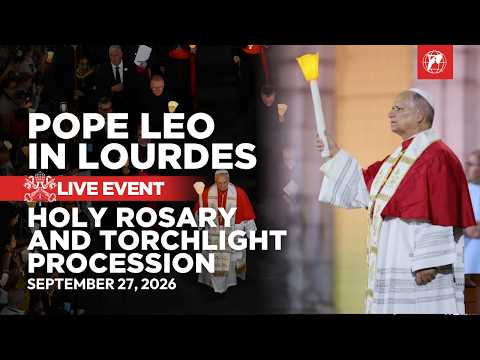
The day ends with the recitation of the Holy Rosary and the traditional Marian torchlight procession, one of the most evocative moments of the Lourdes pilgrimage.
🎥 Videos
▶
Live broadcast of the Rosary and Torchlight Procession in Lourdes
🗓️ Upcoming events
2026-09-28
✈️ Holy Mass in Metz
Final stop of the apostolic journey to France, with Mass at Saint-Étienne Cathedral.