In the afternoon Pope Leo XIV meets the sick, volunteers and staff of the Accueil Notre-Dame, the facility that has welcomed sick pilgrims at the Sanctuary of Lourdes for over 150 years. In his address he says human dignity "cannot be measured or debated" and that "the temptation to take life under the pretext of false compassion must be firmly rejected," reaffirming that "medicine can never become a servant of programmed death." To the sick he says: "you are not a burden, you are the beating heart of our humanity and a precious treasure for the Church." At the end he gives the Accueil a glazed ceramic reproduction of the Annunciation by Andrea della Robbia (1475), then goes up to the fifth floor of the facility to greet more sick pilgrims before walking to the Carmel.
🎥 Videos
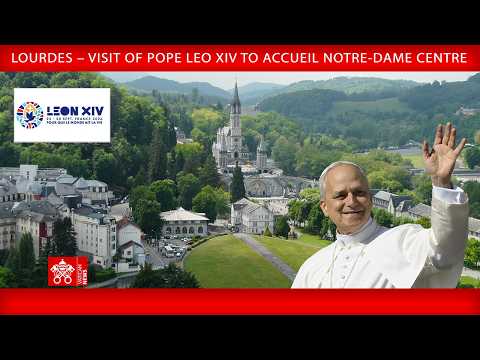
▶
Visit to Accueil Notre-Dame in Lourdes
📷 Photos
The Pope's address at the Accueil Notre-Dame in Lourdes
The Pope greets the sick and volunteers of the Accueil
A moment from the meeting with sick pilgrims
The Pope's gift to the Accueil Notre-Dame: the Annunciation ceramic
Meeting with the sick and healthcare workers at the Accueil Notre-Dame
Dear brothers and sisters, dear sick friends, it is a great joy for me to spend this moment with you, here, in Lourdes, where, for over one hundred and fifty years, pilgrims from all over the world have come to entrust to Jesus, through Mary, their sufferings, whether physical, psychological or spiritual…
Dear brothers and sisters, dear sick friends,
It is a great joy for me to spend this moment with you, here, in Lourdes, where, for over one hundred and fifty years, pilgrims from all over the world have come to entrust to Jesus, through Mary, their sufferings, whether physical, psychological or spiritual. Here fragility is not hidden, but becomes the place of a sacred encounter.
This year, the Sanctuary's pastoral theme takes up the angel Gabriel's greeting to Mary: "Rejoice, full of grace: the Lord is with you" (Lk 1:28). It highlights this wonderful exchange between two gazes, that of the Lord's messenger and that of Mary. In this face-to-face encounter, the humility and generosity of a young girl allow God to carry out his work of salvation. Mary did not keep the Lord for herself, but offered him to the world, telling each one of us: "The Lord is with you." This truth is the foundation of our dignity as persons. And here Mary looks at each of us as a unique person, as Saint Bernadette testifies during the apparitions in the grotto. This maternal gaze reaffirms to us that no one is invisible in the eyes of God.
In an age when some societies tend to look away or close their eyes before the dignity of human life, "there is need first of all to cultivate, in ourselves and in others, a contemplative outlook […]. It is the outlook of those who see life in its deepest meaning, who grasp its utter gratuitousness, its beauty and its invitation to freedom and responsibility. It is the outlook of those who do not presume to take possession of reality but instead accept it as a gift, discovering in all things the reflection of the Creator and seeing in every person his living image (cf. Gen 1:27; Ps 8:6). This outlook […] leads to accepting the person who struggles as a summons to solidarity and to dialogue" (St. John Paul II, Enc. Letter Evangelium vitae, 83), so that the world may have life.
In the dialogue of the Annunciation, as the Lord fixes his gaze upon her, Mary discovers that she is God's chosen one. But at the center of this encounter, each of us discovers that we are personally called and profoundly destined for the love of God, which is the source of life. The human person is in fact "worthy" by the simple fact of existing and of having eternity as its end. Its dignity cannot be measured or debated.
I know that for some of you, because of particular illnesses and sometimes terrible pain, the horizon may seem dark, uncertain, without a way out. But no human law must make you lose the certainty of your dignity. On the contrary, it is precisely in the name of this inalienable dignity of the human person that the temptation to take life under the pretext of false compassion must be firmly rejected. It is impossible to consider taking life as normal. What is legal is not necessarily moral.
Here in Lourdes, city of the sick and of hope, I invite the whole community of healthcare workers to remember the deep meaning of your vocation: to care for a person who suffers, and not to eliminate them. Yes, dear friends, be passionate servants of life! No one has the right, ever, "on the basis of laboratory algorithms, to decide the life of a given embryo or of a given elderly person! Medicine can never become a servant of programmed death!" (Address to members of the Fondation Jérôme Lejeune, June 22, 2026). In this sense, I invite you, on the one hand, to develop tirelessly the structures of palliative care and research; and on the other, to accompany the sick with tenderness, as happens here in Lourdes, where doctors, nurses, stretcher-bearers, chaplains, pastoral teams for the sick and many others exercise their vocation in the service of the dignity of the human person, so that the world may have life. In caring for bodies, you also care for souls. To you, dear members of the hospitality associations, but also to you, healthcare workers, who devote yourselves to the service of your brothers and sisters, I express all my gratitude. Dear sick brothers and sisters, I want to tell you: you are not a burden, you are the beating heart of our humanity and a precious treasure for the Church. I accompany with prayer the trials you are going through. My thoughts go to all those who cannot be here and who, from their homes or their hospital rooms, are united with our gathering. I entrust you all to the maternal love of the Mother of the Lord, asking her to obtain for you the consolations of her Son Jesus. May God bless you and protect you!