Saturday 7 November 2026 — Uruguay: Holy Mass in Paysandú, Casavalle and vigil at Estadio Centenario
10:20
Parque París Londres, Paysandú, Uruguay
⛪ Holy Mass
Holy Mass in Paysandú
📍 Parque París Londres, Paysandú, Uruguay
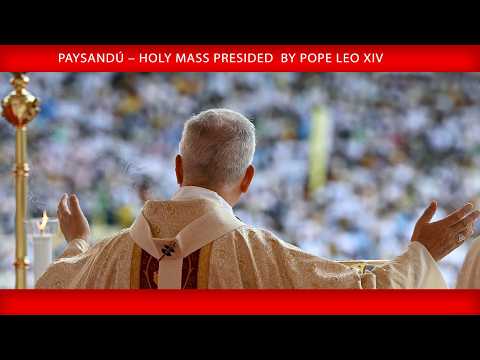
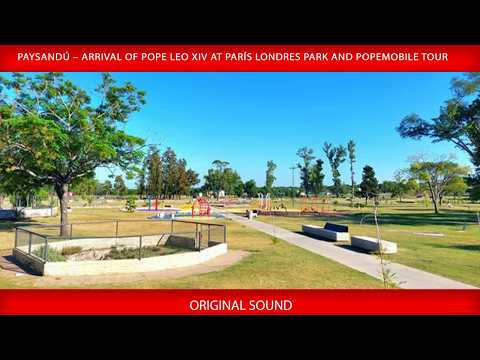
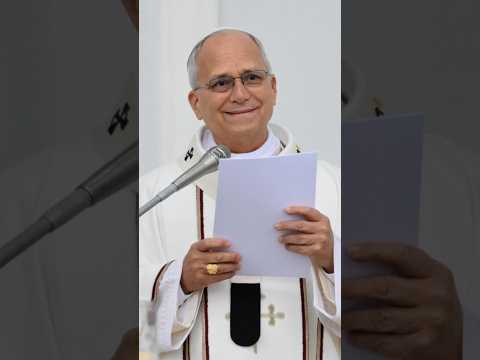
The first Mass of the Latin American journey began at 10:20 in Parque París Londres, Paysandú, after a popemobile tour among the faithful: according to local authorities, about 40,000 people attended. In his homily the Pope recalled Blessed Jacinto Vera, the “gaucho bishop” who in 1864 assisted the wounded of both sides during the siege of Paysandú, and proposed three symbols of the region: the General Artigas International Bridge (being builders of bridges, with solid Christian formation), the palm trees (rooted in Christ and united as a community) and mate (a sign of friendship, encounter and prayer). “Be bridges, so that many may encounter Jesus. Christ is counting on you!” At the end, the Bishop of Salto, Arturo Eduardo Fajardo Bustamante, thanked the Pope.
Homily at Holy Mass in Parque París Londres, Paysandú
Dear brothers and sisters,
The readings we have just heard describe the figure of a righteous man whom the Lord helps and strengthens so that he may carry out the mission entrusted to him. In his Letter to the Philippians, Saint Paul expresses gratitude for the community’s support of his missionary work, conscious that, in his poverty, God is his
Dear brothers and sisters,
The readings we have just heard describe the figure of a righteous man whom the Lord helps and strengthens so that he may carry out the mission entrusted to him. In his Letter to the Philippians, Saint Paul expresses gratitude for the community’s support of his missionary work, conscious that, in his poverty, God is his only wealth and that divine providence is made manifest through the brothers and sisters to whom he has been sent.
The Psalm, for its part, calls blessed those who love the law of the Lord and whose deeds are consistent with their faith. Similarly, in the Gospel, Jesus emphasizes the honest man who serves God and who places the Lord at the center of his life, remaining faithful in everything entrusted to him, whether it be great or small.
Today, as we gather here in Paysandú to celebrate the Eucharist — rejoicing to see so many members of the Church in Uruguay assembled around the same table, together with pilgrims from neighboring countries — the Liturgy of the Word invites us to recall the presence of so many people of faith who came to the Río de la Plata region. From the earliest days of evangelization on this continent, they arrived in the name of the Lord to proclaim the great joy they themselves had experienced in encountering Christ. Like the angels who appeared to the shepherds (cf. Lk 2:10), they joyfully shared the Good News of the Gospel, expressing their faith through works of charity and mercy.
In this celebration, we also wish to remember and give thanks to God for the life and ministry of a son of this land: Blessed Jacinto Vera, Bishop of Montevideo, who bore faithful witness to the faith he proclaimed through generous charity and total dedication to the apostolic mission. He widely exercised his pastoral zeal, sparing no sacrifice. For instance, he often traveled on horseback to care for the sick, despite the great distances, the dangers of the journey, and the harsh weather. The “gaucho bishop” traveled the length and breadth of Uruguay three times, bringing faith and hope to its people. During the historic Siege of Paysandú in 1864, Bishop Vera took up residence on the Isla de la Caridad, across from the besieged city, to care for refugees and the wounded on both sides. He remained there until the siege ended, accompanying his people and pleading in the name of God for the armies of brothers to embrace one another in fraternal love.
Dear brothers and sisters, today it is our turn to continue the legacy left to us by these sowers of the Gospel. We must do so bearing in mind the word of God: with justice, honesty and faithfulness, recognizing that the message we proclaim does not belong to us. It is a treasure we have received from the Lord, and we carry it in earthen vessels (cf. 2 Cor 4:7).
Three symbols that characterize this region can help us reflect on the treasure of faith we have received and the mission now entrusted to us. The first is the bridge; the second the palm groves; and the third is the mate drink.
In this city of Paysandú stands the General Artigas International Bridge, which spans the Uruguay River, uniting two neighboring countries. It is not difficult to imagine the benefits a bridge brings: openness, communication and exchange. That is why it is so important to be builders of bridges! This is the vocation to which we are all called: to build bridges, strengthen bonds, unite, communicate and share the joy of faith, as Blessed Jacinto Vera did, “whether the time is favorable or unfavorable” (2 Tim 4:2).
Moreover, a bridge needs solid foundations if it is to withstand even the strongest currents. Indeed, just as a house built on rock stands firm in the midst of a storm, while one built on sand is in danger of collapsing (cf. Mt 7:24-27), so too a bridge needs proper foundations to withstand the force of wind and water. Whenever you go down to the riverbank and see the bridge, remember that this symbol represents us and reminds us of the importance of a solid Christian formation. We need to be well prepared to give an account of our faith to anyone who asks (cf. 1 Pet 3:15) and not allow ourselves to be carried away “by all kinds of strange teachings” (Heb 13:9). Only in this way can we become instruments of unity and bonds of charity.
The second symbol that characterizes and embellishes this land is the palm groves. The Book of Psalms tells us that “the righteous flourish like the palm tree” (Ps 92:12). This tree can withstand strong winds, has deep roots, rises straight toward the sky in search of light, and produces the sweet yatay fruit. This is a beautiful image of our origin and the destiny to which we are called: to take root in Christ, the Alpha and the Omega, the Beginning and the End of our lives, so that, by remaining united to him, we may bear good fruit (cf. Jn 15:5).
At the same time, we observe that palm trees in this region do not stand alone, but form groves; there are many of them, yet they are neither alone nor far apart. Likewise, the Church is a community of brothers and sisters that sinks its roots and draws from a common spring: the word of God, the sacraments, prayer and charitable works. Together, her faithful lift their eyes to praise Christ — the dawn from on high, whose light guides humanity’s steps along the path of peace (cf. Lk 1:78-79).
Finally, let us consider a symbol found in every home in this country, in every place of study and work, and at every gathering of friends. I am referring to mate, that drink so characteristic of South America, whose profound meaning you can explain better than I can. Surely, many of you enjoyed mate on your way to this celebration today and will have some again on your journey home. Mate has even made its way to Rome!
Mate is a sign of familiarity, friendship and encounter. It teaches us to share and to be together, strengthening the bonds that unite us as brothers and sisters. It is a sign of welcome, integration and shared values. “Drinking mate” is a ritual rich in symbolism, in which dialogue takes place without words and every detail holds its own meaning. I also think of those moments when one drinks mate alone, silently and prayerfully. In those moments of solitude, how often have so many of you entrusted to God your concerns and needs, your deepest desires and longings!
Dear brothers and sisters, we must reflect on these symbols that we share, which give us identity and a sense of belonging, which speak to us of our origins and point us toward the future. Faith, too, has been part of the life of the Uruguayan people since their earliest days, and it must be passed on to future generations with creative courage.
In today’s Gospel, Jesus reminds us of the importance of being faithful to the gifts we have received: “Whoever is faithful in a very little is faithful also in much” (Lk 16:10). Many men and women, like Bishop Jacinto Vera, lived out these words. Faithful to the vocation they had received, they sowed the seeds of the Gospel in the hearts of the Uruguayan people. Those seeds remain alive in the community, but it is essential to continue providing the necessary conditions for them to grow and reach their full potential. This involves continuing to educate children and young people in the faith, accompanying families, supporting the elderly and carrying out works of charity.
Dear brothers and sisters, I encourage you to carry forward the mission of evangelization with enthusiasm. Be bridges, so that many may encounter Jesus. Be a fraternal community that comes together and shares life, projects, dreams and hopes, especially with those most in need. Be a community of prayer that maintains an ongoing dialogue with the Lord as a friend speaks to a friend (cf. Jn 15:15). Christ is counting on all of you! Christ is counting on you!
May our heavenly Mother, Our Lady of the Thirty-Three, protect you on your journey through life and always guide you to an encounter with her Son, Jesus.
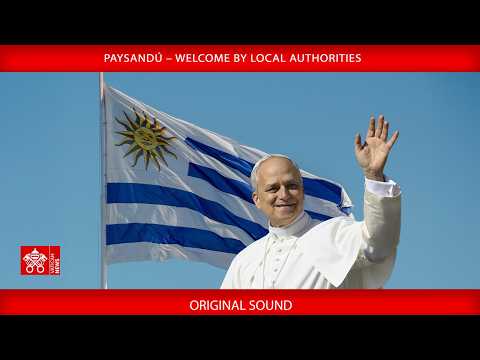
Second day of the Apostolic Journey in Uruguay. At 7:45 the Pope went to the “General Cesáreo L. Berisso” Air Base in Montevideo; take-off was at 8:37 and landing at Paysandú's “Brigadier General Aviator Tydeo Larre Borges” International Airport at 9:38, where he was welcomed by local authorities.
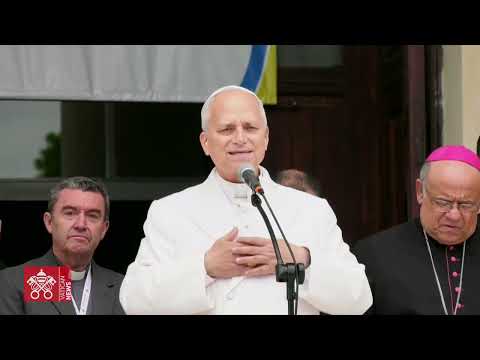
Leaving Parque París Londres around 11:35, the Pope stopped at the Basilica of Our Lady of the Rosary for a moment of prayer; outside, before about a thousand people, he spoke a few off-the-cuff words, unveiled a plaque commemorating the visit and greeted the sick. At the airport he signed the city's book of honour and received a gift from the Intendente of Paysandú. Take-off at 12:41, arrival at the Montevideo Air Base scheduled for 13:30, followed by transfer to the Nunciature.
🎥 Videos
▶
Transfer to Paysandú Airport (Vatican News)
▶
Greeting to the faithful at the Cathedral Basilica of Paysandú (Vatican News, in Spanish)
📷 Photos
Leo XIV in the Basilica of Our Lady of the Rosary in Paysandú (Vatican Media)
Greeting the faithful outside the Basilica in Paysandú (Vatican Media)
Leo XIV in the Basilica of Our Lady of the Rosary in Paysandú (Vatican Media)
Leo XIV in the Basilica of Our Lady of the Rosary in Paysandú (Vatican Media)
Leo XIV in the Basilica of Our Lady of the Rosary in Paysandú (Vatican Media)
Impromptu greeting to the faithful in front of the Basilica of Our Lady of the Rosary, Paysandú
Good morning!
Thank you very much for the warm welcome and for being here.
As you may have heard in the homily during Holy Mass, I spoke of three symbols, three expressions that reflect very well part of life, part of our Christian life. First, being bridge-builders — just as you here have this bridge that unites countries, we must build bridges
Good morning!
Thank you very much for the warm welcome and for being here.
As you may have heard in the homily during Holy Mass, I spoke of three symbols, three expressions that reflect very well part of life, part of our Christian life. First, being bridge-builders — just as you here have this bridge that unites countries, we must build bridges that unite all peoples. They unite us in faith, they unite us because we believe in one God, we believe that peace is possible and we want to build peace.
The palm groves symbolize that we want to be gathered together, that we want to build communities of faith.
And mate — this expression so important in your culture — where two friends or two family members come together, often sharing in a dialogue without words, yet united in sharing life, its difficulties as well as its joys. May these symbols also help us to continue living our lives despite sorrow, difficulties and challenges, seeking God’s presence among us and receiving from the Lord the strength and courage to live out our faith, to proclaim our faith in Jesus Christ, who has given us life. I offer you this blessing as a small gesture of my desire always to be close to you.
The Lord be with you.
May the blessing of Almighty God, the Father, and the Son, and the Holy Spirit, descend upon you and be with you always. Amen.
📍 Parish of Our Lady of Guadalupe, Casavalle, Montevideo, Uruguay
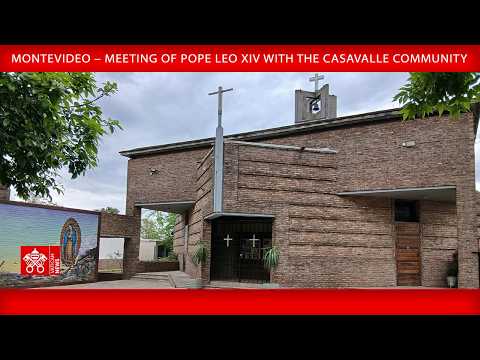
On the way, the Pope makes a brief scheduled stop at the Hogar Sacerdotal Mons. Jacinto Vera, greeting one by one some twenty elderly priests who live there. Then, together with Cardinal Daniel Sturla and parish priest Fr Pablo Coimbra, he blesses a dozen housing units under construction in the parish project for families in greatest need (handover expected in February), to which the Pope contributed through the Papal Foundation. About 12,000 people, many of them children, welcome him in the square next to the parish of Our Lady of Guadalupe. After Cardinal Sturla's greeting and the testimonies of Angélica, Alan and Katherine, Leo XIV reflects on the parable of the Good Samaritan: "We cannot pass by when we know that in Uruguay there are children who do not go to school for fear of never coming back." He calls on the Church, civil society and the State to work together for the common good and recalls Father Cacho (Rubén Isidro Alonso).
🎥 Videos
▶
Meeting with the Casavalle community (full, Vatican News)
▶
Highlights of Pope Leo's visit to Casavalle
▶
Pope Leo calls for Church and state to work together to protect human dignity
▶
Awaiting Pope Leo XIV in Casavalle (Vatican News)
▶
Fr Pablo Coimbra, parish priest of Our Lady of Guadalupe (Vatican News, in Spanish)
📷 Photos
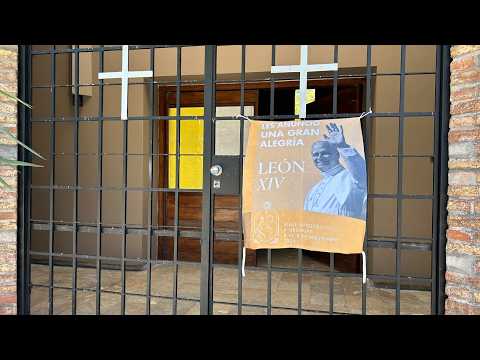
The banner welcoming the Pope to Casavalle (Vatican News)
The Pope at the home for elderly priests (Vatican Media)
The Pope addresses the people of Casavalle (Vatican Media)
The crowd at the meeting with Leo XIV (Vatican Media)
Pope Leo XIV in Casavalle (Vatican Media)
The Pope addresses the people of Casavalle (Vatican Media)
The Pope addresses the people of Casavalle (Vatican Media)
The Pope addresses the people of Casavalle (Vatican Media)
The Pope addresses the people of Casavalle (Vatican Media)
Address at the meeting with the social community of Casavalle
Impromptu Remarks of His Holiness Pope Leo XIV to the Families of Casavalle Our Lady of Guadalupe Parish, Montevideo
God’s blessing comes in many forms. Today we want to ask for his blessing upon every family here present, upon their loved ones and upon all the families who live here in this area.
A great blessing comes when we gather as a commu
Impromptu Remarks of His Holiness Pope Leo XIV to the Families of Casavalle Our Lady of Guadalupe Parish, Montevideo
God’s blessing comes in many forms. Today we want to ask for his blessing upon every family here present, upon their loved ones and upon all the families who live here in this area.
A great blessing comes when we gather as a community, when we learn to work together, to collaborate on a common project, to affirm that life is important, that our faith sustains us, and that we want to be faithful to Jesus, our best friend.
The Lord be with you. May the blessing of Almighty God, the Father, and the Son, and the Holy Spirit, descend upon you. Amen.
Dear brothers and sisters, good afternoon.
It gives me joy to visit this parish, this neighborhood, to walk through the streets and see the projects that have been carried out with such hard work. Being here with you makes me feel at home, and brings back memories of the visits I made to various communities as a missionary. I would like to thank Cardinal Daniel Sturla, Archbishop of Montevideo, Father Pablo Coimbra, parish priest of this community, and Mrs Carmen Albana Sanz for their words of welcome. I also thank all of you for being here today and for preparing this gathering with such enthusiasm. In a special way, I am grateful to Angélica, Alan, and Katherine for sharing their testimonies and opening their hearts to recount with us the triumph of life, faith, and hope.
This parish is dedicated to Our Lady of Guadalupe, whom my predecessors declared “Patroness of Latin America” and “Empress of the Americas.” The loving presence of our heavenly mother on this continent invites us to look beyond the reality around us, to see beyond borders and to open our hearts to eternal realities by lifting our gaze. Mary teaches us to do whatever her Son Jesus tells us (cf. Jn 2:5), and that is also the mission of parishes: to be a lighthouse that points to the presence of Jesus Christ, offering to all the light of God’s Word, the help of the sacraments, the support of prayer and the balm of fraternal charity.
A project has been carried out in this parish community to build several homes for families with limited means. I am pleased to have been able to contribute to this beautiful initiative through the benefactors of the Papal Foundation, to whom I offer my thanks for their generosity. May these homes be for your families much more than simply a roof over their heads: may they be a true home where you can grow in dignity, peace and hope, always experiencing God’s love and closeness.
I would like to share with you a story that Jesus told his disciples, one that you surely know: the parable of the Good Samaritan (cf. Lk 10:29-37). It tells of a man who “fell into the hands of robbers, who stripped him, beat him, and took off, leaving him half dead” (v. 30). The terrible assault of the traveler on the road was a most tragic and unjust situation. Added to his pain was the indifference of those who saw him in need, yet passed him by (cf. vv. 31–32). But the story does not end there. A ray of hope shines through: a Samaritan saw the man, was moved with compassion, approached him, tended his wounds, took him to an inn and provided for his care and recovery (cf. vv. 33–35).
Dear brothers and sisters, this story is repeated today in the widespread insecurity and violence that unfortunately threaten the peace of our neighborhoods and even the lives of our loved ones, and all too often society responds with indifference. Yet we can see another side: the actions of many institutions and people of goodwill who foster peace and offer practical assistance to those in need. A shining example is Father Cacho’s life of selfless service. As Angélica told us in her testimony, he built bridges, tore down walls and fostered encounters.
We need to continue to commit ourselves to the charity and closeness of the Good Samaritan who did not remain indifferent upon seeing misfortune, but took responsibility for his brother’s life. We cannot turn a blind eye to the fact that there are children in Uruguay who do not go to school for fear of never returning home. We cannot silence our conscience when we see a mother lacking the means to feed her children. We cannot ignore the many people around us who are suffering, alone and vulnerable. We heard about this firsthand through Katherine’s moving words. In a country as rich in resources as this, children should never have to go to bed hungry or be denied the chance of a decent education and a dignified future because of the insecurity that reigns in the streets. Much less should they have to suffer violence to the point of losing their lives.
We must work together: the Church, civil society, and the State. We need to shake off our apathy and advocate for the common good. This is what Alan has shared through his experience: today he freely gives to others what he himself has received. It is up to us to decide to build a new city where no one is excluded, or to remain comfortably immersed in our own affairs. As Pope Francis told us, “the decision to include or exclude those lying wounded along the roadside can serve as a criterion for judging every economic, political, social and religious project. Each day we have to decide whether to be Good Samaritans or indifferent bystanders” (Fratelli Tutti, 69).
The Church’s mission stems from evangelical charity, which impels her “to draw near to the wounds of humanity whenever they surface with greater severity. When the Church intervenes, she does so following the example of the Good Samaritan, with discretion and closeness, aware that what arises from urgent necessity cannot become the norm, nor replace the institutional responsibilities proper to the civil community” (Encyclical Letter Magnifica Humanitas, 21). Let us therefore unite our efforts and respond generously to the call to build together a homeland of brothers and sisters.
Dear friends, the parable of the Good Samaritan concludes with Jesus’ command: “Go and do likewise” (Lk 10:37). Every Christian should hear this commandment echoing in their heart every day (cf. Apostolic Exhortation Dilexi Te, 107). May these words renew us and inspire us to continue building a new city together, where love and peace reign. May God bless you, and may our Mother of Guadalupe — for whom I have a special affection and veneration, as I received my episcopal ordination on her feast day — shelter you under her heavenly mantle. Thank you.
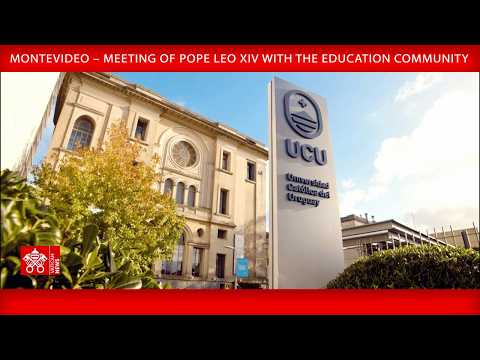
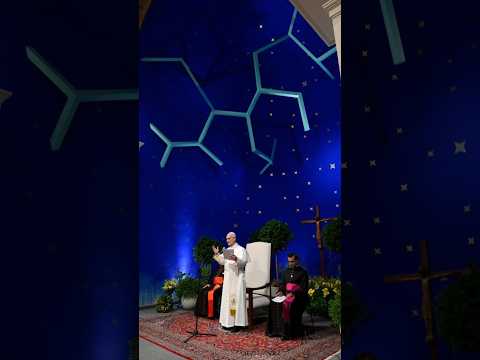
In the main hall of the Catholic University of Uruguay "Dámaso Antonio Larrañaga", entrusted to the Society of Jesus, in the La Blanqueada district, the Pope meets some 360 educators and students, while about a thousand more follow on a giant screen from the terrace. Welcomed by Cardinal Daniel Sturla, Grand Chancellor, and by the rector, he recalls the visit of Saint John Paul II more than 38 years ago and calls for overcoming "dualistic visions", evangelizing the whole person: "body and soul, heart and conscience, mind and will" (Gaudium et Spes). He also urges educators to see others as a blessing, not a threat. At the end he greets the students gathered on the terrace.
🎥 Videos
▶
Meeting with the World of Education (full, Vatican News)
▶
Highlights of Pope Leo's visit to the Catholic University of Uruguay
▶
The Catholic University of Uruguay gets ready to welcome the Pope (Vatican News)
📷 Photos
Pope Leo addresses the world of education (Vatican Media)
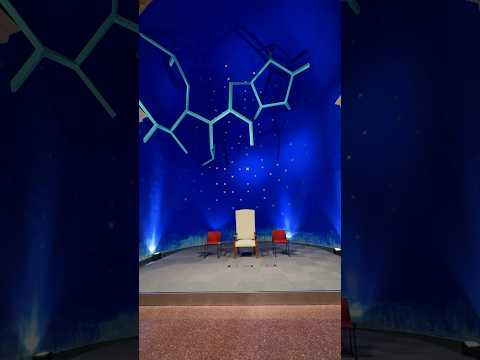
The main hall of the Catholic University of Uruguay (Vatican Media)
The rector's greeting (Vatican Media)
Greeting the thousand students gathered on the terrace (Vatican Media)
Pope Leo addresses the world of education (Vatican Media)
Address at the meeting with the world of education
Dear brothers and sisters,
I am pleased to meet with you, who, following the example of Jesus, the Divine Teacher, have dedicated your lives to the service of education. I greet Cardinal Daniel Sturla, S.D.B., Grand Chancellor of this Catholic University. I also greet the Bishops, the Rector, Father Julio Fernández Techera, S.J., and the civil aut
Dear brothers and sisters,
I am pleased to meet with you, who, following the example of Jesus, the Divine Teacher, have dedicated your lives to the service of education. I greet Cardinal Daniel Sturla, S.D.B., Grand Chancellor of this Catholic University. I also greet the Bishops, the Rector, Father Julio Fernández Techera, S.J., and the civil authorities. I extend a special greeting to the professors and students who have come from so many educational institutions throughout the country.
A little over thirty-eight years ago, Saint John Paul II visited this institution of higher learning, which at the time was just getting started. Today, I wish to express my sincere gratitude for the educational work you have done and continue to do in the communities dedicated to formation and teaching, at every level and stage of learning, in service of the proclamation of the Gospel and the dignity of the human person. This perseverance demonstrates that Catholic education in Uruguay has become “the concrete way in which the Gospel becomes an educational gesture, a relationship, a culture” (Apostolic Letter Drawing New Maps of Hope, 1.1). It also affirms for us that “the Gospel does not grow old, but makes ‘all things new’ (Rev 21:5). Each generation hears it as a regenerating novelty. Each generation… [discovers] its seminal and multiplying power” (ibid.).
The goal of the pastoral mission in education is for students, teachers and school administrators to hear, see, taste, touch and smell the Good News, allowing it to enlighten the senses, just as the vibrant murals on this university campus do. In this way, all who belong to the educational community can grow and recognize more fully their inalienable dignity as human persons. The same holds true in extracurricular and informal educational settings, as well as in educational communities and those focused on social reintegration and therapeutic care. In these contexts, the attentive presence and lived witness of credible, competent adults who collaborate with one another carry even greater weight than words.
In light of the global reality we are experiencing, I believe that to achieve this goal, “dualistic views must be overcome: the human being ‘though made of body and soul, is one.’ Reducing the body to an ‘object’ to be disposed of arbitrarily is always a denial of the dignity of the person” (General Audience, 9 September 2026; Gaudium et Spes, 14).
I therefore invite you to take a brief “journey” through our five senses and, by reflecting on them, to rediscover the beauty of the Gospel and the grandeur of our humanity.
Let us begin by reflecting on the following verse from the Psalms: “When I see the heavens” (Ps 8:4). The psalmist leads us to one of the most sublime operations of our eyes: contemplation. Today, contemplation is understood as looking attentively, almost in wonder, at something spiritual or material. Contemplating creation and encountering God awaken in us an awareness of our place in his plan and of our personal and collective responsibility to preserve the original harmony. We can also appreciate this in the twelve buildings on campus, which blend harmoniously into the surroundings of this neighborhood.
Contemplation is a form of evangelization within the cognitive process of attention, which is becoming increasingly difficult. As progress is made in this regard, our children and young people attain the depth they long for, find spaces for silence and discernment, and become more accustomed to engaging in dialogue with their conscience and with God (cf. Apostolic Letter Drawing New Maps of Hope, 10.3). I invite you, then, to give contemplation a prominent place in your educational work.
Secondly, in saying “the heavens, the work of your hands” (Ps 8:4), the psalmist advances in contemplation to the point of seeing the hands of God, like those of an artist, creating the heavenly lights, the angels and the living creatures that move in the firmament, on the earth and in the waters. Among all these beings, only humans will have fingers that, united with their hands, will cultivate the earth, bring forth fruit, greet their brothers and sisters, caress and embrace. Yet we cannot forget that today those human hands are producing the most terrible of “human works”: war (cf. Address at the UNESCO Headquarters, 25 September 2026).
The Catholic education you are fostering is called to aid the educational community in recognizing the importance of touch, of fingers and of hands in promoting peace. If our students can experience the “baptismal embrace which the Father gave us when we were little ones,” they will long for “yet another embrace, that of the merciful Father who awaits us in glory” (Francis, Apostolic Exhortation Evangelii Gaudium, 144). Helping our children and young people “feel that they live in the midst of these two embraces is the difficult but beautiful task of the one who preaches the Gospel” (ibid.). Those who feel embraced by the Father will inevitably become peacemakers.
Continuing our journey, the Apostle Peter directs our attention to the sense of taste when he says: “You have tasted that the Lord is good” (1 Pet 2:3). This sense evokes the notion of flavor and, with it, the wisdom that comes from experiencing, reflecting on and savoring. I am speaking of the wisdom that draws us closer to God’s goodness; the wisdom that makes us brothers and sisters; the wisdom that makes us saints. Tasting is not limited to recognizing flavors, identifying foods or classifying meals. In the same way, someone who gathers information without discernment, reflection and understanding of context cannot be considered wise.
It is therefore pressing that education in our schools and universities contribute to the “judicious use of technologies and AI, placing the person before the algorithm and harmonizing technical, emotional, social, spiritual, and ecological intelligence” (cf. Apostolic Letter Drawing New Maps of Hope, 10.3). May our children and young people savor “what is good and acceptable and perfect” (Rom 12:2).
To consider the sense of smell, we can turn to the story of the anointing at Bethany as recounted by John the Evangelist: “The house was filled with the fragrance of the perfume” (Jn 12:3). Saint Augustine reminds us that “the world has been filled with good reputation, for a good reputation is a sweet fragrance” (Commentary on Saint John, Treatise 50, 7). Today, however, people’s reputations are under constant attack, to the point that discarding, rejecting and belittling others have become a foul odor to which our sense of smell has grown accustomed.
Indeed, the process of dehumanization we are experiencing poses a challenge to our schools and universities. “The paradox has become increasingly evident: while ‘intelligence’ is attributed to computational systems, we struggle to recognize the inalienable dignity of human persons, whose lives are judged according to the criterion of efficiency and, when deemed no longer productive, are rejected and discarded” (Address at the UNESCO Headquarters, 25 September 2026).
It is essential that we defend the sweet fragrance of the human person, grounded in the sweet fragrance of the Messiah. We need to proclaim anew that human life must be respected at every stage and in every condition. No one is to be rejected.
As we draw our reflection to a close, let us consider the sense of hearing by recalling the words of the evangelist Matthew: “Let anyone with ears listen” (Mt 13:9). We conclude here with the hope that the reflections shared today at this institution of higher learning will be heard and, subsequently, heeded in your educational establishments. Fine-tuning our hearing is important in today’s world. Discerning what we hear makes all the difference. “Saint Augustine, grafting biblical wisdom onto the Greco-Roman tradition, understood that the authentic teacher arouses the desire for truth, educates freedom to read the signs and listen to the inner voice” (Apostolic Letter Drawing New Maps of Hope, 2.2).
Our Catholic education cannot be confined to a closed circle. Rather, it must learn to listen to families, civil society, political and administrative authorities, as well as representatives of the various economic sectors and professional groups. Today, our children and young people “listen” when they participate in volunteer service, missionary activities and community projects. Those who listen recognize others as a blessing, not as a threat. In Sacred Scripture, listening to the Lord is seen as an act of wisdom, prudence and justice (cf. Prov 1:2-5; 2:1-9). Our educational initiatives must embody these three virtues, bearing in mind that generations are changing far more rapidly than in the past and that keeping pace with the times — without abandoning sound tradition — is a real challenge.
Dear brothers and sisters, I ask you to continue on your journey, evangelizing and contemplating the whole person: “body and soul, heart and conscience, mind and will” (Gaudium et Spes, 3). We must not stop. Let us continue walking with him who is the Way, the Truth and the Life. Once again, I express my appreciation for the educational work you carry out. Entrusting it to the protection of the Blessed Virgin Mary, Seat of Wisdom, I cordially impart to you my Apostolic Blessing.
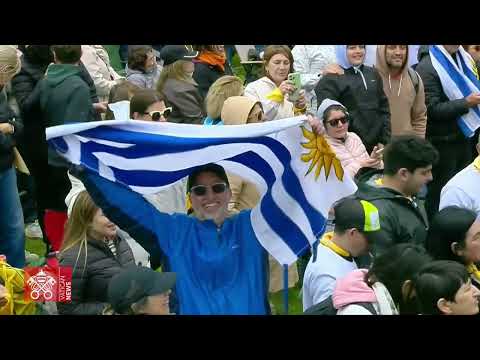
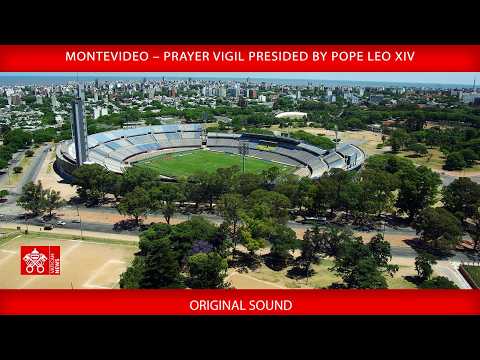
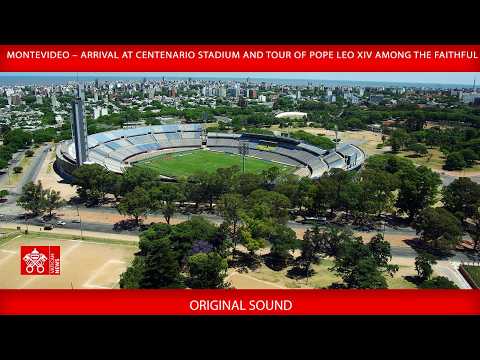
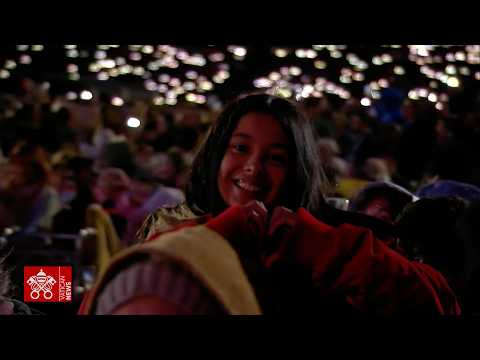
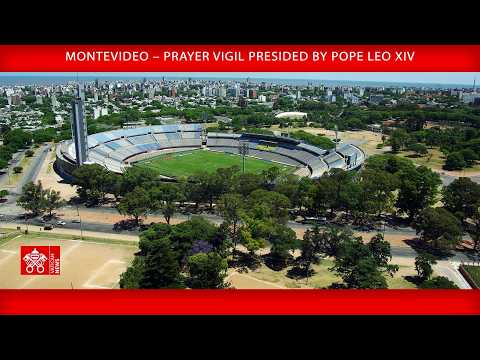
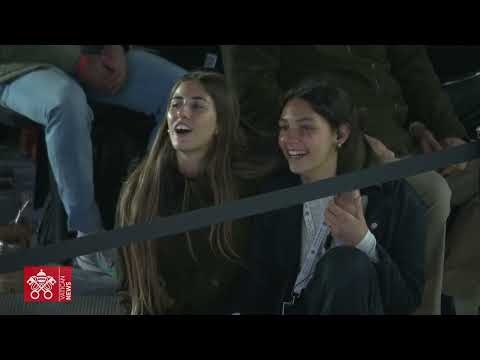
The Pope arrives in an open car at the Estadio Centenario around 7:20 pm: according to local authorities, more than 70,000 people are inside the stadium and another 30,000 in the surrounding areas. After Cardinal Daniel Sturla's greeting and a musical moment led by Lucas Sugo, the vigil continues with the testimonies of a young catechist, a newly baptized young man and a family (Federica, Giovanni, the Gutiérrez Hernández family). In his address Leo XIV starts from the advance of secularization and the experience of being a minority, rereads the present in the light of "little" Bethlehem ("let us not equate smallness with insignificance"), urges young people not to fear "for ever" and not to settle for mediocrity: "Be saints!". The country's seminarians give him a football shirt with the name "León" and the number 14. Around 8:50 pm the Pope returns to the Nunciature.
🎥 Videos
▶
Prayer Vigil with Young People (full, Vatican News)
▶
Arrival at Centenario Stadium
▶
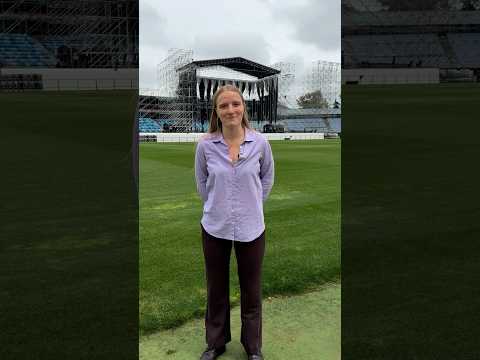
Preparations underway at Montevideo's Centenary Stadium (Vatican News)
▶
Highlights of the prayer vigil at the Estadio Centenario (Vatican News)
▶
Prayer vigil with young people, full (Vatican News English)
▶
Highlights of the second day in Uruguay (Vatican News)
📷 Photos
Aerial view of Montevideo's Estadio Centenario (ANSA)
A view of the Estadio Centenario (Vatican Media)
The Pope among young people (Vatican Media)
The Pope listens to Cardinal Sturla's greeting (Vatican Media)
A "little" Saint Augustine at the vigil (Vatican Media)
Address at the prayer vigil in the Estadio Centenario
Dear brother and sisters, dear Uruguay, good evening! Thank you, thank you!
I give thanks to God for the opportunity to be here with you. I also thank Cardinal Sturla, Archbishop of Montevideo, for his words of welcome, as well as Federica, Giovanni, and the Gutiérrez Hernández family for sharing their testimonies with such sincerity. I know that
Dear brother and sisters, dear Uruguay, good evening! Thank you, thank you!
I give thanks to God for the opportunity to be here with you. I also thank Cardinal Sturla, Archbishop of Montevideo, for his words of welcome, as well as Federica, Giovanni, and the Gutiérrez Hernández family for sharing their testimonies with such sincerity. I know that long years of faithfulness lie beneath what can be seen during a brief visit: families have passed on the faith, priests and consecrated men and women have given their lives, laypeople, often during their youth, have sustained their communities, and many others have placed themselves at the service of others out of love for God. Thank you for making Jesus Christ present in so many lives. He chose us so that we might go and bear fruit (cf. Jn 15:16), and perhaps much of that fruit remains where we ourselves cannot even see it. The Church is deeply grateful to you.
Being here with you this evening gives me the opportunity to share a reflection on something that many Christian communities are experiencing today: the advance of secularization and an increasingly widespread religious indifference. In many places, the faith is no longer passed on as readily as it was in previous generations, and the number of people who live most of their lives without Church attendance or religious practice is growing. The members of the pilgrim Church in Uruguay have had to learn to live and proclaim their faith in this context, as we have just heard. For this reason, their experience can help brothers and sisters in other parts of the world who are beginning to discover, in different ways, what it means to be a minority. Yet even in these circumstances, many persevere: parents who pray with their children, teachers who strive to live and bear witness to their faith, young people who have discovered Christ and wish to follow him even when they feel alone, communities that continue to gather, and priests who travel great distances to bring the sacraments to the faithful. As I reflected on all of this, one small biblical town came to mind: Bethlehem.
The prophet Micah had called it “the least among the clans of Judah” (5:2); Saint Matthew, on the other hand, later said: “By no means are you the least” (2:6). Bethlehem was still small. Nothing had changed in its size or political importance. Perhaps Bethlehem can teach us something about this reality: when we are few in number, when our strength wanes, when we realize that our social presence is no longer what it once was, we may be tempted to judge our situation by purely human standards. The Gospel invites us to see things differently. God chose Bethlehem, and that choice alone is enough to prevent us from equating smallness with insignificance.
We need only think of the Eucharist: the Lord of the universe is present under the humble appearances of bread and wine! That same divine logic is already revealed in his birth. Saint Luke recounts that, when the time came for the child to be born, “there was no place for them” (2:7). All the inns were full. Perhaps we can see in this an image of today’s indifference. Life becomes filled with activities, affections, plans and distractions, until the absence of God is no longer felt as an absence. We end up living without seeking him, or even without realizing how much we need him.
Christ comes, but the inn is full. There is no room inside, so he ends up lying in a manger. Soon Herod will try to kill him, unable to tolerate a reign he cannot control. Something of Bethlehem continues to happen: God can be considered unnecessary, and faith confined to the private sphere, as though it had nothing to contribute to society. When we try to build a world without God, we run the risk of leaving humanity without a place as well. But none of this changes the reality: that Child is God, and he comes to save us. That “us” includes each and every one of us, for indifference can also creep, little by little, into the lives of those of us who believe.
Bethlehem asks us a simple question: is there room for him? Is there room in our time, in our way of thinking, in our homes? Is there room to listen to him, to receive his forgiveness, to allow his word to correct us? We need to keep Christ at the center of our lives through prayer, Mass, Confession and the meditative reading of the Gospel. We must all become disciples again and again. If we want others to find Christ, we need to know the way to Bethlehem ourselves first.
The Magi also went to Bethlehem after seeing a star from afar. They were not experts in the Scriptures. They did not know where their journey would end, and they could not even explain what they were seeking. But that light awakened in them a yearning that set them on their way. Dear friends: with humility and simplicity, you can reflect the light of Christ in your own lives. Perhaps there are people who would never open a Bible on their own, who have not set foot in a church in years, or who cannot even say whether they believe in God. But when they see you, the desire for God may be awakened in them; they may even discover that it is worth risking their lives to find him.
Friends, young people, dare to take the step of marrying, starting a family yourselves. Do not be afraid of “forever”! Married couples, open your home to life, even when the world tells you that a child is a burden. If any of you feel that Christ is calling you to leave everything behind to follow him in the priesthood or in consecrated life, do not ignore that voice out of fear of missing out on other opportunities. When being just and honest comes at a price, pay it. When forgiving seems like a defeat, forgive. When everyone tells you to think of yourselves first, do not be afraid to put yourselves in the last place. Be willing to give up time, money, comfort and plans to serve others. May those who see you find themselves asking: “Why do they live in this way? Where do they get this freedom? Why do they love one another so much?”
The star the Magi saw was not the destination. Its mission was to lead them to Bethlehem, where Christ is. If our lives spark a question, they will have borne fruit when that question guides someone to Jesus. To shed much light, we do not need to be many, but rather to reflect the Lord’s light.
Saint Luke now takes us to another scene: some shepherds are spending the night tending their flocks. They did not follow the star; they did not set out on any journey, nor did they seem to be searching for anything. They are simply in the midst of their lives, doing what they do every night. It is precisely there that God comes to meet them: “Do not be afraid; for see — I am bringing you good news of great joy for all the people” (Lk 2:10). The motto of my visit is inspired by this proclamation: I announce to you a great joy!These words should always occupy a central place in the life of the Church. Good News needs witnesses, for we have received news that deserves to be proclaimed to the world: Jesus Christ! The Son of God has become man! He is God with us!
Through him we know that our sins can be forgiven. We can accompany those who are dying and tell them that their lives will not end in nothingness. We can bring bread and wine to the altar and receive his Body and Blood. We can say to those who have fallen, “Get up; you can still begin again.” Look at what has been entrusted to us! Jesus Christ is our hope. Society may find many valuable things in other institutions, but none can replace the proclamation that God’s love is stronger than death, hatred, violence, war and sin. This is the joy we bring; the Pope has come to remind you about this joy.
The angel adds that this joy is intended for “all the people.” He does not say “for those who were expecting it,” nor “for those who are perfect.” Some people, like the Magi, are already searching, and we must accompany them on their journey. Others, however, like the shepherds of Bethlehem, are not searching for anything. For them, this joy must go out and find them in the midst of their night.
After hearing the proclamation, the shepherds said to one another, “Let us go now to Bethlehem.” There they found Mary, Joseph and the Child. The Evangelist adds that they returned to their fields “glorifying and praising God” (Lk 2:20). They returned to the same work, the same paths and probably the same problems. But they were no longer the same. They had encountered Christ.
Dear friends, may this encounter be like a visit to Bethlehem, so that you can return to your lives in a new way! May Christ truly enter into what you do, what you love, what you choose — even those aspects of your life that no one sees. Be saints! Do not settle for a merely decent life or for a habitual faith, content with doing only the essential. Do not give God only a part of yourselves — give yourselves completely! Saints are men and women who overflow with the abundance of life in Christ. They are free and authentic people whose lives make it attractive to say a resounding “yes” to love, truth and happiness. Do not be afraid, then, to aspire to holiness. Christ did not call us to mediocrity; he called us to a new and full life like his own.
Dear brothers and sisters, dear Uruguay: may everyone know that we have been to Bethlehem. May it be evident that Christ lives and that encountering him makes all the difference. That same Jesus who was born in Bethlehem, who died and rose again, lives forever and remains with us. Christ awaits us, truly present in the Eucharist. How beautiful that Bethlehem means precisely “house of bread.” There was born the One who would give himself to us as the Bread of Life. Today, therefore, we can continue to encounter him — so near and so humble — in every tabernacle. Seek him there, in Eucharistic adoration. Speak to him as you would to a friend, and let him look upon you.
Let us also place our lives under the gaze of Our Lady of the Thirty-Three. May she, the Morning Star who leads us to her Son, teach us to recognize him and follow him. Let us ask the Lord for the grace to always respond to his call like she did: “Here I am, Lord; here is your servant. Let your will be done in me!”