Friday 13 November 2026 — Chiclayo: Holy Mass at Pampas de Pimentel, in his former diocese
10:30
Pampas de Pimentel, Pimentel, Peru
⛪ Holy Mass
Holy Mass at "Pampas de Pimentel"
📍 Pampas de Pimentel, Pimentel, Peru
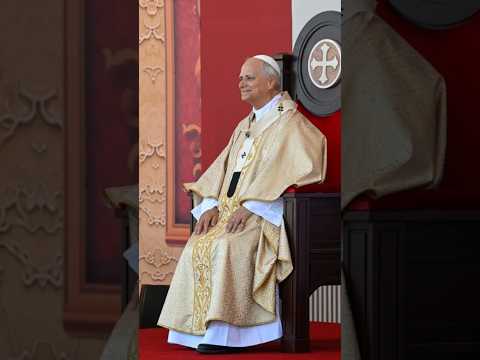
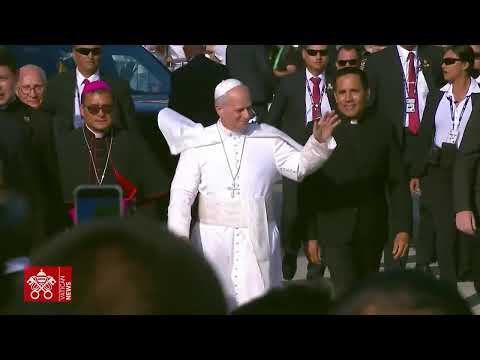
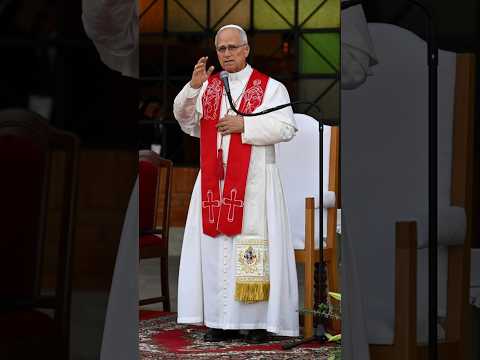
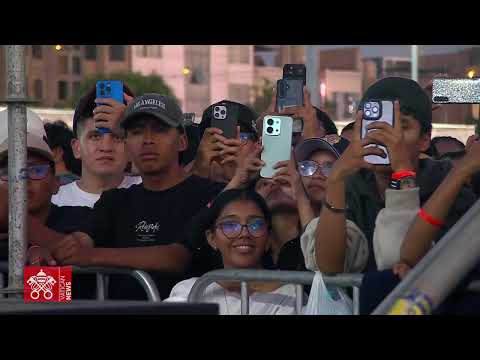
Pope Leo XIV presides at Holy Mass for the evangelization of peoples on the esplanade at the Pampas de Pimentel, near Chiclayo, the diocese he once led as bishop. According to the Press Office bulletin, at 9:15 he left the Air Base and drove to the Pampas; after a tour among the faithful in an open car, the celebration began at 10:56. Local authorities reported about one million people along the streets of Chiclayo and about 500,000 faithful at the Mass. In his homily, delivered in Spanish, he thanked people for their prayers "for my health during this time of trial, which, with God's help, I am overcoming" and recalled that proclaiming the Gospel is the "urgent and binding duty of every baptized person": not imposing doctrines but bearing witness to the encounter with Christ, uniting truth and charity. At the end, the Bishop of Chiclayo, Edinson Edgardo Farfán Córdova, thanked the Pope; at 12:29, after the presentation of the gift, the Pope went to the St. Óscar A. Romero Chapel.
Homily at Holy Mass at the Pampas de Pimentel (Chiclayo)
Dear brothers and sisters:
What a joy it is to return to Chiclayo! It is a blessing for me to be with you once again. Thank you for your affection, the support and your prayers, especially for my health during this time of trial which, with God’s help, I am overcoming. As I look at your faces, a prayer of thanksgiving to the Lord arises in my h
Dear brothers and sisters:
What a joy it is to return to Chiclayo! It is a blessing for me to be with you once again. Thank you for your affection, the support and your prayers, especially for my health during this time of trial which, with God’s help, I am overcoming. As I look at your faces, a prayer of thanksgiving to the Lord arises in my heart for the blessing you have been and continue to be in my life and episcopal ministry. I keep you very much in my prayers. I also ask you to continue praying for me, that Our Lord Jesus Christ may grant me the grace to strengthen always my brothers and sisters in the faith.
Today’s liturgy invites us to consider the urgent and binding duty of every baptized person to proclaim the Gospel. At the same time, it presents an opportunity to grow in the awareness that all Christians, whether ordained ministers or lay faithful — regardless of the degree of formation we have received in the faith — are missionary disciples. In the Apostolic Exhortation Evangelii Nuntiandi, Pope Saint Paul VI recalls that no baptized person can be indifferent to the task of evangelization, given that it is the Church’s essential mission, her deepest vocation and her very reason for being.
In his wisdom, God willed that the Church should be “like a universal sacrament of salvation” (Lumen Gentium, 48). Sustained by the Holy Spirit, the Church carries forward the mission of proclaiming Jesus Christ, so that, in obedience to the missionary mandate she received from him (cf. Mt 28:19-20), his redemptive work may reach the ends of the earth and transform human realities according to the values of the Gospel.
Proclaiming Jesus Christ is a crucial task, and for which we often feel inadequate. As missionary disciples in the twenty-first century, how can we proclaim him today? As a family, or as a parish or diocesan community, how can we carry out the mission to evangelize? The answer is through the witness of an authentically Christian and coherent life. First, we must place Jesus Christ at the center, both of our proclamation and of our existence. Then, we must understand that coherence is not merely the fruit of our own will, but it is also a grace for which we must implore the Lord and with which we are called to cooperate through our personal commitment and effort. For he alone has the power to transform our lives and thus renew our enthusiasm for proclaiming and handing on the faith, enabling us to help the brothers and sisters we meet along our pilgrimage to live a personal relationship with Christ and discover the joy of the Gospel.
A personal encounter with Jesus Christ — a gift that is freely given — has its focal point at the Last Supper, where, in offering his body as the bread of life and his blood as the drink of salvation (cf. Mt 26:26–28), he asks the Father that all his disciples may be one so that the world may believe (cf. Jn 17:21). The Lord awaits us above all in the Eucharist and in the word, the two “tables” that nourish us and give us life. But he also comes to us through ecclesial communion and the fraternal welcome we extend to our neighbor, where we find him present and in need. Evangelizing, therefore, does not mean imposing doctrines or trusting in efficient strategies, but bearing witness to that real encounter with Jesus Christ.
Indeed, evangelization is centered on the witness of life and closeness within the believing community. Without this witness, the explicit proclamation of Jesus Christ is not possible. As Pope Francis reminded us, evangelization is based on faith and on “the beauty of the saving love of God made manifest in Jesus Christ who died and rose from the dead” (Evangelii Gaudium, 36), and not on persuasive speeches based on mere human wisdom or on proselytism (cf. 1 Cor 2:1–5). It is also a task marked by joy, since the joy of the Gospel is renewed and multiplied when it is shared.
The joyful and life-giving transmission of the message of salvation calls for an attitude of humility and solicitude on our part, as well as profound respect for each person’s conscience and freedom. In this task, it may help us to recover the practice of “praying together,” especially in our homes, remembering that Christian families are the missionary nucleus. As “domestic Churches,” they lead their members to participate actively in the life of local communities, of the larger community of the universal Church and of society as a whole.
In this regard, the reading we have heard from the Second Letter of John also helps us to consider the dimension of charity as indispensable to evangelization, because the proclamation of the faith is linked to charity and the care of those most in need. In that letter, Saint John makes an urgent appeal to fraternal love. For a baptized person, love of neighbor is at the heart of the Christian message, the commandment received “from the beginning” (2 Jn 1:5). This practical, committed and respectful love also demonstrates the unbreakable bond between the proclamation of the Gospel and the effort to transform the structures of human coexistence (cf. Magnifica Humanitas, 30).
At the same time, charity is inseparable from truth, which is not a theory, an abstract idea or a utopia, but a person, Jesus Christ, who invites us to conform our lives to his in faithful obedience to his commandments. The harmony between charity and truth calls us to make our faith concrete, so as to spread, with renewed joy, the fragrant perfume of holiness. Let us remember that without truth, love degenerates into mere sentimentality, while truth without love becomes rigid and cold (cf. Caritas in Veritate, 3).
For this reason, evangelization today must face the changing conditions and dynamics involved in the transmission of the faith. In some regions of the world, this transmission has been almost entirely abandoned. Faced with this situation, we must all have the courage to take on new challenges, such as the religious indifference, materialism and selfishness that dictate everyday decisions. This commitment calls us to maintain harmony between a heart filled with love for God and neighbor and a mind anchored in the truth of the Gospel.
Dear friends, mission cannot be improvised. Indeed, we proclaim what we have encountered, the salvation we have experienced, the forgiveness of sins granted to us and the discovery of the true meaning of life, because “every Christian is a missionary to the extent that he or she has encountered the love of God in Christ Jesus” (Evangelii Gaudium, 120).
I pray that this love may set fire to the life of each one of us, so that, as baptized persons and as a Christian community, we may go out into the world and spread to others the joy born of our encounter with the risen Lord. May we make that joy present in our families, in our workplaces through the excellence of our professional work and in the public sphere, resisting the temptation to relegate faith to the private realm. In this apostolic commitment, the Church helps us become aware that, as living stones, we share a common responsibility for building God’s temple (cf. 1 Pet 2:5).
Dear brothers and sisters, the world is waiting for us and the mission is only beginning. Therefore, here in Chiclayo and throughout Peru, I invite you — beginning with this first celebration of our reunion at the Lord’s altar — to commit yourselves to sharing the living hope that is Jesus Christ and to let the Gospel “overflow” from our hamlets, towns and cities, proclaiming to all the “glory of the Lord.” May the intercession of Our Lady of Evangelization help us in the task of proclaiming the Good News to all creation (cf. Mk 16:15). Amen.
On Friday morning, before leaving Lima, the Pope greeted the faithful off the cuff from the balcony of the Apostolic Nunciature. He began in Italian by mistake (“Sorry, I am speaking in Italian; here at home we speak Italian”) and continued in Spanish: “I am now heading to Chiclayo. And we want to continue in that same spirit of joy.” He gave thanks to the Lord “for so many blessings — for faith, for life, and for respect for the human dignity of each person” and imparted his blessing. According to the Bulletin, he left the Nunciature at 7:00.
📷 Photos
The Pope's greeting outside the Nunciature in Lima, 13 November (Vatican News article image)
The faithful outside the Nunciature in Lima listen to the Pope's greeting (Vatican Media)
The Pope's greeting from the balcony of the Nunciature in Lima (Vatican Media)
Greeting from the balcony of the Apostolic Nunciature in Lima
Good morning, good morning, good morning.
A brief greeting before leaving for the next stop on this apostolic journey. Sorry, I am speaking in Italian; here at home we speak Italian.
Good morning. Well, on this beautiful day, we are now ready to travel to the next stop on this visit. I am now heading to Chiclayo. And we want to continue in th
Good morning, good morning, good morning.
A brief greeting before leaving for the next stop on this apostolic journey. Sorry, I am speaking in Italian; here at home we speak Italian.
Good morning. Well, on this beautiful day, we are now ready to travel to the next stop on this visit. I am now heading to Chiclayo. And we want to continue in that same spirit of joy. I give thanks to the Lord for so many blessings — for faith, for life, and for respect for the human dignity of each person. May we live out this unity, just as we are living it here in Lima these days.
May the Lord bless all of you; may his presence in you — in your hearts and in your families — always be alive and fill you with hope, and may we continue to work together every day.
May the Lord be with you. May the blessing of almighty God, the Father, and the Son, and the Holy Spirit, come down upon you.
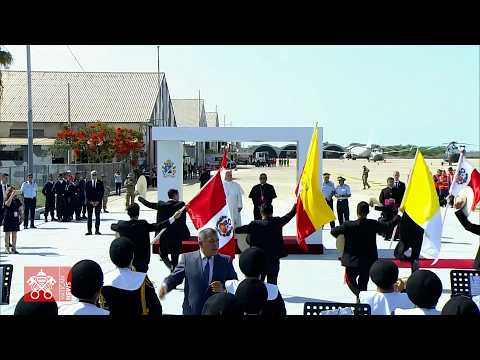
The Pope flies to Chiclayo, the Peruvian diocese he led as bishop from 2015 to 2023, before being appointed Prefect of the Dicastery for Bishops. According to the Bulletin, after taking leave of some local authorities at the Callao Air Base, he departed at 7:57 on a LATAM Airlines A320 and landed at 9:06 at the Chiclayo Air Base “Teniente Coronel Pedro Ruiz Gallo”, where he was welcomed by some local authorities.
🎥 Videos
▶
Lima, Farewell from Local Authorities, November 13, 2026 (Vatican News)
▶
Chiclayo, Welcome by Local Authorities, November 13, 2026 (Vatican News)
▶
Highlights: Chiclayo, Welcome by Local Authorities (Vatican News)
📷 Photos
The welcome at Chiclayo airport (Vatican Media)
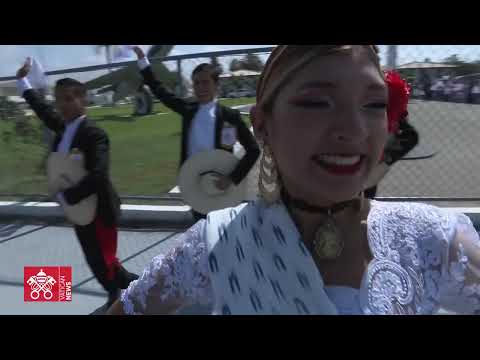
Dances in honour of the Pope (Vatican Media)
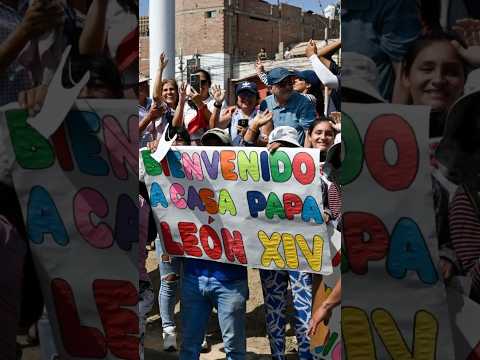
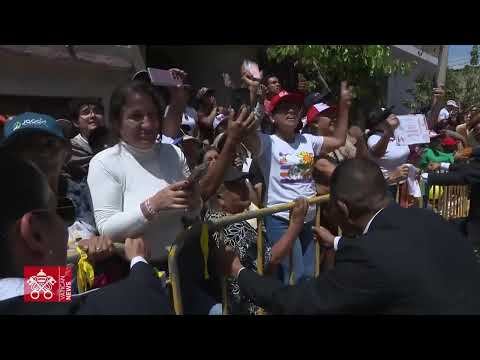
Crowds of faithful along the streets of Chiclayo (Vatican Media)
📍 St. Oscar A. Romero Chapel, Diocese of Chiclayo, Peru
Private visit to the Saint Óscar A. Romero Chapel, with a greeting by the Holy Father. According to the bulletin, at 12:29, after the Mass, the Pope drove to the St. Óscar A. Romero Chapel. The official text of the greeting, published on vatican.va, is addressed to Bishop Edinson of Chiclayo, to Father Alonso, parish priest of Saint Joseph the Worker, and to the Chapel community: the Pope thanks those who built the new Chapel and the faithful for their prayers for his health ("just a month ago I had to undergo surgery"), then prays the Our Father and gives the blessing. According to the bulletin's account, the Pope arrived at the Chapel at 1:30 p.m. (7:30 p.m. Rome time), welcomed by the parish priest Fr José Alonso Serquén; he greeted the families of the priests and some collaborators on the terrace, then held the private meeting on the first floor. After the greeting there was an exchange of gifts, the blessing of some sick people and the unveiling of a commemorative plaque; the Pope then returned by car to the Bishop's House.
🎥 Videos
▶
Highlights of the visit to the St. Oscar A. Romero Chapel (Vatican News)
📷 Photos
The Pope arrives at the new St. Óscar Romero Chapel (Vatican Media)
The Pope in the new St. Óscar Romero Chapel (Vatican Media)
A moment from the encounter (Vatican Media)
The Pope arrives at the new St. Óscar Romero Chapel (Vatican Media)
The Pope arrives at the new St. Óscar Romero Chapel (Vatican Media)
The Pope arrives at the new St. Óscar Romero Chapel (Vatican Media)
Greeting to the community of the Saint Oscar Romero Chapel
Dear brothers and sisters,
To Bishop Edinson of this beloved Diocese of Chiclayo; to Father Alonso, pastor of the Parish of San José Obrero; and to all the members of this community at the San Oscar Romero Chapel, I wish you a very good afternoon.
How truly beautiful it is, indeed it is a blessing from God to be here with you. I am very grateful
Dear brothers and sisters,
To Bishop Edinson of this beloved Diocese of Chiclayo; to Father Alonso, pastor of the Parish of San José Obrero; and to all the members of this community at the San Oscar Romero Chapel, I wish you a very good afternoon.
How truly beautiful it is, indeed it is a blessing from God to be here with you. I am very grateful to God. I am also very grateful to all those — so many of you here today — who have worked together to make the dream of this new chapel dedicated to Saint Oscar Romero a reality. Thank you to everyone who has participated in this project.
At the same time, I want to thank the entire community for your prayers for my health. As you know, it has been just one month since I had to undergo surgery, and God, through his grace, has been wonderful. I know that your prayers and those of so many others have helped me recover and enabled me to be here with you today. Thank you very much.
Jesus Christ came to give us salvation and gave his life by dying on the cross so that we might have salvation and eternal life. But he invites us all to enter into the experience of being part of his Church — to be sisters and brothers, all united in the Church — to continue the mission he began, which he wants us to carry on. He calls all of us who are baptized, each according to our vocation — bishops, priests, consecrated persons, and also the lay faithful — to participate together in the communion that is the Church, to proclaim the Good News, to share our faith, and to continue passing on God’s love to one another, from generation to generation, among neighbors, and among family members. To share this great news that Jesus always walks with us.
Today’s brief visit was squeezed in amid so many other commitments, but it was something I truly wanted to do, because it should be a sign of this closeness, of this desire to build community and to collaborate, always to cooperate, working together to continue the Church’s mission.
Let us pray: I invite all of you to stand to recite the prayer that Jesus taught us. And I very humbly offer God’s blessing to each one of you, to your families, and to your loved ones, because we believe and know that Jesus Christ is with us.
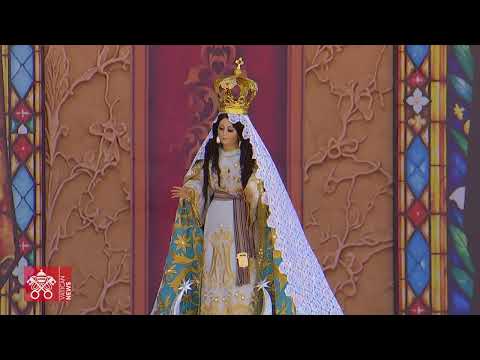
According to the bulletin, at 4:15 p.m. (10:15 p.m. Rome time) the Pope left the Bishop's House and at 4:30 p.m. met bishops, priests, men and women religious, seminarians, synodal teams and pastoral councils at the Shrine of Our Lady of Peace. Welcomed by the rector, Fr José Antonio Jacinto Fiestas, he entered the Shrine for a moment of recollection before the Blessed Sacrament, during which the Golden Rose was presented. On the stage set up outside, after the greeting of the Bishop of Chiclayo, Bishop Edinson Edgardo Farfán Córdova, and the testimonies of a priest, a religious sister from the Archdiocese of Trujillo and a laywoman from the Archdiocese of Piura, the Pope gave his address on the synodal Church: "Before any service, office, profession or ministry, we are baptized", "there is no mission without communion" and the participation of the laity "is not a concession"; he urged that every community have a pastoral council. The meeting ended with the Our Father and the blessing; the Pope then blessed a liturgical bell made in France for the visit. About 5,000 people attended, according to the bulletin. The official text was published on vatican.va in Spanish only.
🎥 Videos
▶
Highlights of the meeting with clergy and parish councils in Chiclayo (Vatican News)
▶
Chiclayo, Meeting with Clergy and Parish Councils – full video (Vatican News - English)
▶
Pope in Chiclayo: 'Our primary identity is as sons and daughters of God' (Vatican News - English)
▶
Chiclayo, Meeting with Clergy and Parish Councils – full video, original audio (Vatican News)
📷 Photos
The Pope before the statue of Our Lady of Peace in Chiclayo (Vatican Media)
The Pope during his address at the Shrine of Our Lady of Peace (Vatican Media)
The square of the Shrine of Our Lady of Peace during the meeting (Vatican Media)
A group of priests at the meeting with the Pope (Vatican Media)
The Pope embraces the Discalced Carmelite nuns of the Monastery of San Juan (Vatican Media)
The group of faithful who gave the Pope a liturgical bell (Vatican Media)
The Pope before the statue of Our Lady of Peace in Chiclayo (Vatican Media)
The Pope before the statue of Our Lady of Peace in Chiclayo (Vatican Media)
The Pope before the statue of Our Lady of Peace in Chiclayo (Vatican Media)
Address to bishops, priests, religious, seminarians, synodal teams and pastoral councils (Chiclayo)
Good afternoon to you all. Thank you for this warm welcome!
I would like to thank Bishop Edinson for the words he spoke on your behalf, as well as those who have shared their testimonies with us.
I warmly greet everyone present: priests, deacons, consecrated men and women, seminarians, members of the synodal teams and pastoral councils, and all o
Good afternoon to you all. Thank you for this warm welcome!
I would like to thank Bishop Edinson for the words he spoke on your behalf, as well as those who have shared their testimonies with us.
I warmly greet everyone present: priests, deacons, consecrated men and women, seminarians, members of the synodal teams and pastoral councils, and all our brothers and sisters who have come from the parishes of the Diocese of Chiclayo and different regions of Peru. And I think some people have come from Ecuador, a warm welcome to you as well! Welcome to this gathering. Thank you for your presence in this shrine dedicated to Mary, our Mother, under the title of Our Lady of Peace.
Dear brothers and sisters, as I come among you today as the Successor of the Peter, I feel even more strongly the bond that unites us in Christ and in his Body, which is the Church — a mystery of communion, and the people of God journeying through history. The richness of this community is fully reflected in all of you, through the variety of your charisms and ministries. One integral dimension of the Church, promoted with great enthusiasm by Pope Francis, is synodality, which means walking together, listening, discerning and participating as co-responsible members in the mission. We therefore ask ourselves: how can we become a more synodal and missionary Church?
At the foundation lies our bond with Christ, rooted in Baptism. We all know that Baptism is the foundation of our Christian identity. Through it, we are incorporated into Christ, made children of God, members of the Catholic Church and sharers in her mission. Before any service, office, profession or ministry, we are baptized. Our primary identity is that of sons and daughters of God and members of his chosen people. As baptized persons, we all share in the priesthood of Christ and in his prophetic mission; therefore, the entire community is co-responsible for evangelization. Baptism entails a permanent vocation to listen to the word, embrace the faith, live charitably, participate in the life of the community, proclaim the Gospel and serve others, especially the poor and the outcast.
The first witness that any Christian community must give is the fraternal love that exists among its members, thereby reflecting the Most Holy Trinity (cf. Jn 13:34-35; 17:22-23). For this reason, communion must precede mission.
The communion of the Church, which makes her a sign and instrument of union with God and of the unity of the human race (cf. Lumen Gentium, 1), is not uniformity. Authentic communion values the diversity of cultures, vocations, charisms and ministries as a richness, and promotes them. Along these lines, authority within the Church must be exercised in the forms of service, discernment and appreciation of charisms and initiatives, since the participation of the laity is not a concession but an expression of their baptismal dignity. A synodal Church, moreover, shares the joys and hopes, the griefs and anxieties of humanity, especially of the poor and those who suffer, as the Second Vatican Council teaches (cf. Gaudium et Spes, 1). Listening to social and cultural realities; defending human dignity; accompanying families, young people, migrants, indigenous peoples and those living in poverty; and working for justice, peace and the common good are not optional tasks, they are requirements of our ecclesial mission.
“Synodality” expresses the idea of walking together. It is a fundamental dimension of the Church, which expresses the identity of the people of God as pilgrims and as an assembly called together by the risen Lord. Brothers and sisters, I encourage you to discover ever more fully the beauty of being synodal communities. How? By seeking to ensure that everyone plays a part, as living stones in a spiritual building (cf. 1 Pet 2:4-5), according to the different vocations and the many gifts and ministries inspired by the one Holy Spirit (cf. 1 Cor 12:1-31).
This requires a spirituality founded on prayer, listening to the word, participation in the Holy Mass, Eucharistic Adoration, fraternal dialogue and communal discernment. It is a communal and pastoral way of life that must be interiorized so that it can be coherently put into practice. Indeed, it is easy to speak about synodality, but putting it into practice is a challenge and requires everyone to examine their attitudes and conduct, beginning with the pastors, who are the primary servants of the community.
For dioceses and parishes to be able to adopt this synodal style of communion, participation and mission, it is worth revitalizing the role of pastoral councils, in which some of you here are involved. Although their input is consultative, their ecclesial importance is considerable: they help the community to listen, understand reality, discern priorities and formulate more appropriate responses. I therefore urge you to ensure that every community can have its own pastoral council, whose members should also commit themselves to receiving suitable formation.
Dear friends, to close, I would like to thank each one of you for your generous dedication to the cause of the Gospel. I encourage you to persevere in this task. May Our Lady of Peace bless your efforts to ensure that the Kingdom of God takes root in this northern land and bears abundant fruit for the glory of God and the good of souls. Thank you.
Let us now return to the spirit of prayer, which is so important in our lives.
Whether we are bishops, priests, consecrated men and women, or laypeople, we must cultivate a life of prayer so that we may always remain united to Christ. Let us now pray together using the words that Jesus himself taught us.
📍 "Santo Toribio de Mogrovejo" Catholic University, Chiclayo, Peru
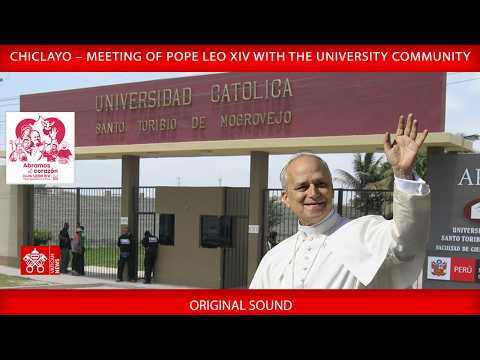
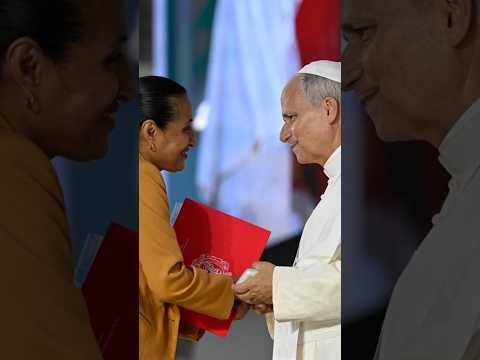
According to the bulletin, at 5.40 pm (11.40 pm Rome time) the Pope arrived at the Santo Toribio de Mogrovejo Catholic University, of which he was Grand Chancellor as Bishop of Chiclayo. Welcomed by the Grand Chancellor, Bishop Edinson Edgardo Farfán Córdova, and by Rector Patricia Julia Campos Olazábal, he made a short golf-cart tour among those present and reached the stage in front of the rectorate. After introductory remarks and the testimonies of a student (Adriano), a lecturer (María de los Ángeles Guzmán Valle, mother of Agustín, a young man with autism) and an academic authority, the Pope delivered his address: the university as a «living community where the search for truth becomes an act of love and service», the «most deadly» risk of submission to the technocratic paradigm, the promises of transhumanism and posthumanism, the limit that «is not a manufacturing defect, but the condition of human greatness», and the example of Saint Turibius. Blessing, exchange of gifts and closing song. About 6,000 people on campus and 50,000 along the route, according to the bulletin. The official text is on vatican.va only in Spanish.
🎥 Videos
▶
Chiclayo, Meeting with the University Community – full video (Vatican News - English)
▶
Highlights – Meeting with the University Community
▶
Chiclayo, Meeting with the University Community – full video, original audio (Vatican News)
▶
Highlights of Pope Leo's meeting with the university community (Vatican News - English)
📷 Photos
Preparations at USAT University for Pope Leo XIV's visit (Vatican News)
The Pope at the Santo Toribio de Mogrovejo Catholic University in Chiclayo (Vatican Media)
The Pope embraces student Adriano Alonso Rafael Durand (Vatican Media)
The Pope greets Professor María de los Ángeles Guzmán Valle (Vatican Media)
The Pope caresses Agustín and his mother María (Vatican Media)
The Pope presents Rector Patricia Campos with a statue of Our Lady (Vatican Media)
The Pope at the Santo Toribio de Mogrovejo University (Vatican Media)
The Pope at the Santo Toribio de Mogrovejo Catholic University in Chiclayo (Vatican Media)
Address at the meeting with the university world (Chiclayo)
Brothers in the Episcopate, Distinguished academic authorities, Dr Patricia Campos, Vice-Chancellor of the University, Respected political and civil authorities, Esteemed professors, researchers and other administrative staff, Dear students,
It is a great joy for me to return to Chiclayo and to meet with you here in the auditorium of USAT (the “Sa
Brothers in the Episcopate, Distinguished academic authorities, Dr Patricia Campos, Vice-Chancellor of the University, Respected political and civil authorities, Esteemed professors, researchers and other administrative staff, Dear students,
It is a great joy for me to return to Chiclayo and to meet with you here in the auditorium of USAT (the “Santo Toribio de Mogrovejo” Catholic University). I first thank the Lord, the God of life, for the years that he allowed me to spend on mission in the service of the Peruvian people. I also thank all of you, because during my years as Grand Chancellor of this institution, you helped me to understand that authority means service, that governance requires listening, and that education is a noble act of hope.
This gathering invites us to recall the enduring legacy of the patron saint of this university, Saint Turibius of Mogrovejo, a renowned jurist and Archbishop of Lima, whose life was a shining example of wisdom, charity and justice. The faith he preached and the knowledge he taught must continue to be the compass that guides research in these classrooms. A university — in particular a Catholic university — is a living community where the search for truth becomes an act of love and service to the great human family (cf. Saint John Paul II, Apostolic Constitution Ex Corde Ecclesiae, 1-2). With you, young people, as the protagonists, the quality of academic education is measured above all by its ability to shape you into wise, honest and mature women and men.
As you know, the world is undergoing complex cultural changes. In this context, the university is called to be a training ground for talent and a laboratory of meaning, a place where intelligence does not bow to utility, but rather serves the truth faithfully. Above all, it is called to serve Truth — with a capital “T” — who is Christ, the Savior of the world. In this way, the Catholic university works to foster the fruitful encounter between faith and reason, and between religion and science, by engaging in humble dialogue, conducting rigorous inquiry and always seeking the common good. This academic approach frees us from the temptation to produce only a skilled workforce for an exclusive and highly competitive market.
A progress that is indifferent to justice and the dignity of workers becomes, in fact, a mechanism of oppression and exclusion. The Catholic university therefore has a duty to remind the public and political spheres that science without a conscience ruins everyone’s life. In the same way, technology without a soul does not truly improve life. A humanistic and Christian education, however, sustains our ability to forge lasting fraternal relationships, so that we may navigate the digital age by moving beyond mere connection toward authentic relationships that foster communion. Dear friends, technology is not always neutral. At times, its forms bear the imprint, interests and ambitions of those who design and control it. For this reason, it must be studied with a clear mind and a pure heart.
The most deadly risk is that of submission to the technocratic paradigm, which reduces reality to material data, considering efficiency to be the supreme value. Both professors and students are called to exercise critical thinking, and I encourage you always to seek that wisdom which neither machines nor computer programs can possess. Only in this way will technological progress be at the service of our integral development, safeguarding the dignity of every person and promoting the common good.
Faced with this mission, the example of Saint Turibius of Mogrovejo lights the way for us. In his time, when indigenous peoples were often subjected to exploitation and discrimination, he defended their human dignity with evangelical fervor. Saint Turibius learned the languages of the people he served, proclaiming the Gospel in their culture and writing a catechism for them, which was one of the first in the Americas to be written in indigenous languages. His pastoral work bears witness to how the logic of the Incarnation continues to bear fruit in every time and place through the Church’s mission. Saint Turibius’ great cultural work in this part of the world continues to inspire us. Indeed, today the deserts are not only the arid expanses of Lambayeque, which that holy shepherd crossed on horseback, but they are the new forms of moral and civic illiteracy that exclude the poor. A university modeled on his example is called to use scientific innovation to bridge social divides and heal society’s wounds.
Thus, dear professors and students, we now turn to reflect on a central issue in contemporary thought: the human limit — that is, the human being as limit. Today, the promises of transhumanism and posthumanism are multiplying. These are ideological currents according to which, sooner or later, technology will eliminate all disease and pain, as well as aging and even death itself. Precisely because scientific progress is a supreme achievement of human intelligence, it must not be confused with a privilege reserved for millionaires seeking immortality, while entire peoples suffer from poverty and oppression. In the face of this mirage, which promotes the illusion of human beings perfected by cybernetics and biotechnology, Christian anthropology reminds us that a limitation is not a manufacturing defect, but rather the very condition of human grandeur.
Indeed, limitations call us to solidarity and openness to the transcendent. While the myth of self-sufficiency traps us in selfishness and leads us to cast aside the weak, recognizing our fragility makes us attentive to the needs of all. Saint Turibius of Mogrovejo experienced physical limits during his grueling journeys; he fell ill, suffered from exhaustion and faced the misunderstanding of the powerful. Moreover, it was precisely through a life so sorely tested that he transformed the ecclesial and social history of an entire country. Today it is up to us to follow his example!
Dear young students, you are the “natives” of this new era. Embrace the opportunities it offers you. Contemplate them in the light of faith, which is a bright beacon in the confusion and darkness of loneliness, boredom and pain. Angela has told us this with great sincerity, showing that faith always gives hope. For it does not deceive like magic, which claims to make every problem disappear. A living relationship with God comforts us, giving meaning to our crosses, which the Lord Jesus carries with us. This is the way to live out faith as a virtue — that is, as a force that gives wisdom and strength, leading us to what is essential, as Adriano explained. Both prayer and study transform our minds to the point of changing our lives. Accepting the truth, then, becomes a conscious effort, and whether through prayer or study, reflection turns into action. Both become an opportunity to seek and discover joy at every stage of life.
In this regard, Professor Guzmán has shared with us a word that is full of meaning: sacrifice. In everyday language, this term implies renunciation, but above all it means to make sacred, and therefore it is a gesture through which our entire existence — even that which the world discards — acquires value. United with the sacrifice of Christ, who reveals the true meaning of this experience, let us open our lives, with all their struggles and hopes, to God’s work. He always transforms into good whatever we place in his fatherly hands.
Dear professors and academic leaders, I encourage you to discover, with wonder and passion, that your work is a lofty expression of intellectual charity. As you accompany these young people in their classes and research, offer each one a consistent witness through your lives. Be free thinkers, for whom truth takes precedence over opinion, and justice over self-interest. Together with your students, tenaciously seek wisdom so that you may share it in your daily lives, among your colleagues and within Peruvian society. As you cultivate your scientific expertise, translate it into works of social justice, especially for the benefit of the poorest, and in the care of creation, which today is so wounded by profiteering that disregards the common good.
Dear friends, I encourage you to move forward with renewed vigor in your educational endeavors. For this reason, I entrust you and your work to the intercession of the Virgin Mary, Sedes Sapientiae. May she, who welcomed the eternal Word into her womb, teach you to journey through this time with courage and faith. May God bless you always!
📍 "Santo Toribio de Mogrovejo" School, Chiclayo, Peru
According to the bulletin, after the meeting at the University the Pope went by car to the Santo Toribio de Mogrovejo School. There he briefly greeted the Chiclayo volunteers gathered in the theatre, thanking them off the cuff («you are wonderful») and imparting his blessing, and then had dinner with the priests of the Diocese of Chiclayo. Afterwards he returned by car to the Bishop's House. According to Vatican News, the Pope then invited those present to pray the Our Father and Hail Mary together and stopped to take some photos with them.
📷 Photos
Leo XIV in Chiclayo on the evening of 13 November 2026 (Vatican Media)
Spontaneous greeting to volunteers at the Santo Toribio de Mogrovejo School
Thank you very much!
There is just one thing I would like to say to you, and that is “thank you, thank you, thank you” for everything you are doing. You have given of your time and energy, and some of you have made great sacrifices to help organize this visit, alongside many other volunteers and so many other people, so that I could make this visi
Thank you very much!
There is just one thing I would like to say to you, and that is “thank you, thank you, thank you” for everything you are doing. You have given of your time and energy, and some of you have made great sacrifices to help organize this visit, alongside many other volunteers and so many other people, so that I could make this visit.
Thank you, you are all wonderful. A round of applause for all of you. Jesus came to teach us many things, but one of the most important is precisely to learn to serve, to give one’s life in service to others. Not to think only of oneself, but to seek ways to put the gifts each of us has received at the service of others. Over the last few days, perhaps under conditions that have not been so easy, you have given of your time and your efforts to help – to help a great deal. So please know that you are in my prayers. In that sense, you are truly at the heart of the Church, and the service you are rendering is great and very important.
I would like to invite you all to stand up, and we will pray.
I shall give you my blessing and then I shall come around to take some photographs. Please remain where you are.
Prayer is always very important for every Christian. Let us pray together as Jesus has taught us.