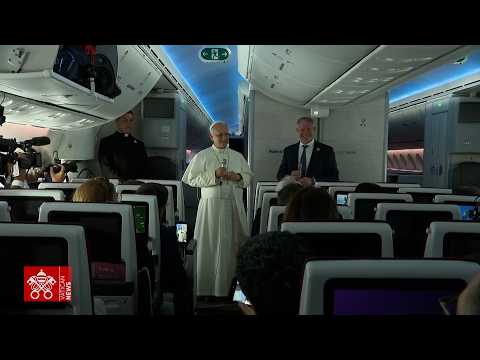


Matteo Bruni
Good morning, everyone. Good morning, Your Holiness. The first thing I would like to say to you, also on behalf of the journalists, is thank you. Thank you for this journey, during which you have helped us discover the diversity of this land, its great variety, and also the great multiplicity of the peoples we have met. We have seen t
Matteo Bruni
Good morning, everyone. Good morning, Your Holiness. The first thing I would like to say to you, also on behalf of the journalists, is thank you. Thank you for this journey, during which you have helped us discover the diversity of this land, its great variety, and also the great multiplicity of the peoples we have met. We have seen their charity, faith, love of the Church and, evidently, their love for you — especially in Chiclayo. We have also seen how faith is a source of hope in the face of great adversity, something you have spoken to us about during these days. But perhaps you would like to say a few words before we begin.
Pope Leo XIV
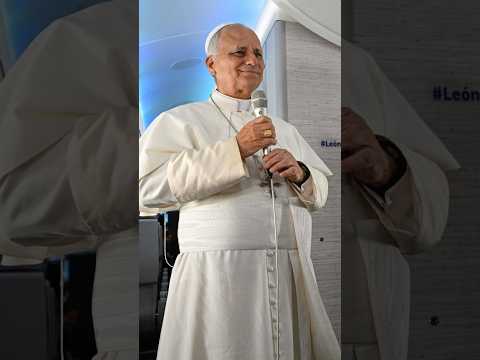
I will begin in English. Good afternoon, everyone. Nice to see you, thank you for the work you have been doing, accompanying us on this journey. I hope I did not tire you out too much. It was, I think, a wonderful trip in many ways. Three countries, three very different countries, yet with common elements, not only linguistically. At the same time, there are great differences among them. I think what occurs to me is: I would say this trip we could entitle Magnifica Humanitas, because it was a true experience of meeting people, recognizing the gifts in the different cultures, the different peoples, the different cities and rural areas that we visited. At the same time recognizing that the great gift of humanity is all the greater because it is God’s creation, and because God chose to incarnate, God chose to become human to help us recognize how great this gift of humanity is. We saw it in so many different ways, so many different colors, different music, different expressions of faith and devotion throughout the days we have been traveling.
Personally, I want to thank God and the peoples, communities and countries that have welcomed me — welcomed us — during these days. We have seen that there is truly much to celebrate. There is great value in the human experience and in the religious experiences, the expressions of devotion and faith, which we have been able to share during these days. I think this is above all where we should emphasize the beauty of an Apostolic Journey such as this: its principal purpose is to share the faith and the message of the Gospel among different peoples, who often have their own experiences of suffering and pain, but who always celebrate our faith in God. Very well, thank you very much. If anyone would like to ask a question, I am ready to try to answer. Thank you.
Very well. Thank you very much. Would anyone like to ask a question?
Matteo Bruni
Thank you, Your Holiness.
Pope Leo XIV
I am ready to try to answer. Thank you.
Matteo Bruni
Thank you, Your Holiness. Perhaps, as we look back on the Magnifica Humanitas of these days, beginning with Uruguay. We have with us Juan Paullier, a journalist with Zorrilla Media.
Juan Carlos Paullier (Zorrilla Media)
Your Holiness, how are you feeling? Were you surprised by the stamina you showed during this journey?
Pope Leo XIV
My stamina?
Juan Carlos Paullier
Were you surprised?
Pope Leo XIV
Other people are surprised by me. I give thanks to God. The truth is that, as everyone knows, after a rather significant operation a little over a month ago, from the very first week — from the beginning — I had in mind that this Journey was scheduled and I wanted to go ahead with it. And so, with God’s help, and I firmly believe thanks to the power of prayer. I received messages, quite literally, from all over the world. With a certain determination, which I also have, and with the help of the doctors, it turned out that it was possible. I have to say that I am not at one hundred per cent, but I am doing quite well. Stamina is one of the gifts the Lord has given me. Thanks be to God.
Matteo Bruni
Thank you, Juan.
Juan Carlos Paullier (Zorrilla Media)
I wanted to ask you specifically about Uruguay—which now seems a long time ago since you were there. One of the things you said was that we should not confuse smallness with insignificance. What concrete example can the Church in Uruguay offer to other communities? Why did you decide to visit a country such as Uruguay, and what fruits do you hope your visit will bear among Uruguayan Catholics, but also in society that is so secular? Thank you very much.
Pope Leo XIV
Thank you. We are in the month of November; the season of Advent and Christmas is approaching. I think, for example, of Bethlehem, and of those small towns where Jesus came with his message, and of how a small community can do great things. Not because it is large in itself, but because faith begins like a mustard seed. In Uruguay, we all saw — and perhaps some were surprised by it — the very strong response of the Catholic community, but not only the Catholic community. Thanks to what I would call happy providence in the planning, we were able to be there for the feast and celebration of Our Lady of the Thirty-Three; a very important feast in the devotion and history of Uruguayan Catholics. With these elements, one begins to see that even in a country considered so secular — a country where many people no longer actively practice a faith or religion, or whose participation is perhaps limited or non-existent — the Church, the faithful and Christians have much to say. The response during these days has been wonderful, and I believe that some seed will have been planted which will grow.
Matteo Bruni
Thank you, Your Holiness. The second question is from Elisabetta Piqué of La Nación, an Argentine journalist.
Elisabetta Piqué (La Nación)
Thank you, Holy Father, for this wonderful journey. We congratulate you, because we are exhausted! I wanted to ask you: on the front page of the Argentine newspapers, we saw that you met President Javier Milei a couple of times. Could you tell us a little about those meetings and, since you gave many messages there, which message was most important for the government of Javier Milei? And then another question, the big question that has been on everyone’s mind. You knew Pope Francis well: why did he never go to Argentina?
Pope Leo XIV
I will not try to answer the second question, because I do not know, and I cannot presume to think or read Francis’s mind, even though I was his collaborator and knew him during the last years of his life, and perhaps a little longer. He left that as a mystery. We can ask him about it in eternal life.
I met President Milei in Rome, when he came to the Vatican. As with Francis, although they represented very different political positions, they apparently got along very well.
I insist that the message I want to give, the message I want to convey, is not political. Although there are some countries that try to push me towards the right or the left, and criticize me or do not criticize me, when I speak about Magnifica Humanitas. That is what I spoke about with President Milei: respect for the human person, and the need to give greater consideration, above all, to those who are most in need in Argentine society.
Yes, we spoke about economic questions and some of the difficulties the country was still facing when he took office, and so on. But above all, there was a mutual understanding when we spoke about the value of life and the value of the human person at every stage of life. We have to seek ways of working together on this. That was the direction of our conversation. You also saw, both when he arrived and when he said goodbye, that he was open to listening to this message. I believe that, in this sense, it was very positive.
Matteo Bruni
Thank you, Elisabetta. Thank you, Holy Father. The next question from Argentina is from Pamela Francescato of Canal 5 Noticias.
Pamela Francescato (Canal 5 Noticias)
Holy Father, I want to congratulate you on your energy. We have seen you doing very, very well throughout. You have conveyed a great deal of love to all of us.
Before you arrived, Argentina was — and still is — going through a difficult time, one marked by darkness in many respects. Since your departure, after hearing your words, the only thing people in Argentina are talking about today is you, on the television and the radio. You have left a very strong impression on all of us. Society needed your voice, and your message about how magnificent humanity is and how we must continue to be human. What advice can you give us? Today, after your visit, Argentina is smiling. What would you say to us?
Pope Leo XIV
I think we are increasingly becoming aware of how we have allowed ourselves to be led by algorithms and by a polarization that is not accidental, but which in many situations has been deliberately provoked.
I believe — this is a side point, though not entirely — that you have a very important role to play in helping everyone overcome this form of polarization and in saying what Argentina has experienced over these few days. How is it possible that people from the right and the left, everyone, have been out in the streets, celebrating and rejoicing in something much greater than a political debate?
Personally, I strongly believe that in the message of Jesus Christ — even as I have the greatest respect for those who are not Christians and choose another path — we can rediscover the message of building bridges and seeking reconciliation. There are elements of our humanity far greater and deeper than the things that so often divide us and give rise to hatred and polarization.
I would like to think that, if for no other reason, this visit has helped awaken in the hearts of many people the realization that we can change our mindset and think differently. Differences of opinion will remain, but there is no need for us to hate one another, to use such violent language, or even to create within families an inability to speak to one another and come together.
So I hope that, by once again sowing seeds of hope and offering messages about the possibility of unity despite difficulties and differences, we can seek solutions while always keeping the common good and the good of the people in mind.
Matteo Bruni
Thank you. The next question comes from Sergio Rubín, a journalist with El Clarín, also from Argentina.
Sergio Rubín (El Clarín)
Thank you very much for visiting us and for all your efforts. The theme of unity clearly ran through your entire message in Argentina, from your arrival to your departure. Many people are wondering whether that message will in fact be heard. My question is this: Argentina once had a large middle class, but has suffered a spectacular social decline, almost as though it had been through a widespread war — which it has not. There is now an adjustment program under way. What can be said about this from the perspective of the Church’s social doctrine? Some people are making great sacrifices; many are suffering. How can we explain the immorality of a country as wealthy as Argentina, and with such intellectual resources as well, being unable to move forward? Thank you very much.
Pope Leo XIV
Thank you. Without going into an economics lesson, I would say that there are international issues and factors that have contributed to the very heavy burden causing so many problems for the middle class, not to mention the poorest people.
Here too, I think we must encourage everyone — the people and citizens, but also the political class — to see how we can work together to rebuild and improve living conditions for the whole population.
In some cases, this involves international cooperation and the search for solutions to the difficulties that are causing serious economic difficulties for peoples.
We must all keep the common good in view. Often, small businesses, if they receive support, can do more to create jobs and strengthen the possibility of rebuilding a middle class. It is very important not only to encourage individuals to find ways of living with hope, but also to encourage those with greater resources to seek ways that serve everyone’s good, and to work towards a world where fewer and fewer people have more and more. The accumulation of wealth is also an issue addressed by the Church’s social doctrine. We must ask how wealth can be redistributed more equitably — much more equitably — so that we do not see the middle class reduced or even eliminated. We must strengthen the working class, individuals and associations, so that people can live with greater dignity.
Matteo Bruni
Thank you, Your Holiness. The next question comes from Peru. Fátima Saldonid works for Peruvian public television.
Fátima Saldonid (Peruvian Public Television)
Holy Father, you know that we are very expressive people, with hugs and many gestures. We were a little concerned by the images when someone threw a rosary at you. I know it was done with great affection, because everyone wanted to be close to you. You have said that your work in Peru taught you how to be a bishop, and then you told us that this tour has also taught you a little about being the Vicar of Christ. What moved you most, and what will you take from this experience into the future of your ministry and your work in the Church? There is something others do not understand: you are our father, but our father who has been promoted; when will our father who has not been promoted come back to us?
Pope Leo XIV
Well, let us leave the last question aside, because I do not know where I will be during the year, much less in the future. I would like to take this opportunity to say that organizing a papal visit involves an enormous amount of work. I am grateful to all the communities: Lima, which has more resources but has done a great deal of work; Pucallpa, which has fewer resources but great warmth in many ways, and which also worked hard to organize yesterday’s events; Cusco and Chiclayo. We must acknowledge and thank everyone who worked on this visit. It would not be fair to them to come back too frequently, so we will let them rest for a while.
The affection of the Peruvian people — even that of the person who, with great faith, simply wanted to offer me a rosary — is something one carries in one’s heart, and perhaps in one’s eye, but it leaves a mark on one’s life. It shows that there is real enthusiasm here, deep faith, and a desire to receive the Lord’s blessing through, in this case, a servant of his, the Pope.
That closeness is itself a message, from both sides. To share the faith with joy and to give the blessing is a little like the Gospel story of the woman who wanted only to touch the hem of Christ’s garment to receive his blessing.
As I travelled in the popemobile, people wanted to touch the Pope’s window. They tried to get past the National Police barriers, but they wanted to live, feel and experience this faith.
Thanks be to God, I try, with the energy he gives me, to be close to them. But I also receive something from them: their enthusiasm, their faith and their devotion. It truly is a gift from God. They have shared it with me, and through me with everyone around the world who has witnessed what we have experienced. I thank God. There are no other words.
Matteo Bruni
Thank you, Your Holiness. Thank you, Fátima. The next question is from Carlos Villarreal of Peruvian public radio.
Carlos Villarreal (RPT Noticias)
Holy Father, how are you? RPT Noticias sends you its greetings. One of the fundamental aspects of your visit has been your arrival in Peru at a very difficult time for us. In your address, you mentioned the violence, the El Niño phenomenon and the rains in the north, which you know very well. In this context, how do you think Peruvians, believers and non-believers alike, can sustain over time the spirit of unity, faith and hope that your visit has awakened in us?
Allow me to ask you another question as well. I know that in Peru you met with people who have reported being victims of regrettable situations involving members of the Church. What feelings did that meeting awaken in you? How did you experience those encounters, and what did they stir within you? Thank you very much, Holy Father.
Pope Leo XIV
Thank you. In a certain sense, at least part of the answer is the same. The Pope — or at least I — am happy to visit every country in the world, if the Lord gives me enough time. But there is only one Pope. He represents, and this is very important, the Vicar of Christ; yet the Church lives at the local level with the bishops, who are its pastors.
I think that part of my message, which I also shared with the bishops, is that they must carry forward the experience of faith we have shared during these days. I told the bishops: now it is your turn to keep this going. Do not lose the gifts we have shared in these days; help this experience of joy, devotion and faith to move forward and continue to grow.
As for the victims, as I believe you know, this is not the first time I have spoken with victims — not only in Peru, but in other countries as well. The Pope cannot listen to everyone throughout the world. So this is also a gesture expressing the desire to be close to victims and to help them find a path which, perhaps gradually, can lead them to genuine healing.
At the same time, it is a commitment to continue working on prevention, so that these things never happen again. It is also a call to bishops and pastoral workers in their dioceses: you are closer to these situations, and you must fulfil your responsibility. You must accompany the victims. You must be the ones who truly take responsibility for accompanying and helping them, so that justice may be done and these crimes may never be repeated.
Matteo Bruni
Thank you, Your Holiness. Thank you, Carlos. Now we move on from the countries we have visited and turn towards Italy. The question is from Fabio Marchese Ragona of Mediaset.
Fabio Marchese Ragona (Mediaset)
Your Holiness, thank you. I ask this question on behalf of all Italians. May we speak in Italian this time? Obviously, it has been a very beautiful and intense journey, full of engagements. Some of us have survived, although we came close to…
Pope Leo XIV
I can see a lot of tired faces back there — what’s going on?
Fabio Marchese Ragona
Yes, yes… We came close to a general farewell… We have obviously seen that you have given so many speeches, and you seemed almost not to feel tired. This made us think about the sudden moment when you were admitted to hospital. We wanted to understand how you experienced that moment as a patient, when you suddenly learned that you had to go to hospital, and whether you will have to continue with check-ups and treatment. Will anything change in your life as Pope?
Pope Leo XIV
The first news came as a surprise. I had no symptoms; I felt well. So when, during some tests carried out as part of a check-up, the annual routine examinations that I have generally been having for many years, they discovered something that had begun as a shadow. Further tests and a biopsy showed that there was something there: it was a tumor. I must say — and this connects with what I said earlier — that I wanted to make this journey, and I said: let us do the surgery straight away. By God’s grace, I was at peace. I felt that it had to be done, so let us do it. I trusted the doctors and the medical care available to us, and we went ahead. Thanks be to God, as you know, everything went very well. In the part of the lung that they removed, the tumor was entirely contained; it had not spread beyond that area. No further treatment is needed for it. As a precaution, I will need to be vigilant with these annual check-ups. How did I feel? I have a brother — and this is public knowledge — who is also going through a much more complicated situation. But we are living through it with great trust in the Lord. Perhaps this can also be a sign to people who are suffering and who may be very afraid, understandably so: it is important to go for check-ups. Prevention is important. We must take care of our health. When treatment is necessary, we should not be too afraid, but should go ahead and do what needs to be done.
Thanks be to God, in this case, and also thanks to the strength of the prayers of so many people, everything has gone very well. I am here as a witness to all of this.
Matteo Bruni
Thank you, Fabio.
Pope Leo XIV
I hope this answer sufficed.
Matteo Bruni
Yes, thank you, Your Holiness. The next question is from Gerry O’Connell of America Magazine.
Pope Leo XIV
Are you going to speak English?
Gerry O’Connell (America Magazine)
I’ll speak in English, Holy Father. First of all, congratulations. This was a wonderful trip. I’ve been on many papal trips and I think this really was magnificent. And seeing you in Peru, I think your heart is in Peru and your body might be in Rome. But my question: Yesterday at Pucallpa, speaking at the port to the missionaries and to the Amazonian leaders, you said to the missionaries, your vicariate is larger than many countries. You have only 25 priests. Now, Holy Father, you went to Peru in 1985 as a missionary. If I understand correctly, the Augustinians in the States responded to Pope John XXIII’s appeal to send priests to Latin America. There were not sufficient priests. You’ve been there 20 years, now you return as a missionary Pope. You still see the situation as a lack of priests there, and also in the United States they’re closing churches. We see that at the Synod on the Amazon, there was a big discussion. There was an approval of a motion to ordain viri probati, mature married men. We see that in the consultation for the Synod on Synodality, this issue was raised. Is the Holy Spirit not saying something to the Church through all this? And secondly, my question: Pope Francis in his Querida Amazonia, didn’t say no and didn’t say yes to the question proposed by the Synod on the Amazon about the mature married men. My question: is this an issue that is still open under you? Are you still considering it? I mean, you’ve been a missionary, you’ve seen the reality.
Pope Leo XIV
Thank you. First of all, let me add some perspective. I will begin where I started my missionary work: in Chulucanas. When I first went to Peru, there were perhaps between 15 and 20 American Augustinians and two Peruvians. Today, among the Augustinians in northern Peru, I do not think there are any Americans — perhaps one, but I would have to check — whereas there are 35 Peruvians. So the Spirit works in many ways, certainly in places where the promotion and formation of vocations are carried out in ways that are, if you will, fruitful. The door is not closed to the possibility that there may be more priests in the future, including Peruvian priests, to serve these missionary areas.
There are challenges, for example in the Amazon region, where the question of vocations has been more complicated for many different reasons. But there are seven Apostolic Vicariates in Peru. Yesterday we were in Pucallpa. Of the figures I gave, Pucallpa, Puerto Maldonado and Iquitos are three of the Vicariates where there are more vocations today. Other Vicariates have far fewer. There is much work to be done.
One of the solutions proposed for consideration is the one you mentioned. It is not the only solution, but it is one that, in certain parts of the Church, can cause division, because it does not enjoy universal acceptance. As I have also made clear several times during this brief year and a half — or however long it has been — that I have been Pope, one of my priorities is first to promote unity and communion among us as members of the Church.
If the Holy Spirit may continue to suggest an idea — not only to me, because the Pope does not change Church doctrine — we all have to listen. The bishops have to listen. Perhaps some things will change in the future. For now, however, I believe that an important part of my ministry, and of the Church’s ministry, is to heal and bring people together, much as we were discussing in relation to polarization over political issues in some countries, including within the Church.
I would say, first, let us come together. Let us consider what we believe the priorities should be, and then we will see how to move forward from there.
I am well aware that many people do not agree with this approach. That is all right. I am here, and this is what I am offering as part of my ministry. I suppose that is enough for now, because the whole question of married men serving as clergy is complicated. As we know, others have made other proposals. All these things will take time, and we will move forward as the Lord leads us.
Matteo Bruni
Thank you, Your Holiness. Thank you, Gerry. The next question is from Sylwia Wysocka of the Polish Press Agency (PAP).
Sylwia Wysocka (PAP)
Thank you for this beautiful journey and for taking us to Chiclayo. You have often spoken during the journey about your operation. Your predecessors signed a letter of resignation, to take effect conditionally in the event of a coma. I wanted to ask whether you too have signed such a letter.
Pope Leo XIV
No!
Matteo Bruni
Thank you! Let us move on to the next question…
Pope Leo XIV
For now, thanks be to God, I do not see any need. Canon law already contains several provisions that cover this matter for the time being. I entrust myself to God, as I said before I was elected Pope. Perhaps I will do it eventually, I think… But for now I see no need. Thank you.
Matteo Bruni
Thank you, Sylwia. Thank you, Your Holiness. The next question is from Valentina Alazraki, whom we know well, of Televisa.
Valentina Alazraki (N+ Televisa)
Good morning, Your Holiness. Thank you for taking us on this wonderful journey. During these days you have repeatedly said that Peru is your homeland, your home, and you have told us how much this people have given you and how they have changed you. You are, in part, the person you are because of what you experienced in Peru. But you have another homeland too, the United States, where you were born. So we would like to know what it was about the United States that formed you, or what the United States gave you. I know you may say that there are no dates yet, but could we imagine a journey from Chiclayo to Chicago?
Pope Leo XIV
The other way round!
Valentina Alazraki (N+ Televisa)
Chiclayo–Chicago.
Pope Leo XIV
Chicago–Chiclayo.
Valentina Alazraki (N+ Televisa)
No, I mean a visit. A visit to the United States.
Pope Leo XIV
Ah, I said a few minutes ago…
Valentina Alazraki (N+ Televisa)
In Spanish…
Pope Leo XIV
A few minutes ago I said that the next trips are still being planned for 2027. One trip that is confirmed is to Korea, for World Youth Day. Apart from that, there are several possibilities that we are considering. But that is all I can say for now.
Valentina Alazraki (N+ Televisa)
No, I meant what the United States has given you, what it has left you with.
Pope Leo XIV
Not the visit. I mean…
Valentina Alazraki (N+ Televisa)
What the United States has given you, and then I’ll ask you one more little question.
Pope Leo XIV
In many ways, I am ‘gringo’, American. There was an article in one of the newspapers represented here which, before the conclave, said: ‘Prevost is the least American of Americans.’
I think that, among other things, when I speak in general, I am direct. I say things as they are. The fact that I speak about my health, and even say, ‘Well, I am going through this,’ would not be typical in many countries or cultures. In the United States it is somewhat more common, and so it happens.
I do not want to provoke any further questions here, but my deep faith in democracy and democratic participation is also part of being American.
My way of living the faith has, of course, been greatly affected — transformed, one might say — by Peru. But I grew up in an American family, a multicultural family, certainly, but one in which the faith was also lived. So I think there are many things that have shaped me; I was formed by that culture as well.
Valentina Alazraki
You know that Mexico is waiting for you with great excitement.
Pope Leo XIV
Thank you very much!
Valentina Alazraki
You visited Our Lady of Guadalupe in Uruguay. May we dream that you will come to Mexico too?
Pope Leo XIV
Of course! I have been to Guadalupe several times, but you may dream — just do not wake up yet. I will come, I will come… I hope so.
Valentina Alazraki
Soon.
Matteo Bruni
We shall see how soon… The next question is from Jean-Marie Guénois, who works for the French newspaper Le Figaro.
Jean-Marie Guénois (Le Figaro)
Holy Father, after this very impressive journey, which has been tiring for you, and came after your operation of 13 October, will you be reconsidering your priorities for the coming months? And if I may also ask also a few, three little questions on three specific, very specific matters. Can you confirm that the Holy See is preparing a document on spiritual abuse that foresees canonical sanctions? On the spiritual abuse, is the Vatican preparing a document on this matter? Are you considering making the Motu Proprio “Traditionis Custodes” more flexible? And will you soon be appointing your first new cardinals? Thank you very much.
Pope Leo XIV
Thank you very much. In reverse order: no comment about future cardinals. There are still enough of them there. I think the number is about 116 currently. We will eventually get around to that.
Spiritual abuse is a very serious topic in the Church. It is being studied in the Vatican. There is not an immediate document as such to be published. Well, not yet. But the concept itself, and the need to be able to address some of those issues canonically, is one of the problems. In order to exercise justice, you need, if you will, a codification or a juridical definition of how it is to be applied. That concept is still very vague, although we could probably all describe specific cases or kinds of situations in which it has occurred. So we are studying the matter and working on it.
No, not right now. Traditionis Custodes was the decision of Pope Francis, and we will continue to follow it. Traditionis Custodes includes the possibility of a dispensation or of allowing the Tridentine Mass — or the Vetus Ordo Mass — to be celebrated. So, once again, for the unity of the Church, the vast majority of Catholics around the world celebrate the rite of Vatican II, of Paul VI, and we will continue to do so. There is a channel available for those who wish to apply for a dispensation.
[Regarding the Holy Father’s Priorities:]
I do not feel that I need to adjust them, thank you. Basically, things will continue as they have been.
Matteo Bruni
Some of the journalists may have to adjust theirs after the journey.
Pope Leo XIV
They are tired.
Matteo Bruni
One final question. Giacomo Galeazzi of La Stampa.
Giacomo Galeazzi (La Stampa)
Your Holiness, I think I can indirectly confirm that you are in good health, because yesterday in Cusco I felt unwell. Clearly, you managed to keep speaking, whereas I could hardly walk! Your Holiness, you voted in the midterm elections. What do you expect now, both for your country and within it and beyond it, at a time when hybrid warfare and cognitive warfare are spreading throughout the world? We are experiencing the consequences in Italy too. Do you expect greater moderation or greater polarization after the midterm vote?
Pope Leo XIV
I can only repeat what I said a few minutes ago: I would like to see a greater capacity for dialogue, for building bridges and for reconciliation, less controversy, less war and less division. I know that this too is a dream, but I know it is possible. So we shall see… I am not making a political comment; I am promoting the social doctrine of the Church, in the hope that some people will listen. Let us always seek to promote dialogue and this capacity to listen.
Matteo Bruni
Thank you, Your Holiness!
Pope Leo XIV
Thank you all! I hope you will be able to get some rest during the flight.
Matteo Bruni
Thank you once again.
Official source ↗