Saturday 21 November 2026 — Regional WYD with the young people of Lazio · Vienna Philharmonic · International Space Forum · Decrees of Saints
11:30
Paul VI Hall, Vatican
🙌 Meeting
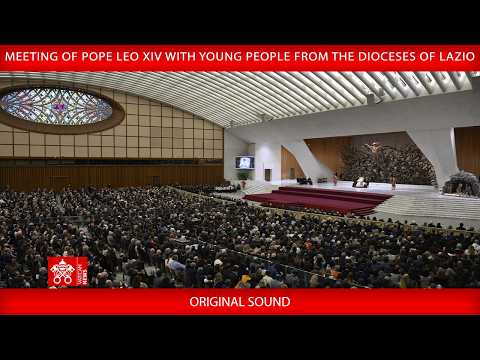
Meeting with the young people of Lazio (regional WYD)
📍 Paul VI Hall, Vatican
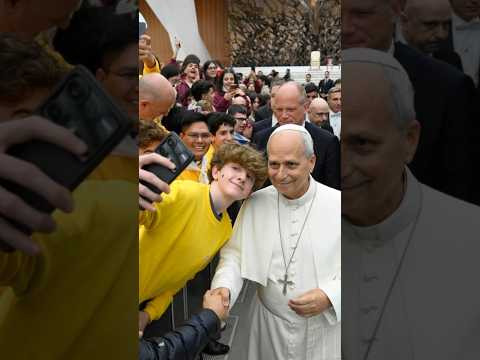
More than 6,000 young people from the dioceses of Lazio gathered in the Paul VI Hall for a regional World Youth Day with Pope Leo XIV, organised by the Youth Ministry Commission of the Lazio Bishops' Conference on the theme of WYD Seoul 2027: "Take courage, I have overcome the world" (Jn 16:33). The programme included a welcome at 8:30, a moment of prayer at 9:45 introduced by Bishop Mauro Parmeggiani, and testimonies from young people. At 11:30 the audience with the Pope began, introduced by a greeting from the Cardinal Vicar Baldassare Reina: Leo XIV answered five questions from young people, and the meeting ended with the renewal of baptismal promises and the blessing. In the morning, after the welcome by Bishop Parmeggiani («The world needs young people who do not surrender to indifference»), seven young people shared their testimonies, among them an engaged couple, a newly baptised young man, a seminarian, a Congolese man who grew up amid the Kivu war and a young Korean woman.
Meeting with young people from the dioceses of Lazio – Answers to questions (tradotto)
In the name of the Father, and of the Son, and of the Holy Spirit.
Peace be with you!
[Greeting by the Cardinal Vicar]
FIRST QUESTION Your Holiness, I am Chiara and I am 26 years old. This morning we met some young people who shared with us their desire – simple and bold – to live their baptismal vocation to the full. Often, however, it is diffi
In the name of the Father, and of the Son, and of the Holy Spirit.
Peace be with you!
[Greeting by the Cardinal Vicar]
FIRST QUESTION Your Holiness, I am Chiara and I am 26 years old. This morning we met some young people who shared with us their desire – simple and bold – to live their baptismal vocation to the full. Often, however, it is difficult to live the faith in a constant and authentic way, and we let ourselves be overcome by uncertainty and doubt. We therefore ask you for some suggestions to get through our periods of dryness in faith, and also to help those around us face the difficulties and trials on the journey of life.
ANSWER OF THE HOLY FATHER
First of all, good morning and welcome, everyone!
It is always a joy to meet you and to reflect with you starting from your questions. I would like to begin by referring to what Chiara has just said: “It is often difficult to live the faith”. By this word, “faith”, do we all immediately mean the same thing? In the Church, “faith” means following Jesus Christ, who is the Son of God, the Saviour of the world. Is it difficult? We can say that sometimes, yes, it is. But it is not difficult like a maths problem or a philosophical question. Christian faith is above all a bond of friendship with Jesus and with those whom He himself called to follow him before us, together with us and also after us. This bond sheds light on the uncertainties we may feel, because it invites us to read and to reflect our life in the Gospel. Then we see that it is the Lord Jesus himself who takes care of his friendship with us, especially when – on our part – it wavers or weakens. I give you two suggestions: the first, to discover in the Gospel the words and gestures with which Jesus loves us, savouring them day after day in the pages of Scripture; and the second, to walk in the Church with our brothers and sisters, because from the very beginning Jesus wanted to have disciples and to form his community with them. Like being together this morning: when we are together it is always easier to believe and to overcome those difficult moments. So this, like this meeting this morning, gives us great joy! Thank you!
SECOND QUESTION Holy Father, I am Flavio and I am 20 years old. On this day we renew our baptismal promises, to welcome once again the call to holiness and to make a difference in this world. And yet we young people often feel called to “perform”; that is, we feel we cannot be fragile, always having to prove something to others. This actually seems to us to be in contrast with the desire for holiness, because we almost feel the need to be perfect. How, then, can we truly live the desire for holiness, coming to terms with our humanity and remaining “incarnate” and “committed” in the realities in which we find ourselves?
ANSWER OF THE HOLY FATHER
Another good question! We must say, to use your words, that holiness is not a performance that stresses us out, nor yet another expectation to be met. On the contrary, holiness is a gift, a call, which corresponds to our deep desire to find happiness, to be happy. Holiness blossoms and matures in us by following Jesus Christ, without competing with others. It is He, the Holy One, who sanctifies us, transforming us into his image.
Dear young people, how lovable, how surprising is the God of Jesus, the God who is Jesus! Being in his company frees us from the burden of counting everything we do and of saving ourselves on our own. Christ saves us, Christ knows us by name; indeed, over time he reveals to us our true name, that authentic identity, that infinite dignity, that place in the world which He has thought of for us. By following Jesus we become who we are. This is the mystery of holiness: it is welcomed as grace, it is lived as mission. It is truly an alternative and convincing way of living, which gives the world a new face through the new faces of those who follow Jesus. Thank you!
THIRD QUESTION Your Holiness, I am Francesca and I am 22 years old. Many of us are at the time of important life choices. As we approach adulthood, the theme of vocation therefore becomes essential to help us understand the road to take. For this reason, first of all, we would like to know how you lived your vocational discernment. We also ask you to point out some tools with which we can welcome the plan of happiness that God has for us.
ANSWER OF THE HOLY FATHER
Thank you for this question. At my age I can tell you that God always calls; and that discernment is living in conversation with the Lord, sharing with Him the experiences and decisions of each day. At your age, of course, this dialogue concerns the questions of every young person: who to become, who to be, with whom, for whom. In our heart, some questions may resound more painfully, when we feel we are not up to it or that we carry the weight of poverty and injustices that do not depend on us. The context and the times in which we live may discourage us, but the Lord loves us here and now, and calls us here and now. These are important years, the ones you are living. And you are living them at an important moment in history. Amid the challenges and promises, the threats and hopes of the present, the Risen Jesus walks with us.
In the Church we find both challenge and help. For example: the challenge of “for ever”! Yes, the Church educates us to faithful choices, which last and withstand difficulties, because God’s love is for ever. And the help of the Church takes concrete form in people, rhythms, places, spiritual and charitable experiences, where we can listen to the living Word that calls us. I can tell you with joy that this is how it was for me too!
FOURTH QUESTION Holy Father, I am José and I am 19 years old. The Sacrament of Baptism gives us belonging to the Church: our faith is born of a deep relationship with the Lord and is fulfilled within the community. What style of witness can we cultivate, without running the risk of living the faith as “free agents”, self-referential or isolated? How can we proclaim the beauty of the Church to young people who feel “far away”?
ANSWER OF THE HOLY FATHER
To answer this question I will challenge you a little on two points. The first point: José Francisco told us that faith “is born of a deep relationship with the Lord and is fulfilled within the community”. And yet one could also say the opposite: faith is born within the community, by meeting believers, and is fulfilled in a deep relationship with the Lord. The two aspects go together, because faith does not close us up either within a community or within ourselves, but always opens us to God and to our neighbour. That is why “going out” was a verb so dear to Pope Francis. Let us think: every Sunday we gather around the table of the Lord to celebrate the Eucharist, and then go out and bring his love into daily life.
The second challenge follows from this, and it is this: there are no “faraway” people! Because God is close to everyone, even to those whom we consider – or who consider themselves – far from Him. God does not push anyone away, because He wants to live with us! Therefore others are our neighbour: we do not choose our neighbour; it is whoever life places beside us and lets us meet. The Church, then, helps us to avoid the mentality that sets “us” against “them”, the “near” against the “far”, “our own” against “the others”. Since we pray saying “Our Father”, we learn to recognize as brother and sister even those who seem far away or who present themselves as adversaries. No one is far away for those who have God in their heart. Thank you!
FIFTH QUESTION Your Holiness, I am Maria Teresa and I am 18 years old. As the theme of the next World Youth Day in Seoul, you chose the words of Jesus: “Take courage, I have conquered the world!”. This promise gives us hope and reminds us that He has already won. He has conquered death, he has conquered evil, he has conquered even our sins. For this reason, we would like to hear a word from you about how we young people today can live the Sacrament of Confession, a special encounter with Jesus who continues to encourage us on our journey. Thank you.
ANSWER OF THE HOLY FATHER
Yes, during the Last Supper Jesus says to his disciples: “In the world you face persecution. But take courage; I have conquered the world!” (Jn 16:33). Listening to these words we understand what it means to win and what the victory is that the Lord gives us. The way in which Christ conquered the world has a name, and it is called salvation. This victory is in no way to be confused with the violent attitude of those who prevail by destroying someone else. We must think carefully about this fact, in this world, a competitive world, in which the culture of power, of challenge, of war poisons every encounter and turns it into a clash, a competition.
Instead, there is the model of Jesus, there is the life of Jesus: Jesus wins on the cross, giving his life for us, freeing us from sin and death. Jesus wins because he knows how to see beyond what is done to him. That is why, while they are crucifying him, He says: “Father, forgive them” (Lk 23:34). This is conquering the world: seeing it with all its evils and loving it, loving it with the love of God, who heals them for ever. It is the work of redemption: through Jesus, God’s mercy melts evil like snow in the sun. This immense good calls us to the good. So, regarding your question, Maria Teresa, Confession is the Sacrament in which we live redemption in a most personal, real way, face to face with the Lord. That is why we come out of it truly free: free to love as He has loved us.
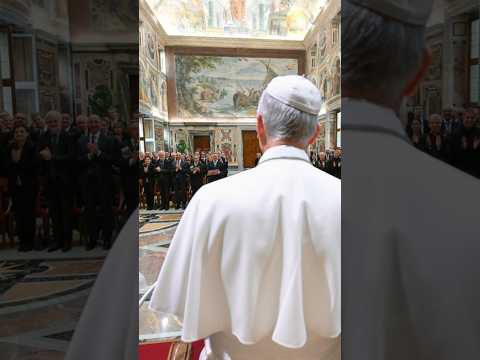
Pope Leo XIV received in the Clementine Hall the members of the Vienna Philharmonic, in Rome for the 25th International Festival of Sacred Music and Art (until 25 November), with Maestro Riccardo Muti also present. Greeting them with «Herzlich willkommen!», the Pope recalled that the orchestra keeps alive the legacy of Haydn, Mozart, Beethoven, Schubert, Brahms and Bruckner, and quoted Benedict XVI, who thanked the orchestra at St Paul Outside the Walls in 2008. «In a time marked by wars and conflicts», music «teaches us to listen to one another» and to seek together a harmonious order: «Like peace, true art is essentially a gift to be shared in order to transform hearts».
🎥 Videos
▶
Pope: In an age of conflicts music teaches us to not be in opposition to one another (Vatican News)
📷 Photos
The Pope meets members of the Vienna Philharmonic (Vatican Media)
Pope Leo XIV and Maestro Riccardo Muti (Vatican Media)
Group photo with the Pope (Vatican Media)
Pope Leo XIV meets with members of the Vienna Philharmonic Orchestra (Vatican Media)
Pope Leo XIV during the audience (Vatican Media)
Pope Leo XIV meets with the Vienna Philharmonic Orchestra (Vatican Media)
In the name of the Father and of the Son and of the Holy Spirit. Amen.
Peace be with you.
Your Eminence, brothers and sisters, dear friends,
Welcome! We are happy to welcome all of you to the Vatican this morning. Herzlich willkommen! You have traveled here for the 25th International Festival of Music and Sacred Art from Vienna, a city that like
In the name of the Father and of the Son and of the Holy Spirit. Amen.
Peace be with you.
Your Eminence, brothers and sisters, dear friends,
Welcome! We are happy to welcome all of you to the Vatican this morning. Herzlich willkommen! You have traveled here for the 25th International Festival of Music and Sacred Art from Vienna, a city that like few others is deeply connected to the history of European music. The names Haydn, Mozart, Beethoven, Schubert, Brahms, Bruckner and many others remind us of a musical heritage that transcends borders to become the shared intellectual property of humanity.
In a special way, the Vienna Philharmonic is the bearer and guardian of this great heritage. Yet your task is not merely to keep the masterpieces of past centuries alive. By bringing these works to life again and again, you also allow the people of our time to share in the sublime experience of beauty.
As you may know, music was a matter particularly close to the heart of my esteemed predecessor, Pope Benedict XVI. In October 2008, at the Basilica of Saint Paul Outside the Walls, he thanked your orchestra for touching the hearts of your listeners with your music and pointing them beyond human reality towards the divine. Yes, beauty is not merely a pleasant or soothing element of our existence. It can also open up a deeper dimension of life and give us a glimpse of the truth of our lives and of the mystery of God. Indeed, all of us need moments in which we can detach ourselves from what is merely practical, moments in which our hearts can expand and we allow ourselves to be touched by a reality greater than ourselves. Especially in our technological age, such experiences can be particularly healing for many people.
Moreover, art in general — and music in particular — is capable of expressing profound human experiences: joy and sorrow, hope and longing, the reality of suffering and a sense of the eternal. It often also leads people into that inner stillness in which the great questions of their lives arise anew.
Dear friends, when we look at an orchestra, we can also see in it a beautiful image of the human family. Each instrument has its own sound, its own special expressiveness, its own distinctive role. None can simply replace the other. Yet the musical work of art comes into being only when the many voices find a common harmony. This requires more than just “perfect technique.” It also requires the ability to listen and to place one’s own contribution humbly at the service of the whole. In an age marked by wars and conflicts, by mistrust and social tensions, music reminds us that human beings are not destined to remain locked in competitive opposition. It teaches us to listen to one another, to be attentive to others and to seek together the harmonious order in which everyone can find their place.
Music, then, is a language that reaches and unites people of different nations, cultures and religions. Like peace, true art is ultimately a gift that is to be shared in order to transform hearts. Our Christian faith recognizes in this experience a reflection of that divine beauty from which all life has sprung and toward which our hearts continue to journey.
Dear members of the Vienna Philharmonic,
Danke! Thank you for your service to music, to culture and thus also to humanity. May your art continue to bring joy and comfort to many people, to awaken hope and to open hearts to what is true, good and beautiful — and to the God in whom it has its origin.
To you, your families and all who are associated with your orchestra, I cordially impart my Apostolic Blessing. Thank you.
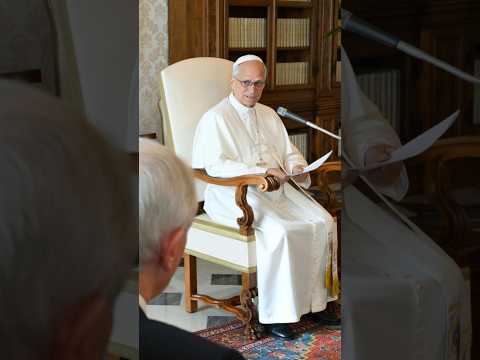
In the Library of the Apostolic Palace, Pope Leo XIV received members of the delegations of the International Astronautical Federation and the Italian Space Agency, ahead of the eighth International Space Forum, to be held on Monday 23 November at the Palazzo della Cancelleria on the theme «The gateway to the sky: space at the service of peace». In his address, delivered in English, the Pope said he «fully» shares the concern to preserve outer space from any non-peaceful use, and pointed to space research as an example of cooperation among countries and cultures, recalling that technologies must be governed according to ethical principles. Space scholars, he said, help us look at the world as a whole, while those who wage war and ruin creation have a «short-sighted vision, often blinded by the idols of power and money».
🎥 Videos
▶
Pope Leo XIV: 'If technology is not applied ethically, risks for humanity are enormous' (Vatican News)
📷 Photos
In the Library of the Apostolic Palace, Pope Leo XIV reads his address in English to the delegations of the International Astronautical Federation and the Italian Space Agency (Vatican Media)
The gift of the International Astronautical Federation to Pope Leo XIV (Vatican Media)
Pope Leo XIV with participants in the International Space Forum (Vatican Media)
Pope Leo XIV with participants in the International Space Forum (Vatican Media)
Pope Leo XIV with participants in the International Space Forum (Vatican Media)
Address to participants in the International Space Forum
Dear friends, good morning and welcome.
I am happy to greet the President of the International Astronautical Federation and the President of the Italian Space Agency, together with the other leaders and participants in this Forum on the theme “The Gate to the Sky: Space for Peace.”
I appreciate the choice of the Vatican as the venue for this year
Dear friends, good morning and welcome.
I am happy to greet the President of the International Astronautical Federation and the President of the Italian Space Agency, together with the other leaders and participants in this Forum on the theme “The Gate to the Sky: Space for Peace.”
I appreciate the choice of the Vatican as the venue for this year’s Forum, which is dedicated to the urgent need to safeguard outer space from any kind of use or exploration for non-peaceful purposes. I fully share this concern and hope that your voice will receive the attention it deserves in political and legislative forums.
Space research and missions have long brought people from different countries and cultures together in mutual respect and cooperation, and today, thank God, they continue to do so. In this way, they reveal one of humanity’s finest qualities: the ability to share knowledge and experience in order to reach new goals together in the service of the common good.
I would like to emphasize this last point: the common good is the goal. Indeed, if technologies and their applications are not adequately governed in accordance with the principles of ethics, the risks for humanity are enormous, as contemporary history teaches us, and as the present-day regression in integral ecology on a planetary scale sadly demonstrates.
You who study space help us to adopt a broader perspective on the world. You invite us to look at it as a whole, and to understand that the interests which lead people to wage war and exploit creation reveal a shortsighted outlook, often shaped by the idols of power and wealth.
In this regard, I am grateful to you. I am also pleased that the Holy See, together with the scholars of the Vatican Observatory, continues to contribute to research in the field of astrophysics. I cordially bless you and wish you every success in your work.
According to the Holy See Press Office bulletin, this morning the Holy Father received Archbishop Filippo Iannone, Prefect of the Dicastery for Bishops; Cardinal Marcello Semeraro, Prefect of the Dicastery for the Causes of Saints; and Archbishop Dieudonné Datonou, Apostolic Nuncio to Burundi. During the audience with Cardinal Semeraro he authorised the promulgation of decrees concerning: the miracle attributed to Blessed Zdenka Schelingová (opening the way to her canonisation), the miracle attributed to Venerable Rosa Staltari, the martyrdom of José Gómez Llor and 54 companions killed in Spain between 1936 and 1939, and the heroic virtues of Angelo Lolli, Abundio García Román and Giulia Gabrieli (who died aged 14 in 2011). The Pope also appointed the Dominican Serge-Thomas Bonino as Theologian of the Papal Household. In the afternoon the bulletin also announced the appointment of Fr Stéphane Duteurtre, parish priest of Notre-Dame-de-Clignancourt in Paris, as Bishop of Saint-Étienne (France).
On 21 November, as reported by Vatican News on 23 November, Archbishop Rino Fisichella, Pro-Prefect of the Dicastery for Evangelization, presented and handed to Pope Leo XIV the first copy of the photo book of the 2025 Jubilee, prepared by the Dicastery. The album retraces the preparations for the Holy Year of Hope, which brought more than 33 million pilgrims to Rome, and documents its 35 major events. Published by the LEV, it is available from Friday 27 November.
📷 Photos
Archbishop Fisichella shows the Pope the 2025 Jubilee photo book (Vatican News)
Archbishop Fisichella gives the Pope the book (Vatican News)